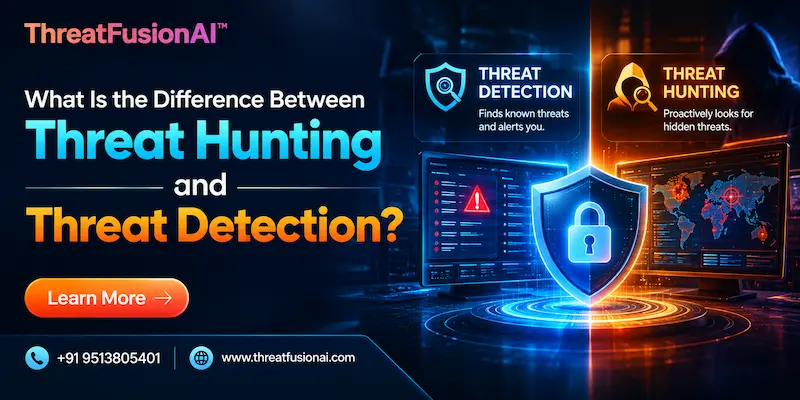
Do you know the difference between Threat Hunting and Threat Detection, and what the impacts of such methods are? If not, then you are in the right place. Here, we will talk about what are the differences and related impacts in detail.
Moreover, we will introduce you to a reliable threat intel solution offered by a reputable VAPT service provider. What are we waiting for? Let’s get straight to the topic!
What Is Threat Detection in Cybersecurity?
The ongoing process of keeping an eye on, spotting, and evaluating security irregularities, illegal activity, and possible cyberattacks throughout an organization's network and assets is known as threat detection.
Security teams can identify active breaches and zero-day exploits before malevolent actors accomplish their goals by combining real-time data from logs, network traffic, and endpoint behaviors with existing threat intelligence.
The vital link between defensive security postures and quick incident response execution is this proactive capability. Let’s find out about the difference between Threat Hunting and Threat Detection and the ways they help their users!
What Is Threat Hunting in Cybersecurity?
The proactive, hypothesis-driven search of networks and endpoints for sophisticated, concealed cyberthreats that have successfully evaded conventional automated security mechanisms is known as "threat hunting."
Security analysts use adversary TTP analysis, threat information, and deep behavioral telemetry to methodically identify and stop covert threat actor activity before significant harm is done.
Threat Hunting vs Threat Detection: What Is the Difference?
|
S.No. |
Topics |
Factors |
What? |
|
1. |
Threat Detection |
Approach |
Functions as a reactive, automated system that flags known dangers using pre-established rules, signatures, and baseline behavior warnings. |
|
Focus |
Incoming security events cause it to swiftly identify and report known harmful activity before it spreads. |
||
|
2. |
Threat Hunting |
Approach |
Operates as a proactive, human-led, hypothesis-driven process that looks for unidentified or elusive threats that have gotten past automatic defenses. |
|
Focus |
Begins with the presumption that a breach has already happened and uses extensive system telemetry analysis to reveal zero-day intrusions and concealed attacker activities. |
Reactive Alerting vs. Proactive Hypothesis-Driven Analysis
Reactive alerting addresses dangers immediately after an event is recognized by using automated rules and signatures to initiate warnings when known signs of compromise surpass predetermined thresholds.
Proactive hypothesis-driven analysis, on the other hand, makes the assumption that compromise has already taken place and methodically queries deep telemetry to find new adversary tactics and covert threats that get past conventional defenses.
How Does Threat Detection Work?
Threat detection works in the following ways:
1. Continuous Telemetry Collection: Incorporates cloud events, network traffic, endpoint activity, and real-time data into centralized platforms such as SIEM or XDR systems.
2. Signature & Pattern Matching: Checks incoming system data for known malware signatures, file hashes, and indicators of compromise (IoCs).
3. Behavioral & Anomaly Analytics: Uses machine learning baselines to identify anomalous data exfiltration patterns, unexpected lateral movement, and odd user behavior.
4. Threat Intelligence Enrichment: Contextualizes IP addresses, domains, and enemy TTPs by correlating observed activities with external threat intelligence sources.
5. Alert Generation & Escalation: Allows security analysts to perform quick triage by filtering noise, assigning risk scores, and initiating automatic alerts or playbook actions.
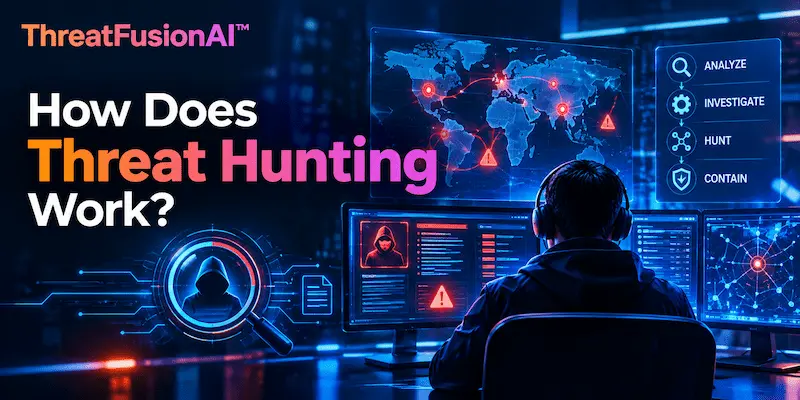
How Does Threat Hunting Work?
|
S.No. |
Factors |
How? |
|
1. |
Hypothesis Formulation |
Create focused inquiries based on adversary TTPs, high-risk asset exposure, or current threat intelligence. |
|
2. |
Data Gathering & Centralization |
Combine application, network, and deep endpoint telemetry into a single analytics repository. |
|
3. |
Pattern Investigation & Telemetry Mining |
Look through past logs to find evasive strategies and small behavioral irregularities. |
|
4. |
Uncovering & Validating Adversary Activity |
Verify suspicious activity, track the path of the attacker, and isolate systems that have been infiltrated. |
|
5. |
Remediation & Security Hardening |
To stop future incidents, neutralize active threats and update automated detection criteria. |
Role of Cyber Threat Intelligence (CTI) in Threat Hunting
The following are the roles of cyber threat intelligence in threat hunting:
● Powers Targeted Hypothesis Generation: Provides new exploitation pathways, active campaign patterns, and real-world adversary TTPs to generate actionable ideas.
● Enriches Log Telemetry with Context: Compares low-level events with infrastructure and known actor signatures to convert unprocessed system logs into context that may be used.
● Prioritizes High-Risk Asset Searches: Focuses hunting efforts on vulnerabilities and important systems that threat organizations in your sector are currently targeting.
● Accelerates Attack Path Mapping: Reconstructs whole adversary kill chains by mapping single behavioral anomalies to proven MITER ATT&CK tactics.
● Closes Defense Gaps with New Content: Creates long-lasting, automatic detection rules based on hunting discoveries and Intel upgrades to prevent recurring threats.
Key Differences Between Threat Hunting and Threat Detection
The following are the differences between threat hunting and threat detection:
a) Initiation Trigger: Threat Hunting is human-led and hypothesis-driven, whereas Threat Detection is automated and alert-driven.
b) Operational Mindset: Threat Hunting operates on the assumption of active compromise, whereas Threat Detection assumes systems are secure until informed.
c) Core Dependency: While Threat Hunting relies on deep telemetry and human domain experience, Threat Detection uses pre-configured signatures and detection criteria.
d) Target Scope: Threat detection identifies predicted irregularities and recognized indicators; Threat hunting isolates new adversary TTPs and covert, unidentified threats.
e) Primary Outcome: While Threat Hunting finds hidden breaches and generates new detection logic, Threat Detection initiates quick incident response.
What Tools Are Used for Threat Detection?
|
S.No. |
Factors |
How? |
|
1. |
SIEM |
Detects security anomalies by centralizing and correlating real-time log data throughout the company. |
|
2. |
EDR / XDR |
Keeps an eye on cross-domain data and endpoint telemetry to identify sophisticated malicious activity. |
|
3. |
NDR |
Exposes unlawful lateral movement by analyzing raw network traffic and flow data. |
|
4. |
SOAR |
Quickly mitigates detected warnings by automating response playbooks and coordinating security operations. |
|
5. |
NIDS / IPS |
To stop harmful inline communication, network packets are scanned against databases of known signatures. |
What Tools Are Used for Threat Hunting?
The following tools are used for threat hunting:
1. Data Lakehouse / SIEM Storage: To perform intricate historical searches, Splunk, Elastic, and Snowflake combine long-term telemetry.
2. EDR & Telemetry Collectors: Sysmon, SentinelOne, and CrowdStrike collect detailed endpoint and process activity.
3. Network Analysis & Threat Hunting Platforms: To find hidden C2 communication, Zeek, Wireshark, and Suricata examine raw packets and flow data.
4. Custom Scripting & Data Science Tools: Custom data processing and statistical anomaly hunts are carried out using Python, Jupyter Notebooks, and KQL.
5. Memory & Host Forensics Toolkits: To find fileless malware, Volatility, FTK Imager, and Velociraptor examine volatile RAM and disk artifacts.
Key Metrics: Mean Time to Detect (MTTD) vs. Mean Time to Respond (MTTR)
The average time it takes security teams to find a security issue or compromise after it first appears is measured by Mean Time to Detect (MTTD). Mean Time to Respond (MTTR), on the other hand, measures how long it typically takes to contain, mitigate, and address a threat when an alarm is raised.
Best Practices for Combining Threat Hunting and Threat Detection
|
S.No. |
Practices |
What? |
|
1. |
Establish a Continuous Feedback Loop |
Create automated, production-grade detection algorithms directly from successful hunting discoveries. |
|
2. |
Normalize and Centralize Telemetry |
To facilitate easy detection and deep hunting searches, standardize host, network, and cloud logs into a single schema. |
|
3. |
Prioritize Rule Tuning and Alert Hygiene |
Reduce analyst fatigue and maintain high alert fidelity by routinely improving the detection mechanisms currently in place to get rid of false positives. |
|
4. |
Align Frameworks to MITRE ATT&CK |
To find and close operational coverage gaps, map proactive hunting hypotheses and automatic alarms against common enemy TTPs. |
|
5. |
Integrate Shared Threat Intelligence |
Utilize adversary trends to inform hunting hypotheses while feeding detection platforms with real-time IOCs and behavioral intelligence. |
Conclusion: Building a Proactive Cybersecurity Defense
Now that we have talked about what is the difference between Threat Hunting and Threat Detection, you might want to get your hands on a dedicated threat intel solution. For that, you can go for ThreatFusionAI, a dedicated threat intelligence platform offered by Craw Security.
Organizations can get notified about the latest cyber threats and malicious risks with the help of ThreatFusionAI, so that they can enhance their security measures. What are you waiting for? Contact, Now!
Frequently Asked Questions
About Threat Hunting and Threat Detection
1. Is threat hunting proactive or reactive?
Because analysts anticipate, look for, and isolate hidden risks that have already evaded automated, reactive security alarms, threat hunting is proactive.
2. Is threat detection automated?
The majority of threat detection is automated, using machine learning, pre-configured rules, and signatures to identify questionable activity instantly.
3. What is the main difference between threat hunting and threat detection?
Threat hunting is a human-driven search to proactively find hidden, undiscovered dangers, whereas threat detection depends on automatic notifications to highlight known security occurrences.
4. Can threat hunting detect unknown threats?
Yes, because threat hunting employs hypothesis-driven behavioral analysis instead of depending on static rules or recognized indicators, it is particularly effective at identifying new and unexpected dangers.
5. Is threat hunting part of a SOC?
Yes, threat hunting is a sophisticated feature of contemporary Security Operations Centers (SOCs) that actively looks for evasive attackers to supplement automatic threat detection.
6. Which is better, threat hunting or threat detection?
Neither is superior on its own; rather, they are complementary skills, with threat hunting proactively capturing what eludes detection and automated threat detection serving as the first line of defense.
7. What tools are commonly used for threat hunting?
The following tools are commonly used for threat hunting:
a) Data Lakehouses & SIEMs (e.g., Splunk, Elastic, Snowflake),
b) EDR & Telemetry Collectors (e.g., CrowdStrike, SentinelOne, Sysmon),
c) Network Analysis Platforms (e.g., Zeek, Suricata, Wireshark),
d) Custom Scripting & Analytics Tools (e.g., Python, Jupyter Notebooks, KQL), and
e) Host & Memory Forensics Toolkits (e.g., Volatility, Velociraptor, FTK Imager).
8. How do threat hunting and threat detection work together?
By proactively identifying hidden, unreported risks, threat hunting continuously develops and improves the automated rules that underpin threat detection.
9. How does threat hunting help detect advanced cyber threats?
Threat hunting helps detect advanced cyber threats in the following ways:
a) Bypasses Signature Dependencies,
b) Reduces Attacker Dwell Time,
c) Uncovers Fileless and Living-off-the-Land (LotL) Attacks,
d) Reconstructs Complex Attack Paths, and
e) Informs Defensive Engineering.
10. What skills are required for effective threat hunting?
The following skills are required for effective threat hunting:
a) Deep Operating System & Network Internals,
b) Adversary Tactics & Framework Mastery,
c) Data Analytics & Query Languages,
d) Log Analysis & Telemetry Correlation, and
e) Hypothesis-Driven & Analytical Mindset.