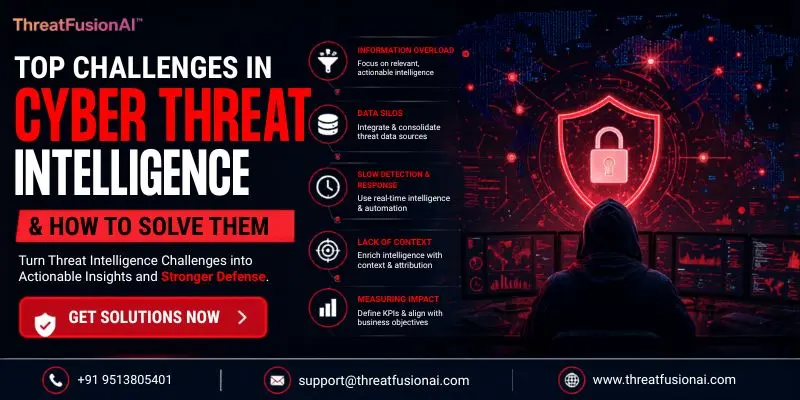
Top Challenges in Cyber Threat Intelligence & How to Solve Them
Let’s talk about the Top Challenges in Cyber Threat Intelligence that a user faces while managing security infrastructure! Here, we will talk about how challenges can affect your working environment.
Moreover, we will introduce you to a reliable Threat Intelligence tool that can help users to enhance their security measures. What are we waiting for? Let’s get straight to the topic!
What are Cyber Threat Intelligence Challenges?
The overwhelming amount of "noise" and false positives produced by automated feeds is one of the main problems in Cyber Threat Intelligence (CTI), which frequently causes alert fatigue for security teams.
Furthermore, it is challenging to confirm the accuracy of data or instantly link threats to particular actors due to the growing usage of sophisticated encryption and AI-driven obfuscation by attackers.
Lastly, fragmented intelligence silos are frequently caused by a lack of common sharing methods between enterprises, which hinders a cohesive defense against systemic global threats. Let’s take a look at the Top Challenges in Cyber Threat Intelligence!
Lack of Contextual Threat Intelligence
When security information is gathered as discrete technical indicators, like IP addresses or file hashes, without taking into account the "who, why, and how" of an attack, contextual threat intelligence is lacking.
Organizations find it difficult to prioritize threats without this narrative layer, frequently squandering vital resources on low-level background noise while overlooking sophisticated, targeted attacks.
Lack of Quality and Reliable Data
The "garbage in, garbage out" philosophy, which emphasizes quantity above accuracy in automated feeds, is the root cause of the problem of unreliable data in intelligence gathering. In 2026, analysts will find it more challenging to discern between noise intended to divert defenders and high-fidelity alarms due to the proliferation of AI-generated false information and "poisoned" threat feeds.
Information Overload and Alert Fatigue
In contemporary security operations centers, information overload happens when the sheer number of threat feeds and telemetry surpasses human processing capabilities, resulting in alert fatigue, a "numbing" effect.
Because of this fatigue, analysts unintentionally overlook or devalue important indicators, giving attackers the ideal "static" to conceal their activities and extend their stay in a network.
Automated Triage and Prioritization
Machine learning algorithms are used by automated triage and prioritization systems to quickly classify incoming security alerts according to risk ratings, past trends, and asset criticality. By moving high-impact risks to the head of the queue, this automation frees up human analysts to concentrate their skills on intricate investigations rather than tedious data entry.
Managing False Positives and False Negatives
|
S.No. |
Factors |
How? |
|
1. |
Tuning the Detection Threshold |
The sensitivity of security technologies must be continuously adjusted by administrators; setting the bar too high results in False Positives, which ban genuine users, while setting it too low results in False Negatives, which miss real threats. |
|
2. |
Implementing Risk-Based Authentication |
Systems now employ a sliding scale that takes into account context, including time of day, location, and device health, in place of a binary "pass/fail," to minimize friction for typical activity while identifying abnormalities. |
|
3. |
Feedback Loops for AI Models |
By designating alarms as "benign" or "malicious," modern Security Orchestration (SOAR) technologies enable analysts to actively retrain the underlying machine learning models, increasing accuracy over time. |
|
4. |
Cross-Tool Correlation |
A possible false positive in an EDR (Endpoint Detection) tool can be cross-referenced with network logs by "stacking" several security levels; if the behavior is isolated, it's probably a false alarm. |
|
5. |
Continuous Red Teaming |
Organizations can find "blind spots" (False Negatives) where their present monitoring techniques are not producing any alarms at all by routinely replicating real-world attacks. |
Difficulty in Threat Correlation
The following is the difficulty in threat correlation:
1. Data Silos and Tool Proliferation: It is practically impossible to follow a single attack path due to the fragmented data perspectives created by disconnected security solutions.
2. Alert Volatility and Ephemeral Infrastructure: Rapid-fire alerts and transient cloud assets vanish before analysts can connect them to form a cohesive narrative.
3. Advanced Persistent Threat (APT) Stealth: In order to avoid activating correlation criteria and blend in with the background noise, sophisticated actors purposefully slow down.
4. Encryption and Traffic Obfuscation: Correlation engines are blinded to the nature of the data by modern encryption, which conceals the payload and command-and-control signals.
5. The "Human Element" in Logic Attacks: Credential abuse and social engineering imitate normal user activity, which technological correlation filters frequently fail to identify as malicious.
Integration Issues with Existing Security Systems
The following are the integration issues with Existing Security Systems:
● API Incompatibility and Version Mismatch: The RESTful or GraphQL interfaces needed to interact with modern cloud-native security technologies are frequently absent from legacy systems.
● Data Schema Disparity: It is challenging to standardize data for a single "pane of glass" view since different vendors utilize different log and alert formats.
● Resource Contention and Latency: Critical delays in real-time threat detection might result from outdated hardware's processing capacity being overloaded by high-volume intelligence streams.
● Vendor Lock-in and Proprietary Silos: Organizations are forced to manually close gaps between competing security technologies because closed ecosystems purposefully limit data export.
● State Synchronization Errors: When multi-layered defenses don't update at the same time, it can result in "race conditions" where one tool stops a danger while another doesn't.
Interoperability Standards: STIX/TAXII and Beyond
Different security systems can automatically communicate threat data thanks to the standardized language and transmission protocol offered by TAXII (Trusted Automated eXchange of Intelligence Information) and STIX (Structured Threat Information eXpression).
Beyond these, contemporary frameworks such as OpenC2 and OCSF are working toward a single command-and-control language that allows vendor-neutral, real-time replies throughout the entire global defense ecosystem.
Real-Time Threat Detection Limitations
The following are the real-time threat detection limitations:
a) The Latency vs. Analysis Trade-off: Conducting thorough security checks on every bit of data might cause network speeds to drop to unacceptable levels; deep packet inspection and behavioral analysis take time.
b) Encrypted Traffic Blindness: Since more than 95% of web traffic is encrypted as of 2026, detection technologies frequently aren't able to "see" the malicious payload without dangerous and resource-intensive decryption procedures.
c) Zero-Day Exploits: Real-time systems are intrinsically unprepared to thwart a novel attack technique as soon as it is introduced, since they usually rely on established patterns (signatures) or previous baselines.
d) Adversarial AI and Evasion: In order to make sure their code can evade real-time filters before distribution, attackers increasingly "test" their malware against detection engines in private using machine learning.
e) System "Noise" and False Alarms: Legitimate administrative activities or software updates might imitate an intruder's activity in complicated cloud systems, leading to "detection paralysis," a situation in which genuine threats are obscured by a deluge of alarms.
Limited Skilled Cybersecurity Professionals
Following are some of the limited skilled cyber security professionals:
1. The "Experience Paradox": A fresh generation of talent cannot enter the profession and fill the talent pipeline since entry-level positions frequently need three to five years of experience or expensive qualifications.
2. Burnout and Mental Health Toll: High turnover rates among senior analysts and incident responders are caused by high-pressure work situations, round-the-clock on-call schedules, and the persistent nature of "alert fatigue".
3. Rapid Tech Evolution: Even seasoned specialists find it challenging to stay "current" due to the shift toward AI-driven assaults and quantum-resistant cryptography, which necessitates constant retraining.
4. Global Competition and Brain Drain: Large software companies and defense contractors provide much greater compensation and perks for remote work, making it difficult for small-to-medium-sized businesses (SMEs) to retain personnel.
5. Educational Lag: The real-world strategies of contemporary threat actors are frequently out of step with traditional university courses, leaving graduates with academic understanding but few "hands-on" abilities.
High Cost of Cyber Threat Intelligence Solutions
The premium put on human knowledge for manual analysis and the high subscription fees for high-fidelity, proprietary data feeds are the main causes of high expenses in Cyber Threat Intelligence (CTI).
Furthermore, the high computational resources needed for real-time AI processing and the hidden costs of integrating these technologies into current infrastructure frequently push security budgets to their limits.
Stakeholder Alignment: Bridging the Intelligence-to-Business Gap
Translating technical threat data into the language of business risk is necessary for stakeholder alignment, with a particular emphasis on how vulnerabilities affect operational continuity and profitability.
By changing the topic of discussion from "malware hashes" to "potential revenue loss" and "regulatory exposure," intelligence teams may obtain the funding and executive support required for a proactive defense.
Compliance and Data Privacy Challenges
The following are some of the compliance and data privacy challenges:
● Jurisdictional Complexity (The "Border" Problem): Conflicting privacy regulations can result in unintentional treaty violations in the "gray zone" created by data kept in one nation but accessible in another.
● The Right to Be Forgotten: Legal requirements to remove personal information at a subject's request must be balanced with the requirement for historical threat records in intelligence databases.
● De-Anonymization Risks: Combining several "anonymous" databases may unintentionally expose personal information, leading to harsh legal repercussions and unethical behavior.
● Chain of Custody for Digital Evidence: Many automated technologies lack the stringent, tamper-proof logging necessary to demonstrate the integrity of OSINT data from collection to court.
● Ethical "Mission Creep": Without stringent policy control, security systems intended for external threat hunting can quickly transform into intrusive inside staff surveillance.
Conclusion: Building a Strong Cyber Threat Intelligence Strategy
Now that we have talked about the Top Challenges in Cyber Threat Intelligence, you might want to know the ways to deal with such challenges. For that, you can get in contact with Craw Security, offering Threat Fusion AI, a dedicated threat intelligence solution for better protection against unknown AI-based threats.
Moreover, this tool automatically detects any risky & suspicious activity over the internet and deals with it without any human interference. What are you waiting for? Contact, Now!
Frequently Asked Questions
About Top Challenges in Cyber Threat Intelligence
1. What is Cyber Threat Intelligence?
Cyber Threat Intelligence (CTI) is the process of gathering, analyzing, and refining information on current or prospective assaults to assist organizations in comprehending their enemies and making proactive, well-informed security decisions.
2. Why is Cyber Threat Intelligence important for organizations?
Cyber Threat Intelligence is important for organizations for the following reasons:
a) Shift from Reactive to Proactive Defense,
b) Reduced Data Breach Costs,
c) Strategic Resource Allocation,
d) Empowering Incident Response, and
e) Improved Vulnerability Management.
3. What are the biggest challenges in implementing threat intelligence?
The following are the biggest challenges in implementing threat intelligence:
a) Data Quality and "Noise" Volume,
b) The Skills and Talent Gap,
c) Integration and Interoperability,
d) Contextual Relevance, and
e) Actionability and Timeliness.
4. How can organizations improve the quality of threat intelligence data?
In the following ways, organizations can improve the quality of threat intelligence data:
a) Source Diversification and Validation,
b) Contextual Enrichment,
c) Automated Data Normalization,
d) Continuous De-duplication and Pruning, and
e) Feedback Loops from Incident Response.
5. What causes alert fatigue in cybersecurity teams?
The main source of alert fatigue is an excessive number of security notifications, many of which are redundant or false positives that are too many for an analyst to properly evaluate.
6. How can false positives be reduced in threat detection systems?
By adjusting detection thresholds, connecting various data sources to validate threats, and putting in place machine learning feedback loops that "learn" to disregard acceptable network activity, false positives are decreased.
7. What tools are commonly used for cyber threat intelligence?
The following tools are commonly used for cyber threat intelligence:
a) Threat Intelligence Platforms (TIPs),
b) Open-Source Intelligence (OSINT) Tools,
c) Adversary-Centric Intelligence Feeds,
d) External Attack Surface Management (EASM), and
e) Digital Risk Protection Services (DRPS).
8. How does AI help in improving threat intelligence?
In the following ways, AI helps in improving threat intelligence:
a) Massive Data Synthesis at Machine Speed,
b) Predictive Analytics and Anomaly Detection,
c) Natural Language Processing (NLP) for Unstructured Data,
d) Automated Triage and False Positive Reduction, and
e) Autonomous Response and Playbook Execution.
9. What is the role of threat intelligence in incident response?
Threat information gives responders the context they need to determine an attacker's identity, motivations, and tactics. This allows them to anticipate the attacker's next move and implement a quicker, more precise containment approach.
10. How can small businesses implement cost-effective threat intelligence solutions?
By employing open-source platforms like MISP, joining industry-specific ISACs for free community sharing, and making use of the built-in security telemetry from established cloud providers like Microsoft or Google, small enterprises can obtain affordable threat intelligence.
Learn More: