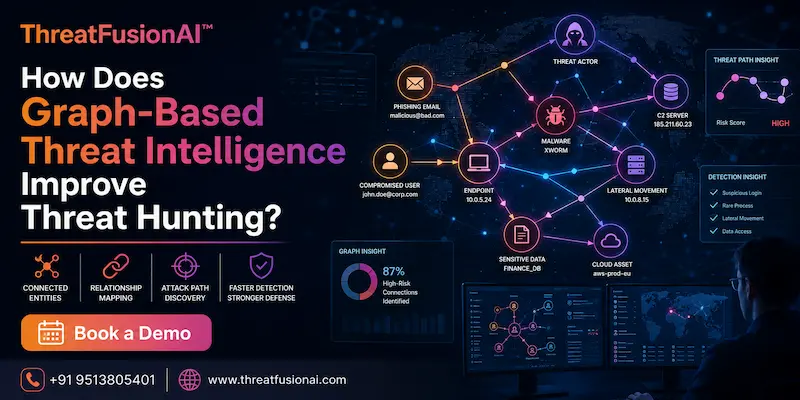
Do you know what Threat Intelligence Platforms are and how these platforms can help organizations to enhance their security measures? If not, then you are in the right place. Here, we will talk about what threat intelligence platforms are and related benefits in detail.
Moreover, we will introduce you to a reliable threat intelligence solution offered by a reputable VAPT service provider. What are we waiting for? Let’s get straight to the topic!
What Is Threat Intelligence?
Data about new cyberthreats, malevolent actors, and attack vectors in the digital world are gathered, examined, and contextualized to provide threat intelligence. It enables enterprises to comprehend attacker behavior, foresee impending threats, and fortify their defensive posture prior to a breach by converting indicators of compromise (IOCs) and adversary tactics into actionable security insights.
Let’s talk about what Threat Intelligence Platforms are, their uses, their features, and their benefits for organizations!
Types of Threat Intelligence
The following are the types of threat intelligence:
1. Strategic: Long-term company decisions are guided by high-level executive insights about cyber risk patterns, threat actor motivations, and financial effects.
2. Operational: To assist defenders in anticipating targeted attacks, a thorough analysis of particular attack plans, adversary capabilities, and impending campaigns is provided.
3. Tactical: SOC analysts can react to current threats with the aid of real-time intelligence about attacker Tactics, Techniques, and Procedures (TTPs).
4. Technical: Phishing URLs, malicious IP addresses, and file hashes used for automated blocking are examples of immediate, short-term indicators of compromise (IOCs).
Threat Feeds vs. Threat Intelligence Platforms (TIPs): What’s the Difference?
|
S.No. |
Topics |
Factors |
What? |
|
1. |
Threat Feeds |
Raw Data Delivery |
Serves as an automated data stream that provides uncontextualized, raw indicators of compromise (IOCs) like file hashes, malicious IP addresses, and domain blocklists. |
|
Direct Control Integration |
Ingested straight into firewalls, SIEMs, or endpoint tools to fuel simple automatic blocking rules; nevertheless, the absence of deduplication or prioritization frequently results in alert fatigue. |
||
|
2. |
Threat Intelligence Platforms (TIPs) |
Centralized Data Fusion & Context |
Maps signs to particular adversary tactics and methods (TTPs) by aggregating, correlating, and enriching various raw threat feeds in addition to internal network telemetry. |
|
Operational Workflow Management |
Oversees the whole IOC lifespan, lowering false positives, giving high-confidence threats priority, and directly coordinating actions using SIEM, SOAR, and EDR systems. |
Why Does Real-Time Detection Matter?
Real-time detection matters for the following reasons:
● Minimizes Attacker Dwell Time: Prevents intruders from moving laterally across company networks by quickly trapping and neutralizing them.
● Prevents Data Exfiltration and Ransomware Encryption: Prevents illegal data encryption cycles and malicious file transfers before they cause operational harm.
● Reduces SOC Alert Fatigue: By giving proven, active threat vectors priority for analyst assessment, it dynamically filters out noise.
● Accelerates Incident Response Times: Initiates automated containment procedures as soon as high-confidence indicators are found.
● Limits Financial and Reputational Damage: Through early intervention, it avoids expensive operational downtime, regulatory fines, and public breach announcements.
How Do Threat Intelligence Platforms Improve Cyber Threat Detection?
Threat intelligence platforms improve cyber threat detection in the following ways:
a) Normalizes and Enriches Raw Telemetry: Automatically integrates different raw logs with contextual threat data, deduplicates them, and formats them.
b) Maps Activity to Adversary TTPs: Reveals the intent and techniques of attackers by connecting discrete security events to structured frameworks such as MITER ATT&CK.
c) Drives Automated Risk Prioritization: Uses confidence measures to dynamically score incoming alerts in order to remove false positives and filter noise.
d) Enables Proactive Threat Hunting: Gives security researchers access to global adversary indications so they can find hidden, undetected network dangers.
e) Orchestrates Speedier Cross-Stack Mitigation: Carries out immediate, automatic containment procedures by directly syncing with SIEM, SOAR, and EDR systems.
Key Features to Look for in a Threat Intelligence Platform
|
S.No. |
Factors |
What? |
|
1. |
Multi-Source Data Ingestion & Normalization |
Combines and unifies internal logs, open-source intelligence (OSINT), and commercial feeds into a single format. |
|
2. |
Contextual Enrichment & Threat Scoring |
Adds adversarial information to raw indicators and uses dynamic risk rankings to eliminate false positives. |
|
3. |
Bi-Directional Security Integrations |
Automates threat detection and response by seamlessly synchronizing threat data with current SIEM, SOAR, EDR, and firewall systems. |
|
4. |
Proactive Threat Hunting & Analytics |
Helps analysts find hidden risks throughout the company by offering behavioral analytics and searchable global threat databases. |
|
5. |
Automated Workflow & Playbook Orchestration |
As soon as high-confidence threats are detected, pre-configured, automated reaction playbooks are triggered. |
How Are AI and Automation Transforming Threat Intelligence?
AI and automation are transforming threat intelligence in the following ways:
1. Automates Large-Scale Data Parsing and De-Duplication: Instantly absorbs, cleans, and de-duplicates unstructured threat data from worldwide streams and dark web sources using natural language processing (NLP).
2. Enables Predictive Behavioral Threat Modeling: Makes use of machine learning to predict enemy strategies and subsequent actions prior to the first network intrusion.
3. Accelerates Incident Triage and Reduces Alert Noise: Incoming alerts are contextually filtered and dynamically scored to quickly eliminate false positives for SOC analysts.
4. Powers Autonomous Response Playbooks: Uses direct SOAR and XDR integrations to initiate immediate, hands-free containment activities like firewall updates and endpoint isolation.
5. Neutralizes AI-Driven Adversary Tactics: Continually modifies defensive algorithms to identify AI-generated phishing campaigns, automated attack scripts, and polymorphic malware.
Top Threat Intelligence Platforms for Real-Time Threat Detection
The following are the top threat intelligence platforms for real-time threat detection:
● ThreatFusionAI: Uses AI algorithms to instantly connect MITER ATT&CK mappings with phishing signs, compromised data, and malware architecture.
● Recorded Future: Uses its enormous Intelligence Graph to automatically evaluate technical, dark web, and open-source feeds worldwide for real-time risk assessment.
● CrowdStrike Falcon Adversary Intelligence: Uses automated cloud telemetry and skilled human threat hunting to map active adversary TTPs and provide predicted containment.
Best Threat Intelligence Platforms for Enterprise Security
|
S.No. |
Factors |
What? |
|
1. |
ThreatFusionAI |
Provides threat graph mapping and AI-driven IOC correlation to detect active malware activity, compromised data, and phishing infrastructure. |
|
2. |
Mandiant Threat Intelligence |
Combines high-fidelity threat actor profiling with unparalleled frontline incident response data to protect multinational corporations from state-sponsored attacks. |
|
3. |
Microsoft Defender Threat Intelligence |
Delivers smooth threat awareness straight into Microsoft 365 and Azure environments by ingesting trillions of daily global telemetry signals across cloud ecosystems. |
Best Threat Intelligence Platforms for SOC Teams
The following are the best threat intelligence platforms for SOC teams:
a) ThreatFusionAI: Uses AI algorithms to instantly connect MITER ATT&CK mappings with phishing signs, compromised data, and malware architecture.
b) Swimlane Turbine: Automates SOC alert triage, incident investigations, and cross-vendor response procedures by combining agentic AI with low-code playbooks.
How to Choose the Best Threat Intelligence Platform for Your Organization?
You can choose the best threat intelligence platform for your organization in the following ways:
1. Map Internal Use Cases and Specific Industry Risks: Directly match platform capabilities to the operational maturity, vertical rules, and unique threat profile of your company.
2. Evaluate Data Quality, Provenance, and Relevance Over Feed Volume: Give contextual, low-noise threat information feeds that align with your attack surface more weight than the quantity of raw indicators.
3. Verify Integration Depth with Existing Infrastructure: Assure smooth, native API compatibility with your existing firewall, SIEM, SOAR, and EDR technology stack.
4. Assess Automation, AI Capabilities, and Workflow Fit: Check if the platform's automated playbooks, auto-enrichment, and dynamic scoring speed up SOC triage.
5. Calculate Total Cost of Ownership (TCO) and ROI Potential: To calculate overall long-term worth, take into account licensing costs, implementation complexity, and labor savings.
Conclusion
Now that we have talked about what Threat Intelligence Platforms are, you might want to get your hands on a dedicated threat intel solution from a reliable source. For that, you can go for ThreatFusionAI, a dedicated threat intelligence platform offered by Craw Security.
ThreatFusionAI can help organizations by notifying them about the latest cyber threats and malicious risks so that they can improve their security measures in time. Thus, you can rely on this amazing threat intel solution. What are you waiting for? Contact, Now!
Frequently Asked Questions
About Threat Intelligence Platforms
1. What Is a Threat Intelligence Platform?
To speed up real-time threat detection and incident response throughout an organization's security stack, a Threat Intelligence Platform (TIP) is a centralized security system that automatically gathers, correlates, enhances, and prioritizes global threat data.
2. How Do Threat Intelligence Platforms Enable Real-Time Threat Detection?
Threat intelligence platforms enable real-time threat detection in the following ways:
a) Continuous Telemetry Correlation,
b) Automated Data Enrichment,
c) Instant Signal Prioritization,
d) Bi-Directional API Integrations, and
e) Orchestrated Autonomous Containment.
3. What Are the Key Features of a Threat Intelligence Platform?
The following are the key features of a threat intelligence platform:
a) Multi-Source Data Aggregation & Normalization,
b) Contextual Threat Scoring & Enrichment,
c) Bi-Directional Security Integrations,
d) Proactive Threat Hunting & Analytics, and
e) Automated Workflow Orchestration.
4. Which Are the Best Threat Intelligence Platforms for Real-Time Threat Detection?
The following are the best threat intelligence platforms for real-time threat detection:
a) ThreatFusionAI,
b) Recorded Future,
c) CrowdStrike Falcon Adversary Intelligence,
d) Palo Alto Networks Cortex TIM / XSOAR, and
e) ThreatConnect.
5. How Does Threat Intelligence Improve SOC Operations?
Threat intelligence improves SOC operations in the following ways:
a) Drastically Cuts Alert Fatigue,
b) Enriches Incident Context instantly,
c) Accelerates Mean Time to Detect and Respond (MTTD/MTTR),
d) Empowers Proactive Threat Hunting, and
e) Streamlines SOC Analyst Triage.
6. Can Threat Intelligence Platforms Integrate With SIEM and XDR Solutions?
To correlate real-time threat data with network telemetry and trigger automated response playbooks, Threat Intelligence Platforms integrate directly with SIEM and XDR systems via bi-directional APIs.
7. How Does AI Improve Threat Intelligence and Detection?
AI improves threat intelligence and detection in the following ways:
a) Automates Massive Threat Data Ingestion,
b) Predicts Adversary Behavior and Intent,
c) Drastically Reduces Alert Fatigue,
d) Drives Autonomous Incident Response, and
e) Neutralizes AI-Driven and Novel Attacks.
8. What Types of Threats Can Threat Intelligence Platforms Detect?
Threat intelligence platforms can detect the following types of threats:
a) Known and Emerging Malware Operations,
b) Phishing Infrastructure and Brand Abuse,
c) Adversary Infrastructure and Botnets,
d) Compromised Credentials and Dark Web Leaks, and
e) APT Tactic and Advanced Vector Changes.
9. How Do You Choose the Best Threat Intelligence Platform for Your Organization?
You can choose the best threat intelligence platform for your organization in the following ways:
a) Align Capabilities with Organization-Specific Risks,
b) Prioritize Data Provenance and Context Over Volume,
c) Verify Native Integration with Your Security Stack,
d) Assess AI-Driven Automation and Triage Features, and
e) Calculate Total Cost of Ownership (TCO) and ROI.
10. What Are the Benefits of Using a Threat Intelligence Platform?
The following are the benefits of using a threat intelligence platform:
a) Unified Aggregation and Contextual Enrichment,
b) Proactive Attack Surface Defense,
c) Drastic Alert Fatigue Reduction,
d) Accelerated Incident Response (MTTD/MTTR), and
e) Enhanced Strategic Decision-Making.