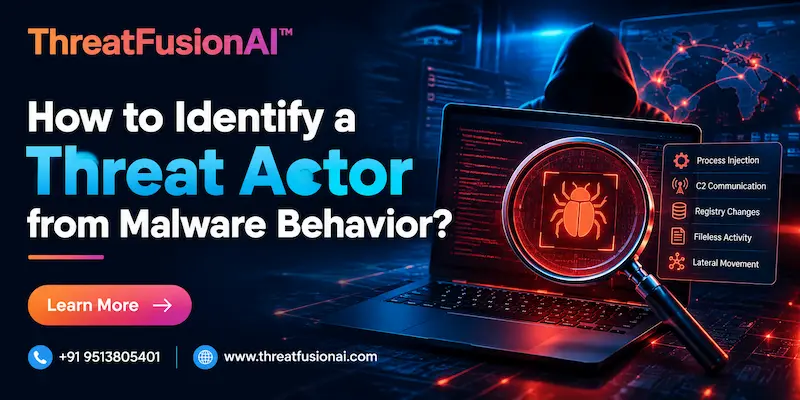
Do you know what a threat actor is, how they target you, and how you can protect yourself against such attacks? If not, then you are in the right place. Here, we will talk about what a threat actor is and related prevention techniques in detail.
Moreover, we will introduce you to a reliable threat intel solution offered by a reputable VAPT service provider. What are we waiting for? Let’s get straight to the topic!
What Is a Threat Actor?
An individual, group, or organization that purposefully starts harmful cyber actions to breach digital systems, networks, or data is known as a threat actor. They include state-sponsored hackers engaged in espionage and internal insider threats, as well as unskilled opportunists and cybercriminal gangs looking to make money.
They carry out attacks including malware deployment, data breaches, and service interruptions by taking advantage of software flaws, human carelessness, and system misconfigurations. Let’s take a look at what a threat actor is and how to identify it!
Why Does Malware Behavior Matter?
Malware behavior matters for the following reasons:
1. Accelerates Threat Attribution: Malware can be directly mapped to known threat actor groups using distinctive behavioral patterns that function as digital fingerprints.
2. Bypasses Signature Evasion: Although file code can be readily changed by attackers, their underlying behavioral activities are still identifiable and consistent.
3. Exposes Intent and Scope: Whether the payload is intended for persistent espionage, extortion, or data exfiltration can be determined by observing operational behavior.
4. Powers Proactive Threat Hunting: Before conventional defenses respond, behavioral indicators enable defenders to identify and neutralize new, zero-day threats.
5. Informs Incident Response and Remediation: Comprehending the precise changes made to the system guarantees total eradication and stops reinfection.
Distinguish Between Malware Families and Threat Actors
|
S.No. |
Topics |
Factors |
What? |
|
1. |
Malware Family (The Software) |
Definition & Nature |
A software classification that includes similar harmful code variations (like LockBit, Emotet, and QakBot) that have similar functionality, codebase, and design roots. |
|
Persistence |
Remains unchanged as a technical artifact, existing or being purchased and sold long after its original creators stop working on it or transfer ownership. |
||
|
2. |
Threat Actor (The Entity) |
Definition & Nature |
The nation-state collective, organized crime group, or actual human being responsible for the hacking (such as APT29, Lazarus Group, or FIN7). |
|
Adaptability |
Functions as a dynamic human operator with the ability to change tactics over time, purchase new malware families from the dark web, and swap tools. |
Analyze the Malware’s Initial Access Method
In order to ascertain how the payload got past the perimeter, analysis of a malware's initial access method entails looking at entry vectors such as spear-phishing attachments, exploited public-facing applications, compromised credentials, or drive-by downloads.
Finding this first point of compromise reveals the operational sophistication of the attacker and identifies certain vulnerabilities that need to be fixed to stop reinfection.
Examine Persistence and Execution Techniques
Analyzing persistence and execution strategies shows how malware assures long-term life through scheduled activities, registry run keys, or altered system services across reboots, and how it initiates its code using mechanisms like PowerShell or DLL injection.
By identifying particular adversary actions through analysis of these processes, defenders can develop focused hunting queries and destroy the foothold prior to lateral migration.
Analyze File, Registry, and System Activity
Monitoring sandbox or endpoint logs to track dropped payloads, changed Windows Registry keys, modified system services, and process creations is part of the analysis of file, registry, and system activities.
By revealing the malware's operational behavior, these local footprint alterations assist analysts in identifying leftover artifacts, identifying stealth methods, and creating accurate host-based indicators of compromise (IOCs).
Examine Network Traffic and Communication Patterns
In order to find beaconing intervals, hardcoded IP addresses, and unique user-agents that malware uses, it is necessary to examine packet captures, DNS requests, and protocols while analyzing network traffic and communication patterns.
Finding these outgoing connections reveals data exfiltration attempts, active command-and-control channels, and network-based indicators of infiltration that are necessary to stop malicious equipment.
Investigate Command-and-Control (C2) Infrastructure
Examining Command-and-Control (C2) infrastructure includes mapping server domains, IP hosting companies, SSL/TLS certificate information, and malware's backup methods for sustaining remote connectivity.
Security teams can map related threat actor operations and destroy adversary command pathways by identifying certain server configurations and communication protocols.
Study Payloads, Capabilities, and Objectives
Examining payloads, capabilities, and goals entails breaking down destructive routines, credential dumpers, and secondary modules to ascertain whether the malware is intended for data exfiltration, ransomware extortion, or silent spying.
This technological evaluation helps incident responders prioritize containment before vital assets are compromised and discloses the adversary's final mission purpose.
Identify Tactics, Techniques, and Procedures (TTPs)
The process of identifying tactics, techniques, and procedures (TTPs) entails mapping the observable behaviors of malware, including its technical methodologies, high-level objectives, and particular execution phases, to standard frameworks such as MITER ATT&CK.
By converting unprocessed technical data into useful operational intelligence, this structured profiling enables defenders to identify enemy trends and fortify specific defenses.
Map Behavior to the MITRE ATT&CK Framework
The process of mapping behavior to the MITER ATT&CK framework entails assigning standardized tactic and technique IDs (e.g., T1059 for Command and Scripting Interpreter) to observed malware operations.
This methodical alignment helps defenders find coverage gaps and benchmark security policies against adversary tradecraft by converting diverse technical logs into a consistent operational strategy.
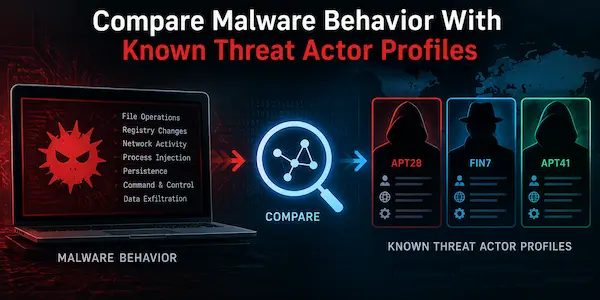
Compare Malware Behavior With Known Threat Actor Profiles
It is necessary to cross-reference observed execution logs, network infrastructure, and code overlaps against established threat intelligence databases in order to compare malware activity with known threat actor profiles.
Analysts can link campaigns to certain adversaries and predict their next strategic actions by matching these particular operational signatures.
Analyze Artifacts, Timestamps, and Language Indicators
Examining metadata like compile timings, embedded debugging paths (PDBs), localized keyboard layouts, and foreign-language string artifacts within the binary is part of the analysis of artifacts, timestamps, and language indicators.
These forensic hints help identify regional adversary characteristics and improve threat attribution by exposing human operating patterns like working time zones and development settings.
Best Tools for Threat Actor Identification
The following are the best tools for threat actor identification:
● Interactive Malware Sandboxes: Payloads can be safely detonated in real-time virtual environments to record behaviors.
● Commercial Threat Intelligence Platforms: Map observed IOCs to known actor profiles automatically by aggregating global adversary data.
● Disassembly and Reverse Engineering Tools: To find underlying logic, encryption keys, and hardcoded developer signatures, decompile binary code.
● Network Analysis and Infrastructure Mapping Tools: Examine C2 traffic and map the IP addresses, domains, and server infrastructure of connected adversaries.
● Open-Source Intelligence and Sharing Hubs: Exchange threat information among community security networks and cross-reference file hashes globally.
Common Challenges in Attributing Malware to a Threat Actor
|
S.No. |
Challenges |
What? |
|
1. |
Anti-Forensic Techniques & False Flags |
Attackers purposefully frame other groups by altering metadata, erasing logs, and inserting foreign code artifacts. |
|
2. |
Shared Infrastructure & Living-off-the-Land |
Different adversary fingerprints are hidden by bouncing attacks through public cloud providers and utilizing native system services. |
|
3. |
Anonymization & Proxy Networks |
True origin locations are hidden when C2 communication is routed via hacked VPN nodes and multi-layered onion networks. |
|
4. |
Evolving Tradecraft & Dynamic Tooling |
To avoid static behavioral signatures, sophisticated threat organizations continuously modify their operating payloads, packers, and custom scripts. |
|
5. |
Dynamic Cybercrime Ecosystems |
Multiple different threat actors can purchase, use, and distribute identical attack tools thanks to malware-as-a-service (MaaS) models. |
Final Thoughts on Malware-Based Threat Attribution
Now that we have talked about what a threat actor is, you might want to get your hands on a dedicated security solution from a reliable source. For that, you can go for ThreatFusionAI, a dedicated threat intelligence platform offered by Craw Security.
The amazing ThreatFusionAI can help organizations to be notified about the latest cyber threats running wild in the IT Industry. What are you waiting for? Contact, Now!
Frequently Asked Questions
About Threat Actor
1. What Is a Threat Actor in Malware Analysis?
A threat actor in malware analysis is a person, group, or nation-state that is in charge of developing, distributing, and managing harmful code in order to accomplish goals such as financial theft, espionage, or system disruption.
2. Can Malware Behavior Reveal Who Created or Operates It?
Yes, examining distinctive malware behaviors such as unique command-and-control protocols, particular code execution patterns, and distinctive operational tradecraft provides a digital footprint that enables researchers to track down and link the attack to certain threat actor groups.
3. What Malware Behaviors Are Most Useful for Threat Attribution?
The following malware behaviors are most useful for threat attribution:
a) Custom Command-and-Control (C2) Protocols,
b) Bespoke Cryptographic Implementations,
c) Post-Exploitation Execution Patterns,
d) Targeted Persistence and Execution Schemes, and
e) Exfiltration and Cleanup Tradecraft.
4. How Does Command-and-Control Activity Help Identify a Threat Actor?
Command-and-control activity helps identify a threat actor in the following ways:
a) Infrastructure Hosting Signatures,
b) Proprietary Communication Frameworks,
c) Network Beaconing and Timing Artifacts,
d) Domain Generation Algorithms (DGAs) and Dynamic DNS, and
e) Covert Data Transfer and Protocol Abuses.
5. Can Malware TTPs Be Linked to Known Threat Actors?
Yes, even while adversaries regularly exchange readily altered file hashes and server IPs, their underlying TTPs reflect costly, habitual practices that closely resemble particular group playbooks and operational tradecraft.
6. How Important Is Threat Intelligence in Malware Attribution?
Because isolated technical artifacts are meaningless without historical context, global campaign data, and established adversary playbooks to map them against, threat intelligence is essential to malware attribution.
7. Can Different Threat Actors Use the Same Malware?
Yes, to save development costs and hide their true identities, different threat actors often use identical commodity strains, open-source penetration testing tools, and Malware-as-a-Service (MaaS) payloads.
8. How Can Analysts Distinguish Malware Families From Threat Actors?
By treating the malware family as a static codebase and distinguishing the threat actor by distinctive operational patterns like targeted Victimology, custom C2 infrastructure selections, and post-exploitation tradecraft, analysts are able to distinguish between the tool and the human.
9. What Are the Biggest Challenges in Identifying a Threat Actor?
The following are the biggest challenges in identifying a threat actor:
a) Deliberate False Flags and Deception,
b) Commoditization of Attack Tools,
c) Living-off-the-Land (LotL) Techniques,
d) Ephemeral Infrastructure and Proxy Networks, and
e) Shared and Interlocking Threat Ecosystems.
10. How Can Organizations Avoid False Threat Attribution?
Organizations can avoid false threat attribution in the following ways:
a) Implement Structured Analytic Techniques (SATs),
b) Correlate Technical and Non-Technical Data,
c) Track Infrastructure Long-Term,
d) Focus on High-Cost Behavioral Patterns, and
e) Leverage Multi-Source Intelligence Sharing.