Do you know what OSINT Tools are and how they benefit the users? If not, then you are at the right place. Here, we will talk about the Top 10 OSINT Tools and see what they have to offer to practitioners in the cybersecurity domain.
Moreover, we will introduce you to a reliable AI-based threat detection tool offered by a reputed VAPT service provider. What are we waiting for? Let’s get straight to the topic!
What is OSINT?
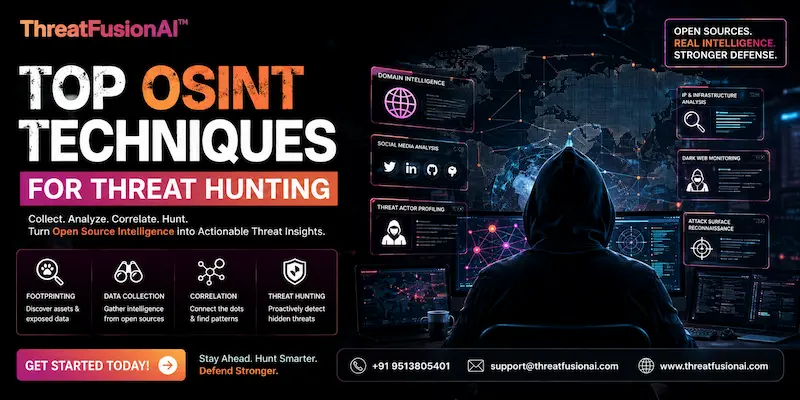
The process of gathering, evaluating, and combining publicly accessible material from a variety of sources, including social media, official documents, and news sources, to provide actionable intelligence is known as open source intelligence, or OSINT.
By enabling security experts to obtain information about possible adversaries or vulnerabilities without having direct contact with the target, it functions as a fundamental component of cybersecurity for threat hunting, risk assessment, and reconnaissance.
Organizations can track new global dangers, proactively identify exposures, and maintain situational awareness in an increasingly interconnected digital ecosystem by utilizing these open channels. Let’s take a look at the Top 10 OSINT Tools and see how such tools work!
Why OSINT Tools Are Important in Cybersecurity and Online Investigations?
OSINT Tools are important in cybersecurity and online investigations for the following reasons:
1. Early Threat Detection: Finds signs of compromise and new attack trends on the open internet before they are used against your infrastructure.
2. Streamlined Reconnaissance: Reduces the time needed for security teams to map a target's digital footprint by automating the acquisition of asset data that is visible to the public.
3. Enhanced Attribution: Helps connect cyberattacks to particular threat actors by correlating different public data, such as IP history, infrastructure trends, and aliases.
4. Proactive Brand Protection: Keeps an eye on forums, social media, and the dark web to spot references to private company information, impersonation attempts, and leaks in real time.
5. Context-Rich Intelligence: Gives investigators the background information they need to make wise security decisions by combining disparate, unstructured public data into a coherent story.
Legal and Ethical Use of OSINT Tools: What You Must Know Before Starting?
|
S.No. |
Legal and Ethical Use |
Why? |
|
1. |
Understand Legal Boundaries |
Make that your collecting practices adhere to all applicable local and international regulations, such as the CCPA, GDPR, and anti-hacking statutes. |
|
2. |
Adhere to Proportionality and Necessity |
To avoid delving too far into irrelevant or unduly intrusive information, only gather the material that is necessary for your research. |
|
3. |
Respect Privacy and Consent |
To uphold ethical integrity, refrain from getting around security measures or entering private spaces, even if they seem accessible. |
|
4. |
Maintain Operational Security (OPSEC) |
Make sure your inquiry doesn't betray your identity or notify the persons you are monitoring by using specialized, anonymised infrastructure. |
|
5. |
Ensure Accountability and Transparency |
To prove the validity and ethical rigor of your research, keep thorough records of every stage of your procedure and establish transparent audit trails. |
How OSINT Tools Work: Data Collection, Analysis, and Intelligence Gathering Process?
In the following ways, OSINT Tools work:
● Requirement & Scoping: Establishes the precise goals and parameters of the study to guarantee that it stays pertinent, focused, and consistent with the law.
● Data Collection (Harvesting): Uses automated scrapers or manual searches to compile unprocessed, publicly accessible data from a variety of digital sources, including social media, search engines, and specialist databases.
● Data Processing & Normalization: Transforms the diverse raw data into a structured state that can be indexed, searched, and connected on various platforms by cleaning, organizing, and formatting it.
● Analysis & Pattern Matching: Uses cross-referencing and analytical methods to find hidden links, derive valuable insights, and find abnormalities in the normalized dataset.
● Intelligence Reporting: Combines the results of the analysis into a concise, useful report that gives stakeholders the background information they need to make wise security or investigative decisions.
Top 10 OSINT Tools for Beginners and Professionals in 2026
The following are the Top 10 OSINT Tools for beginners and professionals in 2026:
a) Google Dorking: Finds sensitive data or particular files indexed on the public web using sophisticated search operators (such as site:, filetype:, and intitle:). Finding information that conventional keyword searches frequently overlook is a fundamental ability for researchers.
b) Maltego OSINT Tool: A robust link-analysis program that uses a node-based graph to show connections between individuals, domains, IPs, and organizations. Finding hidden connections inside a digital footprint and mapping intricate networks are two of its best uses.
c) theHarvester Tool: Automates the gathering of employee names, IP addresses, subdomains, and emails from public sources, such as PGP key servers and search engines. It is a standard tool for mapping the attack surface of a target during preliminary reconnaissance during penetration tests.
d) Shodan OSINT Tool: An internet-connected device's exposed ports, service banners, and setup concerns are all revealed by this specialized search engine. It is used by security experts to find IoT devices or exposed infrastructure before attackers do.
e) SpiderFoot OSINT Tool: An automation platform that automatically correlates data about a target by integrating with hundreds of data sources. For anyone who wishes to perform thorough, multi-module scans with little manual labor, it is great.
f) Recon-ng Framework: Like a "Metasploit for reconnaissance," this modular, CLI-driven tool lets users chain processes to gather data in a methodical manner. Professionals who need to manage structured, workspace-based investigations and script recurring operations will find it ideal.
g) OSINT Framework: An extensive online directory that classifies hundreds of OSINT tools and resources according to the kind of data under investigation. It provides novices with a crucial road map for navigating the wide range of research methodologies.
h) Have I Been Pwned Tool: An essential tool for determining whether passwords or email addresses have been connected to known data breaches. It offers important background information about a target's past security posture and possible credential exposure.
i) Sherlock OSINT Tool: An easy-to-use yet powerful tool that searches hundreds of social media and community platforms for a certain login. Investigators frequently utilize it to swiftly determine a person's online presence across several platforms.
j) Google Maps and Earth OSINT: Offers street-level viewpoints, 3D topography, and high-resolution satellite photos for geolocating objects and examining real settings. These techniques are essential for collecting visual intelligence and verifying physical locations connected to digital goals.
How Professionals Combine OSINT Tools for Better Intelligence Results?
|
S.No. |
Factors |
How? |
|
1. |
Establishing Integrated Workflows |
Ensures that data flows smoothly from discovery to in-depth analysis by connecting various tools into a unified pipeline. |
|
2. |
Automated Data Enrichment |
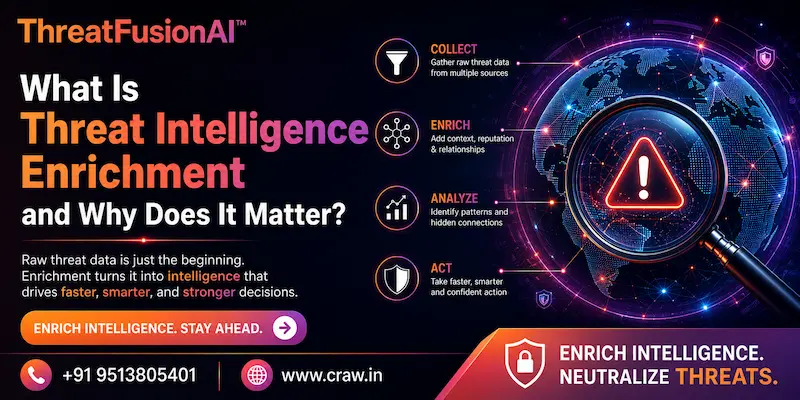
Automatically adds context, metadata, and reputation scores by feeding raw results from one tool into another. |
|
3. |
Cross-Platform Validation (Triangulation) |
Confirms correctness and removes false positives by cross-referencing data from several different sources. |
|
4. |
Continuous Monitoring & Alerting |
Detects and flags modifications or new exposures in real time by setting up continuous automated scans on target assets. |
|
5. |
Structured Case Management |
Consolidates all notes, visual links, and artifacts into a single platform for group analysis and reporting that is ready for an audit. |

Real-World OSINT Use Cases in Cybersecurity and Digital Forensics
The following are some of the real-world OSINT use cases in cybersecurity and digital forensics:
1. Threat Actor Profiling & Attribution: To connect anonymous cyberattacks to actual threat actors or criminal groups, investigators examine digital "fingerprints" such as reused usernames, particular TLS certificate hashes, or trends in infrastructure registration.
2. Proactive Attack Surface Management: Security teams can fix vulnerabilities before attackers can take advantage of them by using OSINT techniques (such as Google Dorking or Shodan scanning) to find their organization's own exposed infrastructure, such as unprotected databases, login portals, or neglected cloud buckets.
3. Incident Response & Phishing Investigation: By focusing on hosting ASNs, registrar patterns, and registrar email addresses to determine the extent of a campaign and instantly block fraudulent domains, analysts use OSINT to dismantle phishing infrastructure during an active security issue.
Limitations of OSINT Tools and Data Accuracy Challenges
The following are some limitations of OSINT Tools and Data Accuracy Challenges:
● Information Overload ("Noise"): It is challenging to effectively identify high-value signals and filter out unnecessary content due to the vast amount of unstructured data that is accessible online.
● Data Reliability & Credibility: Because public sources are often tainted by false information, misinformation, or out-of-date content, careful cross-referencing is necessary to guarantee authenticity.
● Platform & API Restrictions: Automated investigative operations can be abruptly disrupted by social media platforms and websites that often update their terms of service, impose rate limits, or block scrapers.
● Ethical and Privacy Grey Areas: Even while data is legally "public," gathering it, especially personally identifiable information, may breach local data protection regulations like GDPR or violate people's right to privacy.
● Complexity of Verification: It is very challenging to establish a trustworthy "chain of custody" or demonstrate the provenance of digital information, which frequently prevents conclusions from being admitted in formal judicial processes.
Common OSINT Mistakes Beginners Should Avoid
|
S.No. |
Mistakes |
What? |
|
1. |
Failing to Maintain OPSEC |
The target may be able to determine your identity and location if you neglect to use a virtual machine, VPN, or non-attributable accounts. |
|
2. |
Neglecting Data Verification |
Critical investigations are based on false or distorted information when search results are taken at face value without cross-referencing. |
|
3. |
Over-reliance on Automated Tools |
Ignoring subtleties and drawing "black-box" conclusions that lack the depth of critical human examination stems from assuming that instruments produce flawless outcomes. |
|
4. |
Lacking Clear Scope and Objectives |
Investigating without a clear objective results in "scope creep," squandering time on unrelated details that don't address the essential intelligence needs. |
|
5. |
Poor Documentation and Record Keeping |
It is impossible to validate your work, replicate the inquiry, or provide a final report that can be defended if sources, timestamps, and findings are not recorded. |
Future of OSINT: AI, Automation, and Next-Gen Intelligence Tools
The transition from manual searches to autonomous, AI-driven stream monitoring, in which intelligent agents manage large-scale data collecting and pattern identification to free up human analysts to concentrate on high-level decision-making and ethical verification, defines the future of OSINT.
The key focus of this evolution will be the integration of many intelligence domains into real-time, integrated ecosystems that can identify deepfake-driven misinformation and new dangers with previously unheard-of speed and precision.
Conclusion: Mastering OSINT Tools for Smarter Online Investigations
Now that we have talked about the Top 10 OSINT Tools, you might want to protect yourself against online threats, especially AI-based ones. For that, you can get in contact with Craw Security, offering Threat Fusion AI a dedicated AI-based threat detection tool.
It can automatically detect AI-based online threats and can block them from reaching the essential parts of the working environment to harm confidential datasets. What are you waiting for? Contact, Now!
Frequently Asked Questions
About Top 10 OSINT Tools
1. Which is the best OSINT tool?
Whether you are mapping network architecture, looking into a digital identity, or keeping an eye on the dark web, there is no one "best" OSINT tool because the ideal option completely depends on your particular goal.
2. Does CIA use OSINT?
Yes, through its Open Source Enterprise (OSE), the CIA not only employs OSINT but also acts as the functional manager for all OSINT activities across the U.S. Intelligence Community.
3. Is there a free OSINT tool?
Yes, there are numerous effective and popular free OSINT applications that offer professional-level capabilities for data collection and reconnaissance, including SpiderFoot, theHarvester, and the OSINT Framework.
4. Do hackers use OSINT?
Yes, before starting a cyberattack, hackers use OSINT extensively to conduct reconnaissance, find vulnerabilities, and obtain information about their targets.
5. What are OSINT tools?
Software programs, frameworks, and search tools created to automate the gathering, combining, and analysis of publicly accessible data for intelligence purposes are known as OSINT tools.
6. Which AI is best for OSINT?
There isn't a single "best" AI for OSINT; instead, the greatest option depends on your particular goal. For example, Recorded Future offers enterprise-grade threat intelligence, Maltego offers AI-enhanced link analysis, and SpiderFoot offers automated, multi-source reconnaissance.
7. What are the three types of OSINT?
The following are the three types of OSINT:
a) Passive OSINT,
b) Active OSINT, and
c) Semi-Passive (or Targeted) OSINT.
8. How do beginners learn OSINT?
The OSINT Framework website, guided tasks on sites like Trace Labs or Hack The Box, and community-driven tools like Bellingcat's online classes are all viable ways for novices to learn OSINT.
9. What are the most popular OSINT tools?
The following are the most popular OSINT tools:
a) Maltego,
b) Shodan,
c) SpiderFoot,
d) Google Dorking, and
e) theHarvester.
10. Does OSINT require coding?
Although knowing basic Python or scripting is highly suggested to automate monotonous operations and personalize data-collecting workflows, OSINT does not absolutely require coding because many sophisticated applications have graphical interfaces.
Read More: