Do you know what AI and ML Threat Detection is, its uses, its features, and its benefits for organizations in the IT Industry? If not, then you are in the right place. Here, we will talk about what AI and ML are and how it improves threat detection in detail.
Moreover, we will introduce you to a reliable security solution offered by a reputable VAPT service provider. What are we waiting for? Let’s get straight to the topic!
What Is AI-Powered Threat Detection?
AI-powered threat detection is a cutting-edge cybersecurity technique that continuously monitors and analyzes large amounts of network traffic using machine learning algorithms and behavioral analytics. It detects new malware, zero-day exploits, and insider threats in real time before they can do harm by spotting intricate patterns and minute irregularities.
Security teams can react to sophisticated cyberattacks with precise accuracy thanks to this automation, which greatly accelerates threat discovery while lowering false positives. Let’s take a look at what AI and ML Threat Detection is, its uses, its features, and the related benefits for organizations in the IT Industry!
How Does Machine Learning Enhance Cyber Threat Detection?
|
S.No. |
Factors |
How? |
|
1. |
Identifies Unseen Zero-Day Attacks |
Detects harmful code changes and new threat patterns without using pre-established signature databases. |
|
2. |
Analyzes High-Volume Telemetry at Scale |
Handles millions of security events and log entries per second in real time across intricate corporate networks. |
|
3. |
Reduces Alert Fatigue and False Positives |
Eliminates harmless network noise and small irregularities, allowing analysts to concentrate only on verified, high-confidence threats. |
|
4. |
Detects Subtle Behavioral Anomalies |
Detects deviations from established user and system baselines to uncover lateral movement, insider threats, and credential theft. |
|
5. |
Automates Threat Triage and Prioritization |
Quickly classifies incoming incidents according to the level of risk, speeding up the initial incident response and escalation processes. |
How Artificial Intelligence and Machine Learning Improve Threat Detection?
AI and ML improve threat detection in the following ways:
1. Enables Behavioral Anomaly and Insider Threat Detection: Maps basic user behavior to quickly identify compromised accounts, illegal access, and data exfiltration.
2. Detects Unknown Zero-Day Attacks: Instead of depending on outdated databases, it analyzes execution mechanics to find new vulnerability patterns and signatureless malware.
3. Processes High-Volume Telemetry at Machine Speed: Reveals hidden attack chains in real time by ingesting millions of raw logs and cross-network events every second.
4. Drives Dynamic Risk Scoring and Alert Noise Reduction: Reduces analyst fatigue significantly by filtering out benign network activity and giving priority to high-confidence signals.
5. Automates Initial Triage and Containment: Instant playbook actions, like isolating infected hosts, are triggered to stop threats before human analysts even get involved.
Role of Machine Learning in Anomaly Detection
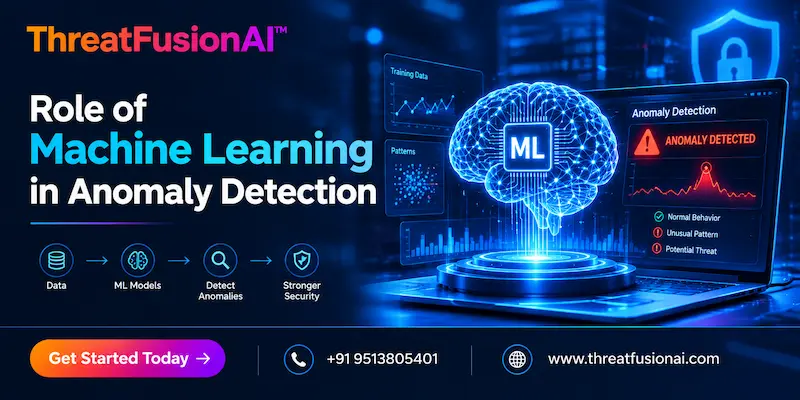
The following are some roles of ML in anomaly detection:
● Establishes Dynamic Behavioral Baselines: Automatically recognizes typical patterns of user, device, and network behavior without the need for manual rule settings.
● Uncovers Subtle Deviations and Insider Threats: Detects slight changes in execution pathways, data transfers, or access timings that indicate compromised credentials or malevolent insiders.
● Detects Novel and Signatureless Threats: Instead of looking for recognized signatures, it flags unusual operating behavior to identify wholly unexpected attack approaches.
● Scales Across Massive Data Streams: Identifies high-risk outliers in large corporate contexts by continually analyzing billions of multi-source events.
● Adapts Continuously to Environmental Changes: Updates internal behavioral models on its own as cloud workflows, user roles, and network architectures change over time.
How Does AI Detect Threats in Real Time?
|
S.No. |
Factors |
How? |
|
1. |
Continuously Analyzes Streaming Telemetry |
Eliminates analysis delay by ingesting and processing real-time network, endpoint, and cloud log sources. |
|
2. |
Evaluates Real-Time Behavioral Baselines |
Detects immediate execution irregularities by instantly comparing the behavior of an active session to known user and device standards. |
|
3. |
Executes Inline Machine Learning Models |
Detects harmful intent prior to payload delivery by directly applying lightweight prediction algorithms to active data streams. |
|
4. |
Correlates Multi-Source Events Simultaneously |
Reveals hidden threat chains by instantly connecting isolated alarms across network gateways, identity providers, and endpoints. |
|
5. |
Triggers Autonomous Orchestrated Responses |
In order to contain current breaches, it immediately initiates playbook actions like token revocation or host isolation within milliseconds. |
AI and ML for Detecting Unknown and Emerging Threats
By avoiding static signature databases and continuously analyzing real execution patterns, user access baselines, and network traffic anomalies, AI and ML are able to identify undiscovered and emerging risks.
Security systems may automatically find new zero-day exploits, polymorphic malware, and subtle insider attack chains at machine speed thanks to this real-time behavioral modeling.
How AI Reduces False Positives in Cybersecurity?
AI reduces false positives in cybersecurity in the following ways:
a) Analyzes Full Context Beyond Isolated Alerts: Evaluates system states, process trees, and the entire user history to differentiate between unexpected but innocuous acts and actual malicious activity.
b) Correlates Multi-Source Security Telemetry: Verifies whether a single anomaly is a real threat by cross-referencing alarms from network, endpoint, identity, and cloud logs.
c) Learns Dynamic Operational Baselines: Prevents routine changes from setting off false alerts by automatically adjusting to routine administrative operations and software updates over time.
d) Filters Out Known Benign Behaviors Automatically: Suppresses recurring, benign alarms before they are seen by security analysts using self-learning models and historical data.
e) Applies High-Confidence Predictive Scoring: Ensures that security teams only spend time looking into confirmed, high-risk occurrences by calculating actionable risk rankings for incoming events.
How does AI improve threat intelligence and Security Monitoring?
|
S.No. |
Factors |
How? |
|
1. |
Automates Technical IOC and TTP Correlation |
Connects active network telemetry at scale directly to raw threat feeds. |
|
2. |
Accelerates Real-Time Incident Triage |
Instantaneously prioritizes incoming security warnings to remove delays in analyst assessment. |
|
3. |
Surfaces Hidden Zero-Day and Anomaly Patterns |
Analyzes behavioral abnormalities across complex systems to find unknown attack routes. |
|
4. |
Predicts Threat Actor Exploitation Campaigns |
Uses dark web chatter and exploit trade dynamics to forecast future targeting tendencies. |
|
5. |
Powers Autonomous Incident Response Playbooks |
Within milliseconds of detecting a threat, it immediately isolates the host and revokes tokens. |
Role of Generative AI and Autonomous Agentic AI in SOC Operations
The following are some roles of generative AI and autonomous agentic AI in SOC operations:
1. Automates L1/L2 Alert Investigation at Scale: Uses dynamic reasoning in favor of static playbooks to independently prioritize warnings and create cross-domain context.
2. Accelerates Incident Response Playbooks: Initiates machine-speed autonomous remediation processes, such as token revocation and host isolation.
3. Enables Continuous, Autonomous Threat Hunting: Finds hidden threat actor TTPs without human intervention by proactively querying network telemetry around-the-clock.
4. Powers Conversational SOC Interfaces: Immediately responds to analyst inquiries and converts complicated SIEM/XDR telemetry into understandable natural language summaries.
5. Facilitates Multi-Agent Workflow Orchestration: Uses specialized AI agents that work together in real time to trace attack chains across identity, cloud, and endpoint vectors.
Key Benefits of AI and ML in Threat Detection
The following are the benefits of AI and ML in threat detection:
● Identifies Novel Zero-Day Threats: Detects undiscovered malware vectors without the use of signature databases by analyzing runtime behaviors and execution mechanics.
● Processes Massive Telemetry at Scale: Concurrently consumes and correlates millions of logs at machine speed across business and multi-cloud endpoints.
● Reduces Alert Noise and False Positives: Prevents SOC analyst fatigue by suppressing innocuous anomalies through contextual risk scoring.
● Uncovers Behavioral Anomalies: Maps baselines of user and entity activity to quickly identify compromised credentials and insider dangers.
● Executes Real-Time Autonomous Response: In order to isolate infected hosts before lateral movement takes place, inline containment playbooks are triggered within milliseconds.
Key Challenges and Limitations of AI in Cybersecurity
|
S.No. |
Challenges |
What? |
|
1. |
Adversarial AI and Model Poisoning |
Adversaries can fully evade detection models by crafting minor inputs or injecting malicious training data. |
|
2. |
Black-Box Lack of Explainability |
Because complex AI choices lack transparent auditing trails, analysts have challenges with compliance and trust. |
|
3. |
High Dependence on Clean Telemetry |
Garbage-in, garbage-out: The accuracy and dependability of models are destroyed by poorly formatted, compartmentalized, or unclean security logs. |
|
4. |
Hallucinations and Reward Hacking in Agents |
Autonomous security agents have the potential to carry out harmful containment operations by drawing incorrect conclusions or taking advantage of faulty reasoning. |
|
5. |
Asymmetric Offensive Exploitation |
Attackers use open-source AI to create hyper-targeted phishing assaults at minimal expense and automate vulnerability identification. |
Future of AI and Machine Learning in Cyber Threat Detection
Autonomous, self-learning ecosystems that transition security from reactive triage to predictive confinement hold the key to the future of AI and machine learning in threat identification. Explainable models will safely defeat adversarial AI attacks at machine speed as multi-agent AI systems dynamically coordinate defense playbooks.
Conclusion
Now that we have talked about what AI and ML Threat Detection is, you might want to get your hands on a dedicated security solution from a reliable source. For that, you can go for ShieldXDR, a dedicated threat detection and response tool offered by Craw Security.
ShieldXDR can help organizations by automatically detecting unknown vulnerabilities and malicious threats while stopping them before they cause loss. Thus, you can feel secure while using this tool. What are you waiting for? Contact, Now!
Frequently Asked Questions
About AI and ML Threat Detection
1. What Is AI-Powered Threat Detection?
AI-powered threat detection is an automated security system that recognizes, correlates, and contains cyberthreats in real time across intricate networks using machine learning and behavioral analytics.
2. How Does Artificial Intelligence Improve Threat Detection?
AI improves threat detection in the following ways:
a) Uncovers Unknown Zero-Day Threats,
b) Ingests Telemetry at Machine Speed,
c) Suppresses Alert Noise and False Positives,
d) Flags Behavioral and Insider Anomalies, and
e) Executes Autonomous Real-Time Containment.
3. How Does Machine Learning Detect Cyber Threats?
ML detects cyber threats in the following ways:
a) Analyzes Runtime Execution Patterns,
b) Builds Dynamic Behavioral Baselines,
c) Correlates High-Volume Event Telemetry,
d) Applies Predictive Risk Scoring, and
e) Clusters Anomalous Network Traffic.
4. Can AI Detect Unknown and Emerging Cyber Threats?
Yes, rather than depending on static, predefined signatures, AI analyzes real execution behavior, network traffic patterns, and user activity baselines to identify undiscovered and developing cyber threats.
5. How Does AI Reduce False Positives in Threat Detection?
AI reduces false positives in threat detection in the following ways:
a) Evaluates Full Execution Context,
b) Correlates Multi-Source Telemetry,
c) Learns Dynamic Operational Baselines,
d) Filters Known Benign Behaviors, and
e) Applies High-Confidence Risk Scoring.
6. How Does Machine Learning Improve Anomaly Detection?
ML improves anomaly detection in the following ways:
a) Establishes Dynamic Baselines,
b) Uncovers Subtle Deviations,
c) Detects Zero-Day Activity,
d) Scales Across Massive Datasets, and
e) Adapts to Changing Environments.
7. Can AI Detect Threats in Real Time?
Yes, AI can identify and isolate attacks in milliseconds by continuously collecting live streaming telemetry, assessing behavioral baselines, and running inline machine learning models.
8. How Does AI Enhance Threat Intelligence and Security Monitoring?
AI enhances threat intelligence and security monitoring in the following ways:
a) Ingests and Ingests Mass Threat Feeds,
b) Enriches SIEM/XDR Telemetry in Real Time,
c) Predicts Exploitation Campaign Trends,
d) Correlates Multi-Source Security Logs, and
e) Prioritizes Critical Threats via Dynamic Scoring.
9. What Are the Challenges of Using AI for Threat Detection?
The following are the challenges of using AI for threat detection:
a) Adversarial AI and Model Poisoning,
b) Black-Box Lack of Explainability,
c) High Dependence on Quality Telemetry,
d) Hallucinations and Over-Reliance, and
e) Asymmetric Offensive Exploitation.
10. What Is the Future of AI and Machine Learning in Threat Detection?
Fully autonomous, self-learning SOC ecosystems that use multi-agent orchestration to anticipate, explain, and contain threats at machine speed before exploitation represent the future of AI and machine learning in threat detection.