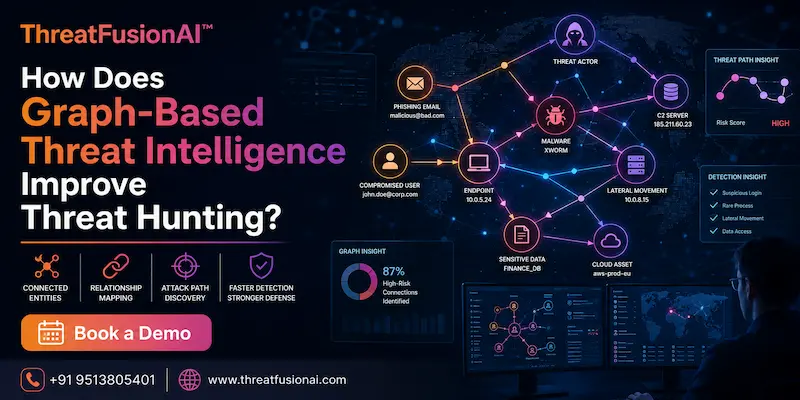
Do you know what Graph-Based Threat Intelligence is and how it can help businesses to improve threat hunting? If not, then you are in the right place. Here, we will talk about what Graph-Based Threat Intelligence is and related benefits in detail.
Moreover, we will introduce you to a reliable threat intelligence solution offered by a reputable VAPT service provider. What are we waiting for? Let’s get straight to the topic!
What Is Graph-Based Threat Intelligence?
Instead of treating cybersecurity telemetry as discrete, flat data points, graph-based threat intelligence models it as an interconnected network of nodes and edges. It uncovers intricate connections and concealed attack routes across domains by connecting indicators of compromise, attack strategies, host assets, and threat actor profiles.
Security teams can quickly query contextual threat information and track multi-vector campaigns back to their source thanks to this graph structure. Let’s find out about the benefits of Graph-Based Threat Intelligence for organizations working in the IT Industry!
Role of Graph Databases in Threat Intelligence
The following are the roles of graph databases in threat intelligence:
1. Fast traversal of complex relationships: Without costly database joins, query multi-hop links between IOCs, IP addresses, and threat actors in milliseconds.
2. Dynamic schema flexibility: Without necessitating database redesigns, add new threat types, attributes, and developing attacker strategies to the data model with ease.
3. Contextual pattern recognition: Use structural graph patterns to match attack behaviors in real time against known threat actor TTPs over millions of nodes.
4. Native visualization support: For quick analyst triage and attack path analysis, map intricate threat environments into visually appealing node-and-edge graphs.
5. Optimized graph algorithms: Use PageRank, shortest path, and community discovery algorithms directly on telemetry to rapidly identify essential infrastructure and patient zero.
Key Components of a Threat Intelligence Graph
The following are some key components of a threat intelligence graph:
● Nodes (Entities): Describe specific cybersecurity components, including host devices, IP addresses, file hashes, domain names, user accounts, and threat actor profiles.
● Edges (Relationships): Describe the directional connections between nodes using terms like "executed," "communicated with," "belongs to," and "exploited" to show how they interact.
● Node & Edge Attributes (Metadata): Keep contextual attributes in the graph, such as port numbers, timestamps, confidence scores, and geographic locations.
● TTP & MITRE ATT&CK Mappings: By associating entities with particular adversary tactics, techniques, procedures, and recognized exploit patterns, you may standardize attacker behaviors.
● Threat Intelligence Feeds & Internal Logs (Data Sources): To create and dynamically update the graph, provide ongoing telemetry from SIEMs, EDRs, cloud platforms, and external threat feeds.
Architecture & Data Pipelines for Graph Intelligence
Scalable data pipelines that accept heterogeneous telemetry via streaming systems like Apache Kafka and normalize the data into standardized formats before sending it to a graph database are the foundation of graph intelligence architecture.
The ingestion layer continuously updates nodes and edges through real-time parsing and entity resolution, allowing low-latency querying and graph analytics engines to quickly identify intricate threat patterns.
How Does Graph-Based Intelligence Connect Security Data?
Graph-based intelligence connects security data in the following ways:
a) Entity Resolution & Identity Normalization: Creates a single, cohesive node entity by combining duplicate or divergent identifiers, such as matching an IP address, user ID, and MAC address.
b) Semantic Relationship Linkage: Creates directed, meaningful connections between nodes to specify precise actions, like associating a file hash with the particular process that carried it out.
c) Multi-Hop Connection Tracing: Reveals latent relationships between seemingly unrelated occurrences by traversing several connected nodes across different data levels.
d) Temporal Sequence Mapping: To determine the exact chronological history of an attacker's lateral movement, timestamped events are chained together along edges.
e) Unified Data Schema Integration: Creates a uniform graph model for cross-platform data correlation by standardizing various telemetry formats from SIEMs, EDRs, and cloud logs.
Connecting IOCs, TTPs, Assets, and Threat Actors
A single graph model that links IOCs, TTPs, assets, and threat actors connects raw security observables to higher-level adversary behavior and affected systems. Security teams may quickly discover the whole extent of an attack vector and determine attribution by tracing edges between certain file hashes or C2 domains (IOCs), MITER ATT&CK tactics (TTPs), vulnerable internal systems (assets), and known adversary organizations (threat actors).
Identifying Hidden Relationships Between Threat Indicators
Graph traversal and community discovery methods are used in graph-based analysis to find hidden linkages between seemingly unrelated indicators. It finds shared command-and-control infrastructure, repetitive code snippets, and common hosting providers that are missed by typical flat log analysis by mapping structural links across many data layers.
How Does Graph-Based Threat Intelligence Improve Threat Hunting?
Graph-based threat intelligence improves threat hunting in the following ways:
1. Contextual attack path visualization: Instantly maps linked nodes to show the precise assault entry point, lateral movement, and progression.
2. Proactive discovery of hidden infrastructure: Before alerts go off, it traverses multi-hop associations to find shared adversary C2 domains, IP addresses, and code patterns.
3. Accelerated root-cause analysis: Quickly identifies patient zero and the original attack vector by tracking malicious behavior back through historical dependencies.
4. Behavior-based hunting via MITRE mapping: Identifies attacker behaviors across isolated systems by querying structural graph patterns against established MITER ATT&CK methodologies.
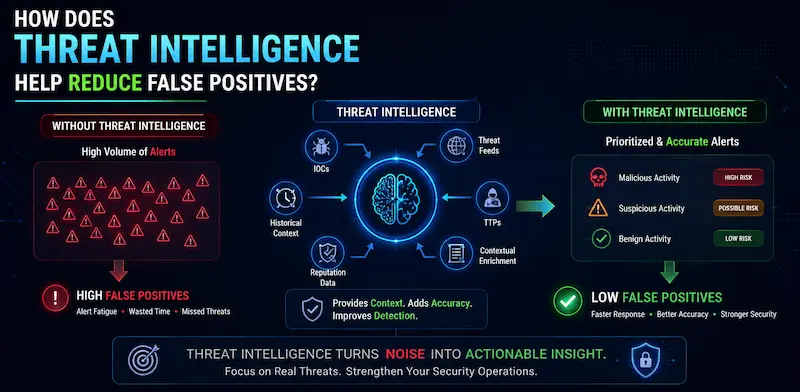
5. Significant noise reduction: Eliminates needless manual investigations by combining disparate, low-level security signals into a single contextual threat story.
Reducing Alert Fatigue for Threat Hunters
By automatically connecting disparate, low-level signals into a cohesive, contextualized incident narrative rather than bombarding hunters with disparate notifications, graph-based threat intelligence lessens alert fatigue.
Analysts can concentrate their investigations solely on serious, multi-vector risks by eliminating background noise and giving priority to high-confidence structural patterns across connected nodes.
Graph-Based Threat Intelligence vs. Traditional Threat Intelligence
|
S.No. |
Topics |
Factors |
What? |
|
1. |
Graph-Based Threat Intelligence |
Relationship-centric data model |
Enables instantaneous multi-hop searching across entities without requiring expensive database joins by modeling security data as connected nodes and edges. |
|
Holistic campaign context |
Reveals the larger attacker approach by automatically mapping shared infrastructure and intricate, multi-stage attack routes. |
||
|
2. |
Traditional Threat Intelligence |
Flat, record-based data model |
Prioritizes individual properties over connections when storing threat data in relational tables or static lists (such as IP/hash blocklists). |
|
Isolated alert analysis |
Requires analysts to manually connect the dots between various security logs since it analyzes occurrences as separate, standalone data points. |
Real-World Threat Hunting Use Cases & Playbooks
The following are some real-world threat hunting use cases & playbooks:
● Lateral Movement & Kerberoasting Playbook: Traces ticket granting requests and user authentication channels between Active Directory nodes to identify lateral host-hopping and unlawful privilege escalation.
● Adversary C2 Infrastructure Uncovering: An attacker's whole command-and-control network can be simultaneously exposed and blocked by mapping shared TLS certificates, hosting companies, and IP registration nodes.
● Ransomware Blast-Radius Tracking: Immediately determines the complete scope of compromised assets during an active epidemic by traversing the file system, host, and network connections in real time.
Challenges of Implementing Graph-Based Threat Intelligence
The following are some challenges of implementing graph-based threat intelligence:
a) High Ingestion Complexity & Entity Resolution: Complex normalizing procedures and significant computing overhead are needed to combine noisy, heterogeneous log formats into discrete nodes and edges.
b) Query Performance & Scalability Bottlenecks: As the graph expands, deep, multi-hop queries across billions of nodes may cause excessive latency and memory fatigue.
c) Steep Learning Curve for Analyst Teams: Instead of using normal SQL or SPL, security analysts need to become proficient in specialized graph query languages like Cipher or Gremlin.
d) Stale Data Management: The graph is cluttered by aging threat indicators and transient cloud infrastructure, necessitating ongoing cleansing to avoid out-of-date context.
e) Integration Hurdles with Legacy SOC Tools: Graph-structured threat data is difficult for traditional SIEMs, ticketing systems, and flat relational databases to natively consume, process, or present.
Best Practices for Using Graph-Based Threat Intelligence in Threat Hunting
|
S.No. |
Factors |
What? |
|
1. |
Standardize Data Normalization and Entity Resolution |
Accurately map unique identifiers into a single, dependable node entity by ingesting diverse logs through uniform schemas. |
|
2. |
Focus Hunts on Structural "Choke Points" |
Investigate important bridge nodes first, such as privileged service accounts or shared C2 domains that link several attack stages. |
|
3. |
Convert Graph Queries into Reusable Visual Playbooks |
For quick analyst execution, package intricate, high-yield graph traversal queries into repeatable visual templates. |
|
4. |
Enrich Telemetry with Behavioral Frameworks (MITRE ATT&CK) |
Contextualize entity relationships by directly mapping graph nodes and edges to standardized attacker TTPs. |
|
5. |
Implement Automated Graph Pruning and Lifecycle Rules |
Maintain optimal database query performance by continuously archiving stale threat indicators and transient cloud entities. |
Conclusion
Now that we have talked about what Graph-Based Threat Intelligence is, you might want to get your hands on a dedicated threat intel solution from a reliable source. For that, you can go for ThreatFusionAI, a dedicated threat intelligence platform offered by Craw Security.
ThreatFusionAI can help businesses by notifying them about the latest cyber threats os that they can prepare better security measures for future threats. Thus, you will feel secure working online. What are you waiting for? Contact, Now!
Frequently Asked Questions
About Graph-Based Threat Intelligence
1. What Is Graph-Based Threat Intelligence?
To uncover intricate attack routes and hidden connections, graph-based threat intelligence is a cybersecurity technique that models security data, including IOCs, assets, TTPs, and threat actors, as an interconnected network of nodes and edges.
2. How Does Graph-Based Threat Intelligence Improve Threat Hunting?
Graph-based threat intelligence improves threat hunting in the following ways:
a) Contextual Attack Path Visualization,
b) Proactive Infrastructure Uncovering,
c) Accelerated Patient-Zero Detection,
d) Behavior-Based Hunting via MITRE Mapping, and
e) Significant Alert Noise Reduction.
3. How Do Threat Intelligence Graphs Connect Different Security Data Sources?
Threat intelligence graphs connect different security data sources in the following ways:
a) Standardizing Unified Schemas,
b) Performing Entity Resolution,
c) Establishing Semantic Relationship Edges,
d) Enriching In-House Logs with External Intelligence, and
e) Mapping Multi-Hop Chronological Chains.
4. What Types of Threat Data Can Be Added to a Threat Intelligence Graph?
The following types of threat data can be added to a threat intelligence graph:
a) Technical Indicators (IoCs),
b) Attack Patterns and TTPs,
c) Threat Actor Entities,
d) Vulnerability Data (CVEs), and
e) Asset and Operational Context.
5. How Does Graph-Based Intelligence Help Identify Hidden Threat Relationships?
Graph-based intelligence helps identify hidden threat relationships in the following ways:
a) Uncovering Shared Infrastructure,
b) Detecting Code Reuse Across Malware Families,
c) Pattern-Matching Adversary TTPs,
d) Community Detection for Threat Clustering, and
e) Mapping Hidden Lateral Movement Paths.
6. How Can Graph-Based Threat Intelligence Improve Threat Actor Attribution?
Graph-based threat intelligence improves threat actor attribution in the following ways:
a) Mapping Shared Attack Infrastructure Across Campaigns,
b) Identifying Distinct Behavioral Footprints (TTP Profiling),
c) Tracking Malware Lineage and Code Resemblance,
d) Uncovering False Flag Operations and Decoys, and
e) Clustering Historic and Active Intrusion Sets.
7. How Does Graph Analysis Help Security Teams Detect Attack Paths?
Graph analysis helps security teams detect attack paths in the following ways:
a) Uncovering Indirect Privilege Escalation Paths,
b) Visualizing Multi-Hop Lateral Movement,
c) Correlating Cross-Domain Telemetry into Single Chains,
d) Pinpointing Critical Remediation "Choke Points", and
e) Simulating Adversary Exposure and Blast Radius Pre-Breach.
8. What Are the Benefits of Using Graph Databases for Threat Intelligence?
The following are the benefits of using graph databases for threat intelligence:
a) High-Performance Multi-Hop Querying,
b) Intuitive, Relationship-First Data Modeling,
c) Context-Rich Attack Path and Pattern Visualization,
d) Dynamic Schema Flexibility, and
e) Advanced Algorithmic Insights.
9. What Challenges Do Organizations Face When Implementing Graph-Based Threat Intelligence?
Organizations face the following challenges when implementing graph-based threat intelligence:
a) Heavy Ingestion and Entity Resolution Overhead,
b) Query Performance and Scalability Bottlenecks,
c) Steep Learning Curve for Analyst Teams,
d) Stale Data Lifecycle Management, and
e) Frictionful Integration with Legacy SOC Architectures.
10. How Will Graph-Based Threat Intelligence Shape the Future of Threat Hunting?
Graph-based threat intelligence shapes the future of threat hunting in the following ways:
a) Enabling Autonomous Graph-Native AI Agents,
b) Transitioning from Reactive Point Inquiries to Continuous Pattern Mining,
c) Powering Real-Time Attack Path Prediction and Preemptive Containment,
d) Democratizing Advanced Threat Queries Through Natural Language Interfaces, and