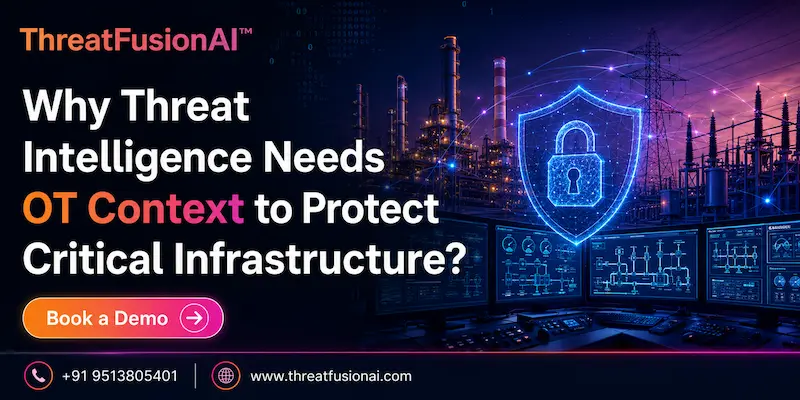
Do you know what OT Context is and how it can be helpful for threat intelligence & businesses around the world? If not, then you are in the right place. Here, we will talk about OT context and related benefits in detail!
Moreover, we will introduce you to a reliable threat intel solution offered by a reputable VAPT service provider. What are we waiting for? Let’s get straight to the topic!
The Growing Cyber Threat Landscape for Critical Infrastructure
As nation-state APTs, hacktivists, and RaaS syndicates expand beyond IT targets to disrupt operational technology (OT), the cyber threat picture for critical infrastructure is fast-growing. Attackers are increasingly using identity theft, AI-driven automation, and zero-day vulnerabilities to compromise linked industrial control systems (ICS/SCADA).
This change puts manufacturing facilities, water utilities, and electricity grids at risk for supply chain failures, high-impact ransomware, and serious physical disruptions that endanger public safety and business continuity.
IT vs. OT: Understanding the Key Differences
|
S.No. |
Topics |
Factors |
What? |
|
1. |
Information Technology (IT) |
Primary Focus |
Oversees the processing, storing, and communication of data across business networks in order to facilitate corporate and transactional activities. |
|
Security Priority |
Prevents illegal data access and breaches by enforcing the CIA Triad with a strong focus on confidentiality and integrity. |
||
|
2. |
Operational Technology (OT) |
Primary Focus |
Keeps an eye on and has direct control over industrial machinery, physical devices, and infrastructure operations (such as PLCs, SCADA systems, and sensors). |
|
Security Priority |
Places a high priority on safety and continuous availability, since unapproved instructions or system outages can result in bodily harm, environmental dangers, or fatalities. |
Why Does Traditional Threat Intelligence Fall Short in OT?
Traditional threat intelligence falls short in OT for the following reasons:
1. Focuses on IT Indicators of Compromise (IOCs): Gives domain names, phishing IPs, and file hashes precedence over specific OT telemetry.
2. Lacks Visibility into Proprietary Industrial Protocols: Fieldbus protocols such as Modbus, DNP3, Ethernet/IP, and BACnet cannot be analyzed or decoded.
3. Ignores Physical Safety and Process Impact: Evaluates risk based on data loss rather than hardware damage, physical risks, or operational downtime.
4. Fails to Understand Lower Purdue Levels: Lacks activity in the control and field layers (Levels 0–3) and primarily operates at the corporate network layers (Levels 4/5).
5. Recommends Incompatible Remediation Playbooks: Recommends common IT measures that result in hazardous disruptions on live control systems, such as automated host separation or quick patching.
What Is OT Context?
The exact Purdue model layer, vendor firmware, private communication protocols, and engineering function of physical industrial assets are all intimately linked to cyber telemetry through the granular operational intelligence known as OT context.
It converts general security signals into knowledge of how a possible attack affects operational continuity, plant safety, physical equipment, and crucial control procedures.
Why Does OT Context Matter?
|
S.No. |
Factors |
Why? |
|
1. |
Prevents Unintended Physical Damage & Outages |
Prevents security measures from inadvertently stopping vital equipment or causing physical system failures. |
|
2. |
Accurately Prioritizes Operational Vulnerabilities |
Rather than using raw CVSS scores, it ranks threats according to how they actually affect plant safety. |
|
3. |
Eliminates Disruptive IT Response Playbooks |
Substitutes safe, OT-tailored containment procedures for dangerous automated patching and host isolations. |
|
4. |
Accelerates Triage for Control Room Operators |
Converts complicated network alarms into understandable physical context so that operators can take rapid action. |
|
5. |
Detects Unauthorized Physical Process Changes |
Detects anomalous logic changes, rogue orders, or sensor manipulation before process failure. |
Why Must Threat Intelligence Understand OT Environments?
Threat intelligence must understand OT environments for the following reasons:
● Decoding Proprietary Industrial Protocols: Reveals embedded payload commands by parsing non-standard ICS communication such as Modbus, DNP3, and PROFINET.
● Navigating Purdue Model Network Architecture: Accounts for rigorous network segmentation between different control levels, ranging from physical sensors to corporate software.
● Detecting Living-off-the-Land (LotL) Tactics in Control Logic: Detects malicious exploitation of native PLC functions, dual-use binaries, and genuine engineering tools.
● Distinguishing Operational Anomalies from Cyber Attacks: Distinguishes between benign equipment degradation, routine maintenance changes, or physical sensor malfunctions and malicious infiltration.
● Aligning Mitigation with Physical Safety Protocols: Customizes response options to avoid ungraceful mechanical shutdowns, chemical overpressurization, and safety system trips.
The Role of Asset Context in Threat Intelligence
The following are the roles of asset context in threat intelligence:
a) Precision Vulnerability Matching: To remove unnecessary alarms, threat intelligence is mapped to precise hardware models, firmware updates, and software builds.
b) Purdue Level Risk Mapping: Identifies an asset's location within the control architecture to determine its vulnerability to enterprise-level threats.
c) Criticality-Based Risk Prioritization: Ranks security warnings according to how the asset directly affects operational uptime, manufacturing capacity, and physical safety.
d) Behavioral Baseline Comparison: Immediately identifies unwanted network modifications by comparing incoming telemetry to standard industrial communication baselines.
e) Tailored Incident Containment: Allows for focused reaction operations that isolate vulnerable systems without running the danger of plant-wide failures or shameful shutdowns.
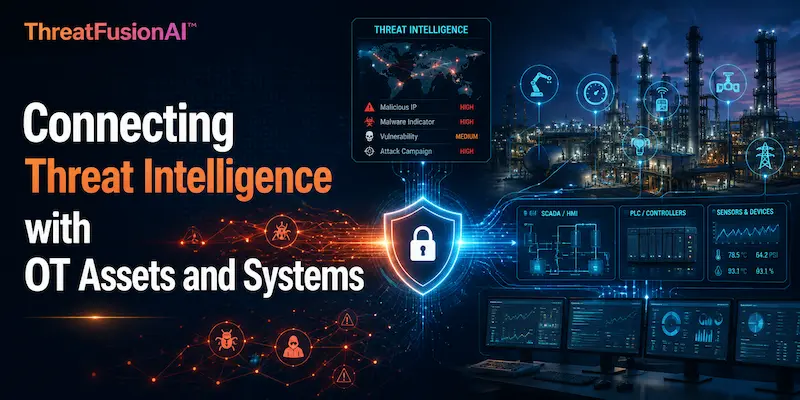
Connecting Threat Intelligence with OT Assets and Systems
|
S.No. |
Factors |
How? |
|
1. |
Continuous Passive Asset Discovery & Mapping |
Detects network topology and physical devices in real time without introducing dangerous probe traffic. |
|
2. |
Automated Vulnerability Correlation (CSAF/ SBOM) |
Quickly matches bills of materials and advisories for software components to the precise OT firmware inventory. |
|
3. |
Deep Packet Inspection (DPI) for Industrial Protocols |
Exposes harmful payloads within native ICS traffic by decoding unencrypted fieldbus commands. |
|
4. |
MITRE ATT&CK for ICS Behavior Alignment |
Connects established industrial adversary strategies, tactics, and procedures to observed network activity. |
|
5. |
Unified SIEM/ SOAR Data Pipeline Integration |
Integrates enhanced industrial telemetry for centralized threat detection and response into central security platforms. |
Identifying Threats That Can Impact Industrial Operations
You can identify the following threats that can impact industrial operations:
1. Destructive ICS Malware & Ransomware: Neutralizes wiper payloads that are intended to destroy OT endpoints or take industrial processes hostage, such as Industroyer and CaddyWiper.
2. Exploitation of Insecure Remote Access Vectors: Identifies unsegmented jump boxes, open RDP ports, and misconfigured vendor VPNs that are exploited to penetrate plant networks.
3. Unauthenticated Control Logic & Firmware Manipulation: Detects rogue firmware flashing across old protocols, ladder logic shifts, and unauthorized PLC code overwrites.
4. Supply Chain & Third-Party Vendor Compromise: Detects backdoored integrator maintenance tools, corrupted engineering software packages, and malicious updates.
5. Living-off-the-Land (LotL) Abuse of Native Engineering Tools: Exposes threat actors that submit fraudulent operational commands utilizing legitimate software (such as RSLogix and TIA Portal).
Mapping OT Cyber Threats to Purdue Model Architecture
By observing how attacks start in enterprise networks (Levels 4/5) and swing down to supervisory control (Level 3), control logic (Level 1/2), and physical instrumentation (Level 0), Mapping Threats to the Purdue Model classifies cyber hazards by architectural layer.
Security teams may predict adversary lateral movement, evaluate the physical process impact in each zone, and implement targeted segmentation defenses before an intrusion reaches vital field equipment thanks to this structural alignment.
Integrating Cyber-Physical Systems (CPS) Protocols into Threat Data
In order to incorporate CPS protocols into threat data, proprietary unencrypted industrial communications like Modbus, DNP3, and Ethernet/IP must be decoded using Deep Packet Inspection (DPI) in order to retrieve operational function codes.
By enabling security teams to identify unlawful write commands, firmware modifications, and unusual process parameters directly in native control traffic, this enhances threat intelligence.
Protecting Safety, Availability, and Operational Continuity
Using OT-aware threat intelligence provides zero unplanned operational downtime across critical infrastructure, protects human safety, and averts catastrophic equipment failure. Security teams may contain cyber breaches early without causing emergency plant trips or running the risk of dangerous physical effects by assessing threats through a process-first lens.
Translating Cyber Threat Intelligence into Actionable Response for Control Room Operators
By converting intricate cybersecurity telemetry into operator-ready warnings, threat information can be used to identify corrupted SCADA screens or impacted valve controllers, for example.
Because of this, plant operators may quickly apply manual overrides, isolate impacted network segments, or modify process baselines without running the risk of embarrassing physical shutdowns.
Common Challenges in Applying Threat Intelligence to OT
|
S.No. |
Challenges |
What? |
|
1. |
Pervasive Reliance on Legacy, Unpatchable Hardware |
Outdated systems don't have native logging features or current security fixes; thus, they continue to operate. |
|
2. |
Prevalence of Proprietary, Non-Standard Protocols |
Standardized encryption, authentication, and security monitoring formats are absent from legacy fieldbus traffic. |
|
3. |
Inaccurate Risk Scoring via IT-Centric Vulnerability Models |
By neglecting the impact of operational disruption and physical safety, CVSS measures misprioritize defects. |
|
4. |
Operational Silos Between IT SOCs and Plant Engineers |
Actionable context cannot be shared between physical operations teams and security analysts due to cultural differences. |
|
5. |
Risk of Disruptive False Positives and Incompatible Playbooks |
Automated reactions may inadvertently trip safety devices or result in needless plant shutdowns. |
The Future of Threat Intelligence in Critical Infrastructure
AI-driven behavioral analytics, automatic CPS threat sharing, and real-time interaction with physical safety instrumented devices are key components of critical infrastructure threat intelligence in the future.
Proactive detection of zero-day OT exploits and dynamic confinement techniques that safeguard operational continuity without posing a danger of bodily harm are made possible by this evolution.
Conclusion: Making Threat Intelligence OT-Aware
Now that we have talked about what OT Context is, you might want to get your hands on a dedicated threat intel solution from a reliable source. For that, you can go for ThreatFusionAI, a dedicated threat intelligence platform offered by Craw Security.
The amazingly dedicated ThreatFusionAI can help businesses to improve their security measures beforehand so that they can fight against online threats without getting worried. What are you waiting for? Contact, Now!
Frequently Asked Questions
About OT Context
1. What is threat intelligence in critical infrastructure?
The gathering, analysis, and use of specialized security data to detect, foresee, and stop cyberattacks that target industrial control systems, physical equipment, and vital social services is known as threat intelligence in critical infrastructure.
2. Why does threat intelligence need OT context?
Threat intelligence needs OT context for the following reasons:
a) Accurately Gauges Physical and Safety Impact,
b) Decodes Proprietary Industrial Protocols,
c) Eliminates Risky IT Response Playbooks,
d) Prioritizes Vulnerabilities by Operational Criticality, and
e) Provides Actionable Insights to Control Room Operators.
3. How is OT threat intelligence different from IT threat intelligence?
While IT threat intelligence places more emphasis on data confidentiality, network privacy, and preventing enterprise indicators of compromise, OT threat intelligence concentrates on physical safety, process uptime, and deciphering proprietary control protocols.
4. What makes OT environments more challenging to secure?
The following factors make OT environments more challenging to secure:
a) Legacy Hardware & Unpatchable Architecture,
b) Prioritization of Safety and Continuous Uptime,
c) Proprietary & Diverse Protocol Ecosystem,
d) Fragile, Resource-Constrained Controllers, and
e) Expanded Remote Access & Supply Chain Vectors.
5. What types of OT context are important for threat intelligence?
The following types of OT context are important for threat intelligence:
a) Physical Process Impact & Safety Risk,
b) Purdue Model Network Location,
c) Proprietary Protocols & Fieldbus Data,
d) Baseline Operational Behavior, and
e) Asset Metadata & Firmware Revisions.
6. How does OT context improve threat detection?
OT context improves threat detection in the following ways:
a) Reduces False Positives,
b) Enables Deep Payload Inspection,
c) Exposes Living-off-the-Land (LotL) Tactics,
d) Leverages Deterministic Baselines, and
e) Provides Process-Aware Risk Context.
7. Can OT context help reduce false positives?
Yes, OT context lowers false positives by using predictable operating baselines to differentiate benign sensor anomalies, equipment degradation, and routine engineering maintenance from actual cyber intrusions.
8. How does threat intelligence support OT incident response?
Threat intelligence supports OT incident response in the following ways:
a) Guides Safe Playbook Execution,
b) Pinpoints Physical Blast Radius,
c) Accelerates Root Cause Analysis,
d) Enables Target Isolation, and
e) Provides Adversary TTP Attribution.
9. What are the challenges of implementing OT-aware threat intelligence?
The following are the challenges of implementing OT-aware threat intelligence:
a) Decoding Proprietary Protocols,
b) Limited System Visibility,
c) Risk of Operational Disruption,
d) Flawed Threat Scoring, and
e) Cultural and Domain Silos.
10. How can organizations build an effective OT threat intelligence strategy?
Organizations can build an effective OT threat intelligence strategy in the following ways:
a) Establish Asset Visibility and Protocol Parsing,
b) Integrate Operational and Physical Context,
c) Bridge IT SOC and OT Engineering Silos,
d) Adopt OT-Specific Threat Sources and Vulnerability Models, and
e) Design Safe, Process-Aware Playbooks.