Do you know what a Threat Intelligence Software is, and how businesses can benefit from such software? If not, then you are at the right place. Here, we will talk about what threat intelligence software is and its features in detail.
Moreover, we will introduce you to a reliable threat intel solution offered by a reputable VAPT service provider. What are we waiting for? Let’s get straight to the topic!
What Is Threat Intelligence Software?
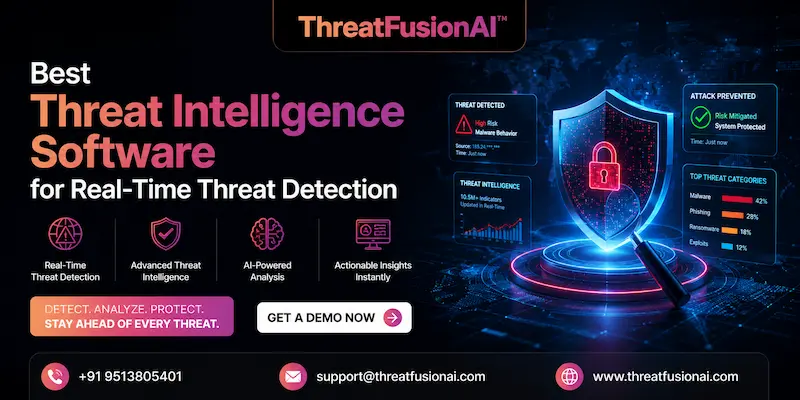
Threat intelligence software is a security tool that gathers, compiles, and examines worldwide information on cyberthreats from many sources in order to spot dangerous trends and attacker strategies.
It assists enterprises in anticipating possible threats, expediting incident response, and proactively defending their digital infrastructure by transforming raw data into actionable information.
In the end, these solutions automatically block known indicators of compromise (IoCs) and neutralize threats before they can penetrate a network by integrating seamlessly with current security technologies.
Let’s talk about what Threat Intelligence Software is and how it can help organizations to protect themselves against online threats!
Why Is Real-Time Threat Detection Critical for Modern Organizations?
Real-time threat detection critical for modern organizations for the following reasons:
1. Minimizes Attacker Dwell Time: Immediately apprehends attackers before they have a chance to expand their presence within the company network or migrate laterally.
2. Prevents Catastrophic Data Exfiltration: Prevents valuable intellectual property and customer records from being transferred without authorization.
3. Reduces Costly System Downtime: Prevents massive ransomware locks and operational paralysis by stopping the execution of harmful payloads.
4. Combats Sophisticated Automated Attacks: Combats machine-driven, fast-moving threats that exceed human reaction, such as botnets and credential stuffing.
5. Ensures Continuous Compliance and Trust: Demonstrates compliance with regulations and protects consumer trust by demonstrating that the network is actively protected.
How does Threat Intelligence Software Detect Cyber Threats in Real Time?
Threat intelligence software detects cyber threats in real time in the following ways:
● Real-Time Data Ingestion: Continuously streams and compiles log data from cloud environments, endpoints, and network firewalls.
● Automated Pattern and Signature Matching: Instantly checks files and traffic for harmful code fingerprints and known hashes.
● Behavioral and Heuristic Analysis: Keeps an eye on system activity to spot unusual behavior that differs from defined baseline procedures.
● Threat Intelligence Feed Correlation: Identifies active indicators of compromise (IoCs) by cross-referencing incoming data with real-time global threat feeds.
● Automated Orchestration and Triage: Initiates containment procedures and immediate security alerts to eliminate dangers without the need for human intervention.
Threat Intelligence Software vs SIEM vs XDR
|
S.No. |
Topics |
Factors |
What? |
|
1. |
Threat Intelligence Software (TI) |
Focuses on External Context |
Collects, evaluates, and distributes worldwide information about malicious IP addresses, attacker strategies, and new threat indicators. |
|
Acts as an Informational Feed |
Feeds external threat info into other security tools so they know what to search for, rather than individually ingesting or monitoring an organization's own server logs. |
||
|
2. |
Security Information and Event Management (SIEM) |
Focuses on Internal Log Aggregation |
Acts as a central repository that receives, processes, and stores enormous amounts of log data from every device in the company network. |
|
Prioritizes Compliance and Analysis |
Although it frequently lacks native, automated reaction and containment capabilities, it is excellent for historical inquiry, compliance auditing, and general security research. |
||
|
3. |
Extended Detection and Response (XDR) |
Focuses on Endpoint and Network Action |
Combines security measures for cloud environments, network perimeters, and endpoints to actively identify and eliminate threats. |
|
Prioritizes Automated Containment |
Provides sophisticated, automatic reaction capabilities to stop an active breach in its tracks, such as blocking a malicious user or isolating an infected laptop. |
Key Features to Look for in Threat Intelligence Software
The following are some key features to look for in threat intelligence software:
a) Comprehensive and Diverse Threat Data Feeds: Combines current indicators from commercial, dark web, open-source, and sector-specific sources.
b) Real-Time Automated Data Correlation: Detects current threats by instantly connecting incoming external threat signals with internal network logs.
c) Seamless SIEM, SOAR, and XDR Integrations: Use APIs to establish a direct connection with your current security stack in order to automate threat blocking and incident containment.
d) Advanced Machine Learning and Behavioral Analytics: Examines suspicious files and network patterns to find morphing malware strains and zero-day exploits.
e) Actionable and Context-Rich Reporting: Provides precise campaign objectives, guided remedial actions, and unambiguous information about attacker motivations instead of just raw data.
Top 5 Best Threat Intelligence Software for Real-Time Threat Detection
The following are the top 10 best threat intelligence software for real-time threat detection:
1. ThreatFusionAI (Craw Security): An AI-powered threat intelligence and risk assessment database with an emphasis on realtime data leak analysis and phishing detection.
2. Recorded Future Intelligence Cloud: Uses large-scale automated graph analytics to map technological indicators and global danger landscapes in real time.
3. CrowdStrike Falcon Intelligence: Provides adversary profiles and context-rich cyber threat tracking that are directly integrated with elite endpoint detection.
4. Google Threat Intelligence (Mandiant): Combines Google's extensive worldwide telemetry network with Mandiant's frontline incident response visibility to provide unparalleled threat insights.
5. ThreatConnect Intelligence Operations: A strong Threat Intelligence Platform (TIP) with an emphasis on data operationalization, playbook execution, and cyber risk assessment.
How to Choose the Right Threat Intelligence Solution for Your Business?
|
S.No. |
Factors |
How? |
|
1. |
Assess Your Team's Operational Maturity |
Select a tool based on the size, expertise, and capacity of your team to manage complicated feeds. |
|
2. |
Verify Integration Compatibility |
Make sure the program uses native APIs to establish a direct connection with your current SIEM, EDR, and firewall stack. |
|
3. |
Evaluate Data Relevancy and Quality |
Pay attention to systems that monitor risks that are relevant to your sector, region, and technological stack. |
|
4. |
Prioritize Actionable Context Over Raw Data |
Instead of endless lists of unverified IP addresses, choose a vendor that provides attacker profiles and specific mitigation actions. |
|
5. |
Review Total Cost of Ownership (TCO) |
Compare the initial subscription fees to the time needed for implementation, the infrastructure needed, and the amount of work your employees must do every day. |
Benefits of Using Threat Intelligence Platforms
The following are the benefits of using threat intelligence platforms:
● Transforms Reactive Defense Into Proactive Shielding: Changes the focus of security teams from pursuing active breaches to fixing vulnerabilities before attackers take advantage of them.
● Drastically Accelerates Incident Response Times: Reduces the amount of time needed to investigate malicious warnings from days to minutes by providing instant insight on threats.
● Reduces Alert Fatigue via Automated De-duplication: Eliminates unnecessary information and false positives, allowing analysts to concentrate only on important, confirmed concerns.
● Empowers Smart, Data-Driven Security Spending: Enables you to invest in defenses that truly matter by highlighting the particular dangers that are targeting your sector.
● Fosters Streamlined, Global Collaboration: Makes it simple for internal departments, subsidiaries, and reliable industry peers to exchange threat data using established formats.
Common Challenges When Implementing Threat Intelligence Software
The following are some common challenges when implementing threat intelligence software:
a) High Volume of False Positives and Alert Fatigue: Overwhelm analysts with lots of unconfirmed indicators, making important alarms obscured.
b) Complex Integration with Legacy Systems: When attempting to link contemporary threat APIs with antiquated security stacks, data silos and visibility holes are created.
c) Lack of Actionable, Contextual Data: Delivering enormous lists of malicious IP addresses without the attacker profiles or corrective actions required for a successful response.
d) Severe Cybersecurity Skill Shortages: Locating and keeping specialist analysts who can switch to active hunting and understand advanced threat telemetry.
e) Inability to Measure Return on Investment (ROI): Executives find it challenging to demonstrate measurable economic value because success implies that a security violation never happened.
Best Practices for Maximizing Threat Detection Accuracy
|
S.No. |
Factors |
What? |
|
1. |
Implement Continuous Behavioral Baselining (UEBA) |
Monitor typical user and device behavior continuously to quickly identify unusual, dangerous deviations. |
|
2. |
Prioritize and Enrich High-Fidelity Multi-Source Data |
To get rid of blind spots, combine validated global threat intelligence with internal endpoint logs. |
|
3. |
Map Security Rules to the MITRE ATT&CK Framework |
To methodically decrease coverage gaps, align your detection rules with known adversary methods. |
|
4. |
Deploy Machine-Learning Noise Filters |
To eliminate unnecessary alarms and identify genuine signs of compromise, use automated algorithms. |
|
5. |
Establish a Feedback Loop via Continuous Attack Simulation |
To evaluate your detection rules and continuously improve your security stack, execute automated breach simulations on a regular basis. |
Future Trends in AI-Powered Threat Intelligence
The following are the future trends in AI-powered threat intelligence:
1. Autonomous Self-Healing Networks: As soon as an incursion is discovered, AI immediately fixes vulnerabilities and modifies network boundaries.
2. Hyper-Personalized Threat Modeling: Instead of focusing on broad industry trends, systems customize security by examining a company's unique digital footprint.
3. Generative AI Cyber Explainability: Large language models convert intricate technical malware code into executive summaries that are easy to understand.
4. Predictive Attacker Infrastructure Mapping: Before attackers begin their attacks, machine learning tracks and flags suspicious servers and domains.
5. Defensive AI vs. Offensive AI Battles: Security technologies fight completely automated, polymorphic AI malware in real-time at machine speed.
What is Threat Fusion AI?
Craw Security created ThreatFusionAI, an AI-driven threat intelligence and cyber protection platform that gathers and correlates data from several sources to quickly identify phishing scams and data breaches.
It scores risk, keeps an eye on the dark web, and initiates automatic containment workflows within enterprise security systems using machine learning and behavioral analytics.
Benefits of Threat Fusion AI for Organizations
|
S.No. |
Benefits |
How? |
|
1. |
Proactive Phishing and Data Leak Visibility |
Monitors active phishing efforts and dark web leak records to stop identity theft and brand exposures before they affect consumers. |
|
2. |
Aggregated Multi-Source Intelligence |
Unifies enterprise, open-source, and dark web indicators into a single, all-inclusive reference database for security professionals. |
|
3. |
Drastic Reduction in Alert Fatigue |
Enhances signal credibility by up to 73% by correlating real-time telemetry with global threat streams. |
|
4. |
Lightning-Fast Automated Containment |
Uses SOAR-ready playbooks to update firewalls and isolate infected endpoints in milliseconds after a threat is detected. |
|
5. |
Quantifiable Cyber Risk Governance |
Creates board-ready risk dashboards with real-time financial impact analytics and loss exposure tracking from technical system logs. |
Conclusion
Now that we have talked about the Threat Intelligence Software, you might want to get your hands on a dedicated threat intelligence solution from a reliable source. For that, you can go for Threat Fusion AI, a dedicated threat intelligence platform offered by Craw Security.
The amazing Threat Fusion AI platform can notify businesses about real-time cyber threats and risks that can put organizations in huge chaos, causing data and financial loss. What are you waiting for? Contact, Now!
Frequently Asked Questions
About Threat Intelligence Software
1. What is threat intelligence software, and how does it work?
In order to assist businesses in anticipating, identifying, and automatically stopping incoming assaults, threat intelligence software is a security platform that gathers and evaluates global cyber threat data in real time.
2. Why is real-time threat detection important for businesses?
Real-time threat detection is important for businesses for the following reasons:
a) Minimizes Attacker Dwell Time,
b) Prevents Catastrophic Data Exfiltration,
c) Reduces Costly System Downtime,
d) Combats High-Speed Automated Attacks, and
e) Ensures Continuous Compliance and Trust.
3. What are the key features of the best threat intelligence software?
The following are the key features of the best threat intelligence software:
a) Comprehensive and Diverse Threat Data Feeds,
b) Real-Time Automated Data Correlation,
c) Seamless SIEM, SOAR, and XDR Integrations,
d) Advanced Machine Learning and Behavioral Analytics, and
e) Actionable and Context-Rich Reporting.
4. How does threat intelligence software detect cyber threats in real time?
Threat intelligence software detects cyber threats in real time in the following ways:
a) Real-Time Data Ingestion,
b) Automated Pattern and Signature Matching,
c) Behavioral and Heuristic Analysis,
d) Threat Intelligence Feed Correlation, and
e) Automated Orchestration and Triage.
5. What is the difference between threat intelligence software and SIEM?
A SIEM focuses on gathering and examining internal security logs from throughout an organization's network in order to identify anomalies and oversee compliance, whereas threat intelligence software aggregates and analyzes external global data regarding attacker methods and dangerous signs.
6. Can threat intelligence software prevent ransomware attacks?
Yes, by identifying known ransomware infrastructure, banning malicious sites, and identifying early-stage attacker methods before the actual encrypted payload can be released, threat intelligence software stops ransomware attacks.
7. Which industries benefit the most from threat intelligence platforms?
The following industries benefit the most from threat intelligence platforms:
a) Financial Services and Banking,
b) Healthcare and Pharmaceuticals,
c) Government and Defense Contractors,
d) Energy, Utilities, and Critical Infrastructure, and
e) Retail and E-commerce.
8. How do I choose the best threat intelligence software for my organization?
You can choose the best threat intelligence software for your organization in the following ways:
a) Define Your Core Use Case and Team Maturity,
b) Assess Data Quality and Relevancy,
c) Verify Native Integration Capabilities,
d) Evaluate Actionable Context Over Raw Telemetry, and
e) Review Total Cost of Ownership (TCO).
9. What are the common challenges of implementing threat intelligence software?
The following are the common challenges of implementing threat intelligence software:
a) High Volume of False Positives and Alert Fatigue,
b) Complex Integration with Legacy Systems,
c) Lack of Actionable, Contextual Data,
d) Severe Cybersecurity Skill Shortages, and
e) Inability to Measure Return on Investment (ROI).
10. What are the latest trends in AI-powered threat intelligence and real-time threat detection?
The following are the latest trends in AI-powered threat intelligence and real-time threat detection:
a) Rise of Autonomous Agentic AI Ecosystems,
b) Prompt Language & Indirect Injection Analysis,
c) Combating Self-Modifying AI Malware,
d) Hyper-Personalized Automated Threat Modeling, and
e) Generative AI Cyber Explainability and Triaging.
Click on th link for more information about threatfusionai