Do you know what Cyber Threat Intelligence (CTI) is and how it can improve the level of security measures for users? If not, then you are at the right place. Here, we will talk about the CTI and related features in detail.
Moreover, we will introduce you to a reliable threat intel solution offered by a reputable VAPT service provider. What are we waiting for? Let’s get started!
What is Cyber Threat Intelligence (CTI)?
Evidence-based knowledge about current or potential cyberthreats to an organization's IT infrastructure, including context, mechanisms, indicators, and practical guidance, is known as cyber threat intelligence (CTI).
To comprehend the goals, objectives, and attack tactics of an attacker, it gathers and examines unprocessed data from open-source feeds, dark web monitoring, and technical logs. CTI enables security teams to proactively anticipate breaches, expedite incident response, and make well-informed risk-management decisions by converting complicated threat data into organized insights.
Let’s take a look at what Cyber Threat Intelligence (CTI) is, its uses, and its benefits for organizations!
Why is Cyber Threat Intelligence Important for Modern Businesses?
|
S.No. |
Factors |
Why? |
|
1. |
Shifts Defense from Reactive to Proactive |
Anticipates hacker movements and patches vulnerabilities early to stop attacks before they reach the network. |
|
2. |
Accelerates Incident Response Times |
Provides security teams with instant context and compromise indications so they may identify and eliminate threats in a matter of minutes. |
|
3. |
Informs Strategic Decision-Making and ROI |
Assists leaders in allocating security funds to defenses that specifically address the dangers that their industry faces. |
|
4. |
Reduces Alert Fatigue for Security Teams |
Eliminates unnecessary background noise so that analysts can concentrate just on verified, dangerous cyberthreats. |
|
5. |
Prevents Severe Financial and Reputational Damage |
Prevents expensive ransomware attacks and data breaches, protecting consumer confidence and averting hefty fines from authorities. |
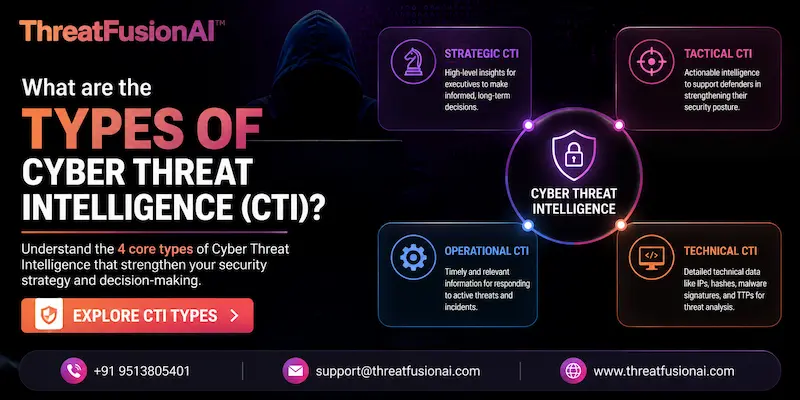
What are the Main Types of Cyber Threat Intelligence (CTI)?
The following are the main types of CTI:
1. Strategic Cyber Threat Intelligence: High-level examination of long-term patterns and the reasons behind attacks for decision-makers and executives.
2. Tactical Cyber Threat Intelligence: Information on attacker techniques, tools, and tactics (TTPs) that defenders might use to strengthen security measures.
3. Operational Cyber Threat Intelligence: Information that can be used to help incident responders respond to specific, incoming, or ongoing cyberattacks.
4. Technical Cyber Threat Intelligence: Threat detection is automated using instantaneous, short-term data such as malicious IPs, file hashes, or URLs (IoCs).
How does Cyber Threat Intelligence Help Organizations Prevent Cyber Attacks?
CTI helps organizations prevent cyber attacks in the following ways:
● Identifies Emerging Threats Early: Proactively alerts you to emerging trends and motivations of attackers before they target your network.
● Accelerates Threat Detection: Provides real-time indicators (IoCs) to security systems so they may quickly identify and stop harmful activities.
● Empowers Vulnerability Management: Identifies the security holes that are being actively exploited so that teams can address the most dangerous ones first.
● Improves Incident Response Speed: Provides vital information about the actions of attackers, enabling defenders to quickly contain and destroy breaches.
● Guides Strategic Security Investments: Provides data-driven insights to assist leadership in allocating funds and resources to the most pressing security vulnerabilities.
Key Sources of Cyber Threat Intelligence
|
S.No. |
Factors |
What? |
|
1. |
Open-Source Intelligence (OSINT) |
Publicly accessible information from open-source threat feeds, social media, security blogs, and government alerts (such as CISA). |
|
2. |
Internal Network Logs |
Firewall logs, SIEM alerts, and endpoint detection (EDR) telemetry are examples of security data produced inside an enterprise. |
|
3. |
Commercial Threat Feeds |
Cybersecurity providers' paid subscription services that offer selected, validated, and up-to-date threat information. |
|
4. |
The Dark Web and Underground Forums |
Keeping an eye on covert networks where hackers purchase, sell, and exchange malware, exploits, and credentials that have been stolen. |
|
5. |
Information Sharing Communities (ISACs) |
Networks tailored to a particular industry, such as ISACs for healthcare or finance, allow businesses to safely exchange threat information with one another. |
Common Challenges in Cyber Threat Intelligence
The following are some common challenges in CTI:
a) Data Overload and Alert Fatigue: Massive amounts of raw threat data overburden security staff, causing them to overlook important alerts.
b) Lack of Context: The exact information required to determine if a threat truly poses a risk to the company is frequently absent from raw intelligence.
c) Talent and Skill Shortages: There is a severe shortage of qualified analysts who can decipher and apply complicated threat data.
d) Integration and Interoperability Issues: Threat feeds frequently employ various forms that are difficult to integrate with current security workflows and technologies.
e) Perishable Data: Indicators of compromise (IoCs) can become outdated and ineffective in a matter of hours due to the speed at which cyber threats are evolving.
Essential Tools and Platforms Used for CTI
The following are some essential tools and platforms used for CTI:
1. Threat Intelligence Platforms (TIPs): Centralized systems that automatically compile, correlate, and evaluate threat information from various streams.
2. SIEM and SOAR Systems: Threat intelligence is ingested by security platforms to identify threats and automate quick, preprogrammed incident responses.
3. MISP (Malware Information Sharing Platform): Global communities use this well-known open-source tool to exchange and work together on threat indicators.
4. OSINT Frameworks and Scanners: Toolkits that are accessible to the public and are used to collect threat information from public repositories, open-source digital assets, and domains.
5. EDR and XDR Platforms: Threat intelligence-based endpoint and network technologies that find, stop, and isolate harmful behavior on devices.
Future Trends in Cyber Threat Intelligence
|
S.No. |
Factors |
What? |
|
1. |
AI and Machine Learning Dominance |
Massive datasets will be automatically analyzed by AI to find intricate threat patterns at machine speed. |
|
2. |
Increased Focus on Dark Web Automation |
In order to quickly identify compromised passwords, automated bots and scrapers will monitor criminal forums in real time. |
|
3. |
Shift Toward Predictive Intelligence |
Systems will progress from monitoring previous attacks to predicting the precise location and method of the next attack by hackers. |
|
4. |
Geopolitical and Supply Chain Intelligence |
Risks associated with third-party vendor software and state-sponsored warfare will be major areas of intelligence concern. |
|
5. |
Standardized Collaborative Sharing |
Unified automation standards will be adopted by global industries to enable instantaneous and seamless cross-border sharing of threat data. |
Why Choose Craw Security for Cybersecurity Training and CTI Skills?
You can choose Craw Security for cybersecurity training and CTI skills for the following reasons:
● Certified Threat Intelligence Analyst (CTIA) Curriculum: Provides an industry-aligned, approved curriculum that is directly matched to international EC-Council requirements.
● Hands-on Virtual Labs ("Crack The Lab"): Offers free access to gamified, real-world cyberattack simulations so that defensive techniques can be safely practiced.
● Expert, Industry-Vetted Faculty: Includes instruction from qualified experts with more than ten years of active, practical penetration testing experience.
● Flexible Learning & Global Recognition: Provides flexible online (VILT) or classroom choices in facilities accredited by international organizations such as the US Department of Defense.
● 100% Placement Assistance: Builds resumes, conducts extensive mock interviews, and establishes direct links with leading international IT companies to ensure job preparedness.
Conclusion
Now that we have talked about what Cyber Threat Intelligence (CTI) is, you might want to get your hands on a dedicated threat intel solution from a reliable source. For that, you can go for Threat Fusion AI, a dedicated threat intel platform offered by Craw Security.
Threat Fusion AI can help companies’ security analysts to prepare better security measures beforehand while getting updates on the latest cyber threats in advance. What are you waiting for? Contact, Now!
Frequently Asked Questions
About Cyber Threat Intelligence (CTI)
1. What are the different types of Cyber Threat Intelligence (CTI)?
The following are the different types of CTI:
a) Strategic Cyber Threat Intelligence,
b) Tactical Cyber Threat Intelligence,
c) Operational Cyber Threat Intelligence, and
d) Technical Cyber Threat Intelligence.
2. What is the difference between strategic, tactical, operational, and technical CTI?
The main distinction is who uses the intelligence and how quickly they act: Technical CTI provides instantaneous data (such as malicious links or file hashes) for automated system blocking; Operational CTI tracks active ongoing attacks for incident responders; Tactical CTI describes hacker techniques for security teams, and Strategic CTI directs executive business decisions.
3. Why is Cyber Threat Intelligence important for businesses?
CTI is important for business for the following reasons:
a) Prevents Costly Data Breaches,
b) Minimizes System Downtime,
c) Optimizes Security Budgets,
d) Accelerates Patch Management, and
e) Ensures Regulatory Compliance.
4. How does Cyber Threat Intelligence help prevent cyber attacks?
CTI helps prevent cyber attacks in the following ways:
a) Exposes Attacker Plans Early,
b) Blocks Known Malicious Activity Automatically,
c) Prioritizes Critical Vulnerability Patching,
d) Enables Proactive Threat Hunting, and
e) Hardens Security Architecture.
5. Who uses Cyber Threat Intelligence within an organization?
The following individuals use CTI within an organization:
a) Security Operations Center (SOC) Analysts,
b) Incident Response (IR) Teams,
c) Vulnerability Management Teams,
d) Executive Leadership and C-Suite (CISO, CIO, CEO), and
e) Risk and Compliance Officers.
6. What are the primary sources of Cyber Threat Intelligence?
The following are the primary sources of CTI:
a) Open-Source Intelligence (OSINT),
b) Internal Security Telemetry,
c) Commercial Threat Feeds,
d) The Dark Web and Underground Forums, and
e) Information Sharing Communities (ISACs).
7. Which industries benefit the most from Cyber Threat Intelligence?
The following industries benefit the most from CTI:
a) Banking and Financial Services,
b) Healthcare and Pharmaceuticals,
c) Manufacturing and Supply Chain,
d) Energy, Utilities, and Critical Infrastructure, and
e) Government and Public Sector.
8. What tools are commonly used for Cyber Threat Intelligence?
The following tools are commonly used for CTI:
a) Threat Intelligence Platforms (TIPs),
b) SIEM and SOAR Systems,
c) Malware Information Sharing Platform (MISP),
d) OSINT and Reconnaissance Tools, and
e) EDR and XDR Platforms.
9. What challenges do organizations face when implementing Cyber Threat Intelligence?
Organizations face challenges when implementing CTI:
a) Data Overload and Alert Fatigue,
b) Lack of Actionable Context,
c) Severe Talent and Skill Shortages,
d) Integration and Interoperability Issues, and
e) The Perishable Nature of Data.
10. How can beginners learn Cyber Threat Intelligence and build a career in cybersecurity?
Beginners can learn CTI and build a career in cybersecurity in the following ways:
a) Master Networking and Security Fundamentals,
b) Earn Industry-Recognized Certifications,
c) Get Hands-on Practice with CTI Tools,
d) Learn Threat Frameworks and Methodologies, and
e) Engage with the Community and Build a Portfolio.