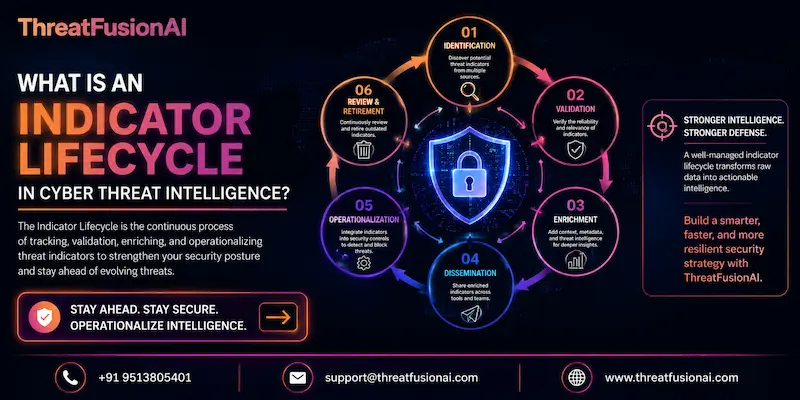
Do you know what the Indicator Lifecycle in Cyber Threat Intelligence is and how it can ensure better security for future threats? If not, then you are at the right place. Here, we will talk about the Indicator Lifecycle in Cyber Threat Intelligence and related features in detail.
Moreover, we will introduce you to a reliable threat intel platform offered by a reputed VAPT service provider. What are we waiting for? Let’s get straight to the topic!
What Is an Indicator Lifecycle in Cyber Threat Intelligence?
In Cyber Threat Intelligence (CTI), the lifecycle of an indicator refers to the organized, multi-phase process that a threat indicator like a malicious IP address, file hash, or domain goes through from the time it is first discovered until it is retired.
It dictates the methods security teams use to gather, confirm, examine, identify, and react to these threat indicators, so that defenses continue to be precise and practical. The overarching aim of lifecycle management in this context is to enhance the defensive utility of threat data, while methodically phasing out stale or outdated indicators in order to avert false positives and alert fatigue.
Let’s take a look at what the Indicator Lifecycle in Cyber Threat Intelligence is and how it can help organizations in the IT Industry!
Why Is the Indicator Lifecycle Important in Cyber Threat Intelligence?
|
S.No. |
Factors |
Why? |
|
1. |
Prevents Alert Fatigue and False Positives |
Keeping security alerts highly accurate and actionable requires expiring stale data. |
|
2. |
Optimizes Security System Performance |
Eliminating outdated indicators prevents firewalls and SIEMs from becoming overwhelmed by extensive, inflated blocklists. |
|
3. |
Enhances Operational Relevance and Context |
By guaranteeing that threat intelligence is up to date, it becomes possible for defenders to concentrate exclusively on current, tangible threats. |
|
4. |
Ensures Faster Incident Response Times |
With automated lifecycle updates, teams invest no time in examining threats that are dead or not relevant. |
|
5. |
Maximizes Security Resource ROI |
Analysts can focus their resources and budget on preventing current vulnerabilities that have a high impact. |
The Relationship Between Threat Data, Information, and Intelligence
Threat data comprises raw, uncontextualized facts such as isolated IP addresses or file hashes. When processed, aggregated, and structured to uncover patterns of malicious activity, these facts transform into information.
When this information is thoroughly examined in conjunction with attacker motives, historical context, and specific organizational risks, it becomes actionable threat intelligence that can inform strategic defensive decisions.
Types of Threat Indicators Used in Cyber Threat Intelligence
The following are some of the types of threat indicators used in cyber threat intelligence:
1. Atomic Indicators: Unprocessed data items such as particular IP addresses, domain names, or email addresses that need no further processing.
2. Computed Indicators: Derived data objects formed through the analysis of raw data, typically cryptographic file hashes (such as MD5, SHA-1, or SHA-256).
3. Behavioral Indicators (TTPs): Patterns, methods, and strategic actions that an attacker employs to carry out a cyberattack during its entire lifecycle, as documented.
4. Strategic Indicators: Detailed high-level narrative profiles of threat actor identities, geopolitical motivations, and long-term campaign targets.
Common Indicators of Compromise (IOCs) in Cyber Threat Intelligence
|
S.No. |
Factors |
What? |
|
1. |
Unusual Outbound Network Traffic |
Significant data transfers or interactions with identified harmful servers suggest possible data exfiltration. |
|
2. |
Mismatched File Hashes |
Unanticipated changes in file signatures that indicate authentic software or system executables have been altered or substituted with malware. |
|
3. |
Privileged Account Anomalies |
Unapproved privilege escalation, unexpected logins during off-hours, or credential usage from unknown geographic regions. |
|
4. |
Spikes in Database Read Volume |
Substantial and abrupt rises in data requests that frequently uncover an assailant collecting sensitive data through SQL injection. |
|
5. |
Suspicious Registry or System Changes |
Changes to system configuration files or registry keys that were not permitted and aimed at creating lasting access for the attacker. |
The Pyramid of Pain in Cyber Threat Intelligence
The Pyramid of Pain is a conceptual framework that categorizes various threat indicators according to the level of "pain" they inflict on an adversary when identified by defenders. It categorizes indicators based on their complexity, placing easily modifiable assets such as file hashes and IP addresses at the bottom and intricate behavioral patterns like Tactics, Techniques, and Procedures (TTPs) at the top. Blocking these TTPs can dismantle the attacker’s entire operational strategy.
The Different Stages of the Indicator Lifecycle
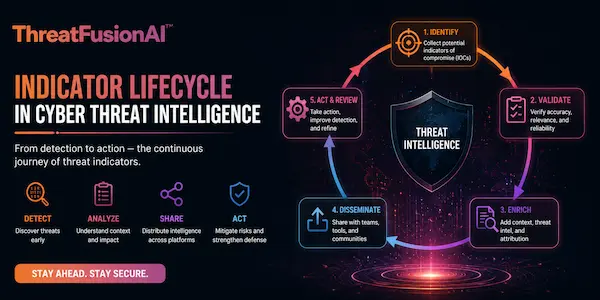
The following are the different stages of the indicator lifecycle:
● Indicator Collection: Collecting unrefined threat data from internal logs, open-source feeds, and commercial threat intelligence sources.
● Indicator Validation: Checking the correctness of collected data to remove duplicates, formatting issues, and clear false positives.
● Indicator Analysis: Assessing the validated information to comprehend the fundamental threat, its seriousness, and its possible effects on the organization.
● Indicator Enrichment and Contextualization: Including additional layers of threat data, like actor attribution, historical campaigns, and vulnerability associations.
● Indicator Distribution: Distributing the enhanced threat intelligence to security tools, internal teams, and trusted industry-sharing communities.
● Indicator Detection: Implementing the indicators into security systems such as SIEMs, firewalls, and EDRs to proactively search for matches.
● Indicator Response: Taking defensive measures like blocking IP addresses or isolating hosts whenever an indicator sets off a security alert.
● Indicator Retirement: Removing or archiving systematically indicators that are dead, obsolete, or no longer represent an active threat.
Benefits of an Effective Indicator Lifecycle for Organizations
|
S.No. |
Benefits |
How? |
|
1. |
Drastic Reduction in False Positives |
Keeping alerts highly accurate by expiring stale data allows teams to concentrate solely on genuine threats. |
|
2. |
Enhanced Security Infrastructure Performance |
By removing outdated indicators, you can prevent firewalls and SIEMs from becoming overloaded with excessive blocklists. |
|
3. |
Proactive Cyber Threat Defenses |
With ongoing lifecycle updates, organizations can foresee and prevent emerging attacks before they occur. |
|
4. |
Optimized Incident Response Workflows |
Data on pre-validated indicators allows for the immediate prioritization and containment of critical breaches by incident responders. |
|
5. |
Maximization of Cybersecurity ROI |
Budgets for security and hours allocated to analysts are dedicated exclusively to vulnerabilities that are currently high-impact. |
Challenges and Pitfalls in Managing Indicator Lifecycles
Following are some challenges and pitfalls in managing indicator lifecycles:
a) Managing Massive Data Volume (Alert Fatigue): The inundation of thousands of unvetted threat feeds overwhelms analysts and obscures high-priority security alerts.
b) Delayed Indicator Retirement: When stale threat markers are not purged, it leads to inflated infrastructure defenses and the occurrence of ongoing false positives that incur expenses.
c) Lack of Contextual Enrichment: When raw indicators are deployed without attribution or severity scores, defenders are left unaware of the true impact of the threat.
d) Inconsistent Data Standards: Diverse internal security tools have incompatible file formats, which delay automation and complicate cross-platform integration.
e) Slow Distribution and Propagation Time: When critical threat data is not shared promptly, it gives active attackers the opportunity to launch their strikes before defenses can be updated.
Conlcusion
Now that we have talked about the Indicator Lifecycle in Cyber Threat Intelligence, you might want to get a dedicated threat intel solution from a reliable source. For that, you can go for Threat Fusion AI, a dedicated threat intel platform offered by Craw Security.
Threat Fusion AI can help users learn about the latest cyber threats and malicious risks, which gives them the time to prepare better security measures for future threats. What are you waiting for? Contact, Now!
Frequently Asked Questions
About Indicator Lifecycle in Cyber Threat Intelligence
1. What Is an Indicator Lifecycle in Cyber Threat Intelligence?
The indicator lifecycle in Cyber Threat Intelligence is a multi-stage management process that encompasses the collection, validation, analysis, deployment, and retirement of threat markers, ensuring they remain accurate, actionable, and free of false positives over time.
2. Why Is the Indicator Lifecycle Important for Cybersecurity?
Indicator Lifecycle is important for cybersecurity for the following reasons:
a) Prevents False Positives and Alert Fatigue,
b) Optimizes Security System Performance,
c) Provides Actionable Operational Context,
d) Accelerates Incident Response Times, and
e) Maximizes Security Resource ROI.
3. What Are the Main Stages of the Indicator Lifecycle?
The following are the main stages of the Indicators Lifecycle:
a) Indicator Collection:
b) Indicator Validation,
c) Indicator Analysis,
d) Indicator Enrichment and Contextualization,
e) Indicator Distribution,
f) Indicator Detection,
g) Indicator Response, and
h) Indicator Retirement.
4. What Are Indicators of Compromise (IOCs) in Cyber Threat Intelligence?
Indicators of Compromise (IOCs) are digital forensic artifacts, like malicious IP addresses, domain names, or file hashes, that remain on a network or system and signify that a security breach has taken place.
5. How Are Threat Indicators Collected and Validated?
Threat indicators were collected and validated in the following ways:
a) Ingesting Diverse Feed Sources,
b) Leveraging ISACs and ISAOs,
c) Automating Deduplication and Parsing,
d) Cross-Referencing and Reputational Scoring, and
e) Evaluating Contextual Age and Relevancy.
6. What Is the Difference Between an Indicator Lifecycle and a Threat Intelligence Lifecycle?
The primary distinction lies in the fact that the threat intelligence lifecycle encompasses a wide-ranging, strategic process aimed at converting raw data into actionable security decisions, while the indicator lifecycle constitutes a detailed, tactical sub-process dedicated to overseeing the daily management of individual technical threat markers (such as IPs or file hashes) from their inception to their retirement.
7. How Does Indicator Enrichment Improve Threat Detection?
Indicator enrichment improves threat detection in the following ways:
a) Eliminates Ambiguity with Attributed Context,
b) Reduces False Positives via Confidence Scoring,
c) Enables Proactive Threat Hunting,
d) Accelerates Incident Prioritization, and
e) Supercharges Automated Playbooks.
8. Which Tools Are Commonly Used for Indicator Lifecycle Management?
The following tools are commonly used for indicator lifecycle management:
a) Threat Intelligence Platforms (TIPs),
b) Security Orchestration, Automation, and Response (SOAR),
c) Security Information and Event Management (SIEM),
d) Endpoint Detection and Response (EDR) & Next-Gen Firewalls (NGFW), and
e) Data Standard and Integration Frameworks.
9. What Are the Common Challenges in Managing the Indicator Lifecycle?
The following are the common challenges in managing the indicator lifecycle:
a) Overwhelming Data Volumes and Alert Fatigue,
b) Lack of Contextual Enrichment,
c) Stale Indicators and Delayed Retirement,
d) Inconsistent Data Formats and Interoperability Issues, and
e) Lagging Distribution and Propagation Times.
10. How Can Organizations Improve Their Indicator Lifecycle Management Process?
Organizations can improve their indicator lifecycle management process in the following ways:
a) Implement Automated Time-to-Live (TTL) Policies,
b) Deploy a Centralized Threat Intelligence Platform (TIP),
c) Integrate SOAR Playbooks for Faster Response,
d) Enrich Indicators Before Enforcement, and
e) Establish Continuous Feedback Loops with Incident Response.