Do you know what the role of Threat Intelligence is in Cybersecurity and the related benefits for organizations? If not, then you are at the right place. Here, we will talk about threat intelligence and related features in detail.
Moreover, we will introduce you to a reliable threat intelligence solution offered by a reputable VAPT service provider. What are we waiting for? Let’s get straight to the topic!
What Is Threat Intelligence in Cybersecurity?
In the field of cybersecurity, Threat Intelligence refers to the gathering, processing, and examination of information about current or potential threat actors and harmful actions. Organizations can proactively identify security risks and predict potential breaches by understanding the motives, targets, and tactical behaviors of attackers.
Security teams can make informed, data-driven decisions to strengthen defenses and speed up incident response in real time, thanks to this actionable knowledge. Let’s take a look at what is the role of Threat Intelligence in Cybersecurity and related benefits in detail!
Why Is Threat Intelligence Important for Incident Response?
|
S.No. |
Factors |
Why? |
|
1. |
Accelerates Threat Detection |
Recognizes established signs of breach immediately to intercept harmful actions before they proliferate. |
|
2. |
Reduces Response and Investigation Time |
Offers comprehensive attacker context to prevent security analysts from spending hours pursuing unsubstantiated leads. |
|
3. |
Informs Containment Strategies |
Exposes particular methods of attack, enabling teams to utilize exact and focused isolation strategies. |
|
4. |
Enables Proactive Threat Hunting |
Provides defenders with precise actions to look for concealed threats that are not yet identified. |
|
5. |
Optimizes Resource Allocation |
Guides security teams to concentrate on validated, high-priority risks rather than pursuing every alert. |
Types of Threat Intelligence Used in Incident Response
The following types of threat intelligence are used in incident response:
1. Strategic Threat Intelligence: Motivations of attackers and geopolitical trends were analyzed at a high level to inform decisions regarding executive risk over the long term.
2. Tactical Threat Intelligence: Information on particular tactics and tools used by attackers that assists defenders in outlining present behaviors of threat actors.
3. Operational Threat Intelligence: Real-time information about impending attacks directed at particular weaknesses or organizational resources.
4. Technical Threat Intelligence: Automated machine detection utilizes technical indicators such as malicious hashes, IP addresses, and phishing URLs.
How Does Threat Intelligence Improve Incident Detection?
Threat intelligence improves incident detection in the following ways:
● Flags Known Malicious Indicators: Immediately compares network traffic with current global databases of harmful IP addresses, domains, and file hashes.
● Exposes Attacker Tactics and Behaviors: Cross-checks internal logs against established threat actor playbooks to identify subtle, fileless attack methods.
● Reduces Alert Fatigue: Excludes low-priority background noise by distinguishing between non-threatening system anomalies and high-fidelity, confirmed threats.
● Correlates Disconnected Events: Links together minor incidents that appear to have no connection across endpoints, networks, and cloud environments into a single attack timeline.
● Enhances Signature-Based Defenses: Updates the rulesets of security tools in a dynamic manner to prevent zero-day exploits and quickly changing malware variants.
How Does Threat Intelligence Speed Up Threat Investigation?
|
S.No. |
Factors |
How? |
|
1. |
Instantly Contextualizes Alerts |
Offers immediate information about the attacker's identity, purpose, and severity, allowing analysts to comprehend the situation without beginning from square one. |
|
2. |
Eliminates Dead-End Leads |
Eliminates non-threatening system behaviors and false alerts, ensuring that investigation teams concentrate solely on genuine, confirmed threats. |
|
3. |
Maps the Attack Footprint |
Shows the complete scope of the breach across endpoints and networks to rapidly track the entry point of the threat and its path of spread. |
|
4. |
Uncovers Attacker Infrastructure |
Identifies related command-and-control servers and external domains tied to the opponent, halting broader operations immediately. |
|
5. |
Provides Ready-Made Playbooks |
Provides pre-vetted response workflows customized to specific tactics of threat actors, enabling analysts to bypass guesswork and take immediate action. |
The Role of Threat Intelligence in Each Phase of Incident Response
The following are the roles of threat intelligence in each phase of incident response:
a) Preparation: In order to bolster defenses before an attack, feeds update rulesets and vulnerability information in security systems.
b) Detection & Analysis: Cross-reference alert data with established threat indicators to promptly recognize and rank active security violations.
c) Containment, Eradication, & Recovery: Describes the conduct of attackers to guarantee that systems at risk are securely removed from access and entirely cleansed of malware.
d) Post-Incident Activity: Recognizes internal security vulnerabilities revealed by the breach in order to strengthen defenses against comparable future tactics.
e) Continuous Monitoring (Feedback Loop): Transforms findings from internal incidents into local threat intelligence for the continuous updating and development of proactive defenses.
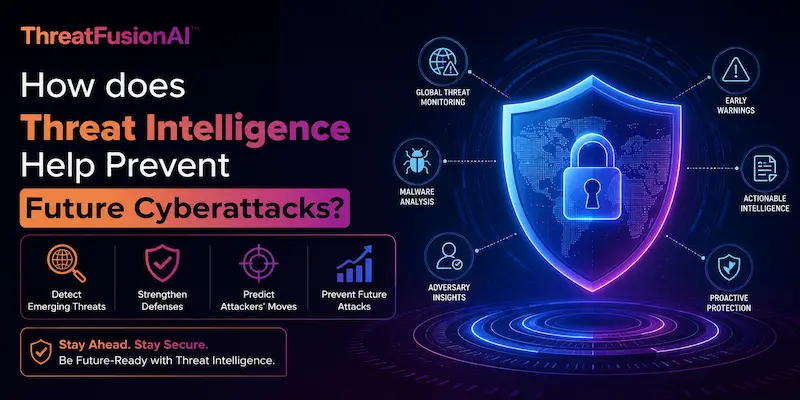
How does Threat Intelligence Help Prevent Future Cyberattacks?
Threat intelligence helps prevent future cyberattacks in the following ways:
1. Proactive Vulnerability Patching: Emphasizes the vulnerabilities that are being exploited on a global scale, allowing teams to prioritize the patching of critical gaps.
2. Predictive Attacker Profiling: By examining present trends, incentives, and sectors preferred by threat actors, it predicts future objectives and approaches.
3. Dynamic Rule Optimization: Constantly refreshes the detection and firewall rules to prevent developing assault strategies from reaching the network.
4. Targeted Threat Hunting: Employs recognized assailant markers to probe internal systems for concealed dangers that evaded primary protections.
5. Informed Security Architecture Strategy: Long-term security investments are guided by actual threat landscapes instead of generic speculation.
Best Practices for Integrating Threat Intelligence into Incident Response
|
S.No. |
Factors |
What? |
|
1. |
Automate Ingestion and Orchestration |
Incorporate threat feeds directly into your SOAR and SIEM tools to immediately block and parse known indicators without manual delays. |
|
2. |
Prioritize Feed Quality and Relevance |
Concentrate on well-selected, industry-specific intelligence sources instead of inundating analysts with generic threat lists that lack specificity. |
|
3. |
Establish a Continuous Feedback Loop |
Enhance your own intelligence repositories with raw data, indicators, and insights from resolved internal incidents. |
|
4. |
Train Analysts on Tactical Interpretation |
Train your response team on how to shift from fundamental technical indicators to comprehending the behaviors and playbooks of threat actors. |
|
5. |
Standardize on Common Taxonomies |
Utilize standardized frameworks such as STIX/TAXII and MITRE ATT&CK to guarantee uniform communication among all security tools and teams. |
Common Challenges of Using Threat Intelligence in Incident Response
The following are some common challenges of using threat intelligence in incident response:
● Information Overload and Alert Fatigue: Flood security teams with a vast amount of unprioritized threat data, resulting in essential alerts being overlooked amidst the chaos.
● Lack of Actionable Context: Provides raw indicators of compromise, lacking the essential operational details that analysts require for prompt remediation decisions.
● Data Quality and Stale Intelligence: Depend on threat feeds that are poorly vetted or outdated, resulting in high false positive rates and disruption of business operations.
● Integration and Tool Proliferation Issues: Has difficulties in synchronizing various intelligence formats across fragmented security tools, resulting in operational silos and the need for manual workarounds.
● The Cyber Skills and Expertise Gap: Needs specialized analyst training to convert complex threat actor profiles and raw metadata into effective response strategies.
Real-World Examples of Threat Intelligence in Incident Response
The following are some real-world examples of threat intelligence in incident response:
a) Containing the WannaCry Ransomware Spread (2017): Analysts found a hardcoded domain for a "kill switch" in the malware, which stopped global infections overnight.
b) Defending Financial Institutions Against Targeted APT Campaigns: Before a planned heist, banks utilized shared dark web intelligence to prevent access from specific nation-state IP pools.
c) Neutralizing Advanced Supply Chain Compromises: Security teams utilized indicators from the SolarWinds breach to swiftly eliminate backdoored code from enterprise systems.
Future Trends in Threat Intelligence and Incident Response
|
S.No. |
Trends |
What? |
|
1. |
Rise of Agentic and Autonomous AI Defenses |
Utilizes self-governing AI systems to counter automated, machine-speed attacks without human intervention. |
|
2. |
Shift toward Continuous Exposure Management |
Substitutes periodic vulnerability scans with real-time mapping of expanding attack surfaces across multiple clouds. |
|
3. |
Identity-First Detection and Zero Trust Integration |
Continuously monitor behavior-based sessions to treat user credentials as the main firewall. |
|
4. |
Business-Impact Metrics Over Alert Volume |
Gives priority to response workflows according to financial risk and operational continuity, rather than the overall number of incidents. |
|
5. |
Quantum Readiness and Cryptographic Planning |
Enhance the current data encryption layers to meet post-quantum standards prior to the obsolescence of legacy cryptographic models. |
Conclusion
Now that we have talked about what Threat Intelligence is in Cybersecurity, you might want to get your hands on a dedicated threat intelligence solution. For that, you can go for Threat Fusion AI, a dedicated threat intelligence platform offered by Craw Security.
Threat Fusion AI can help users to automatically detect suspicious threats and can help with getting updated on the latest cyber threats. Thus, you can feel safer while working in your work environment. What are you waiting for? Contact, Now!
Frequently Asked Questions
About Threat Intelligence in Cybersecurity
1. What is threat intelligence in cybersecurity?
In the field of cybersecurity, threat intelligence refers to analyzed information that sheds light on an attacker’s motivations, targets, and actions, with the aim of anticipating and preventing cyberthreats.
2. Why is threat intelligence important for incident response?
Threat intelligence is important for incident response for the following reasons:
a) Accelerates Threat Detection,
b) Reduces Investigation Time,
c) Informs Precise Containment,
d) Enables Proactive Threat Hunting, and
e) Optimizes Resource Allocation.
3. How does threat intelligence improve incident detection?
Threat intelligence improves incident detection in the following ways:
a) Flags Known Malicious Indicators,
b) Exposes Attacker Tactics and Behaviors,
c) Reduces Alert Fatigue,
d) Correlates Disconnected Events, and
e) Enhances Signature-Based Defenses.
4. What are the different types of threat intelligence?
The following are the different types of threat intelligence:
a) Strategic Threat Intelligence,
b) Tactical Threat Intelligence,
c) Operational Threat Intelligence, and
d) Technical Threat Intelligence.
5. How does threat intelligence help security teams investigate cyber incidents?
Threat intelligence helps security teams investigate cyber incidents in the following ways:
a) Instantly Contextualizes Alerts,
b) Eliminates Dead-End Leads,
c) Maps the Full Attack Footprint,
d) Uncovers Attacker Infrastructure, and
e) Provides Ready-Made Response Playbooks.
6. Which tools are commonly used for threat intelligence in incident response?
The following tools are commonly used for threat intelligence in incident response:
a) Threat Intelligence Platforms (TIPs),
b) Open-Source Sharing Communities (MISP),
c) Endpoint Detection and XDR Ecosystems,
d) Global Repository and Sandbox Tools, and
e) Security Orchestration (SOAR) Integration Modules.
7. How can organizations integrate threat intelligence into their incident response process?
Organizations can integrate threat intelligence into their incident response process in the following ways:
a) Automate Ingestion via SIEM and SOAR,
b) Embed Intelligence into IR Playbooks,
c) Establish a Continuous Feedback Loop,
d) Prioritize Feed Relevance and Curation, and
e) Standardize on Unified Taxonomies.
8. What are the biggest challenges of using threat intelligence effectively?
The following are the biggest challenges of using threat intelligence effectively:
a) Information Overload and Alert Fatigue,
b) Lack of Actionable Context,
c) Data Degradation and Stale Intelligence,
d) Integration and Tool Interoperability Barriers, and
e) The Cyber Skills and Analytical Expertise Gap.
9. How does threat intelligence help prevent future cyberattacks?
Threat intelligence helps prevent future cyberattacks in the following ways:
a) Drives Risk-Based Vulnerability Management,
b) Enables Proactive Threat Hunting,
c) Optimizes Dynamic Security Controls,
d) Constructs Predictive Attacker Profiles, and
e) Shapes Long-Term Security Strategy.
10. What are the best practices for implementing threat intelligence in incident response?
The following are the best practices for implementing threat intelligence in incident response:
a) Centralize and Align Telemetry,
b) Embed Actor Behavior (TTPs) Directly into Playbooks,
c) Automate Enrichment for Immediate Triage,
d) Fuel Proactive Threat Hunting, and
e) Close the Loop with Post-Incident Lessons.