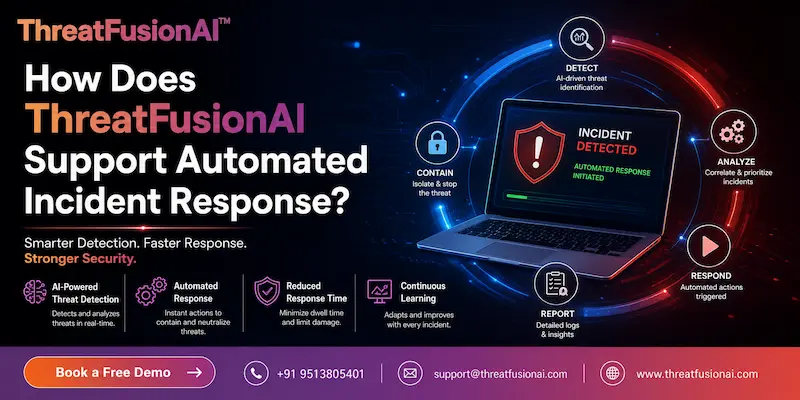
Do you know how amazing the ThreatFusionAI platform is for users working in the IT Industry while being piled up with a huge amount of datasets? If not, then you are at the right place. Here, we will talk about what ThreatFusionAI is and its related features in detail.
Moreover, we will discuss why ThreatFusionAI can be a trustworthy threat intel platform for users. What are we waiting for? Let’s get straight to the topic!
What Is ThreatFusionAI?
ThreatFusionAI is a platform for unified threat intelligence and cyber defense that is powered by AI. It was created to gather, correlate, and analyze threat data from multiple sources in real time.
It aids organizations in charting campaign risks and overseeing covert operations such as data leaks by combining behavioral analytics and machine learning with integrated SIEM, SOAR, and XDR functionalities.
In the end, the platform enables security operations center (SOC) teams to isolate endpoints, block malicious indicators, and automate incident response workflows with remarkable speed. Let’s take a look at what ThreatFusionAI is, its uses, its features, and its benefits for organizations working in the IT Industry!
What Is Automated Incident Response in Cybersecurity?
In the field of cybersecurity, automated incident response refers to a technology-based method that employs software workflows and playbook automation to immediately identify, contain, and reduce digital threats without the need for manual human involvement.
It dramatically reduces cyber damage and minimizes the window of opportunity for attackers by instantly carrying out pre-defined actions like blocking malicious IP addresses or quarantining infected endpoints.
Why Is ThreatFusionAI Important for Modern Cybersecurity?
|
S.No. |
Factors |
Why? |
|
1. |
Accelerated Incident Response |
Reduces containment time to mere milliseconds through the immediate execution of automated SOAR playbooks. |
|
2. |
Proactive Threat Prevention |
Monitor developing dark web activities and phishing operations to prevent breaches by obstructing harmful infrastructure in advance. |
|
3. |
Reduced Operational Noise |
Utilizes cross-platform behavioral correlation to remove false alerts and identify high-priority signals. |
|
4. |
Enhanced Visibility and Intelligence |
Provides complete clarity by integrating real-time global telemetry with unified XDR and SIEM data streams. |
|
5. |
Automated Security Orchestration |
Facilitates operations through the use of pre-configured playbooks that effortlessly update firewalls and isolate compromised hosts. |
How Does ThreatFusionAI Automate Incident Detection and Response?
ThreatFusionAI automates incident detection and response in the following ways:
1. Multi-Source Data Ingestion: Consolidates telemetry from endpoints, cloud environments, network logs, and dark web feeds into one platform.
2. AI-Driven Behavioral Correlation: Utilizes machine learning to consolidate distinct, minor anomalies into a coherent and identifiable attack timeline.
3. Intelligent Noise Reduction: Consolidates hundreds of fragmented alerts into a single, high-fidelity security incident to reduce alert fatigue.
4. SOAR-Ready Playbook Orchestration: Immediately activates pre-set digital response scripts when a high-risk threat fingerprint is confirmed.
5. Automated Containment and Remediation: Implements proactive measures such as isolating affected hosts, canceling user access, and preventing harmful IPs from connecting immediately.
How Does ThreatFusionAI Use AI and Machine Learning to Accelerate Response?
ThreatFusionAI uses AI and ML to accelerate in the following ways:
● Real-Time Behavioral Layering & Anomaly Detection: Establishes normal asset baselines through benchmarks to immediately identify and mark deviations such as unauthorized data shifts.
● Cross-Platform Multi-Signal Correlation: Chains combines network, cloud, and endpoint events into a cohesive, traceable attack narrative.
● Intelligent Risk Scoring and Prioritization: Scores incidents based on threat severity and asset value to emphasize the most critical risks.
● Dark Web and OSINT Predictive Intel: Reviews underground forums and open-source data to proactively prevent the establishment of emerging malicious infrastructure.
● Autonomous SOAR Playbook Execution: Instantaneously activates defensive scripts that have already been validated in order to address network threats that have been validated, all without any delays attributable to human involvement.
Key Features of ThreatFusionAI for Automated Incident Response
|
S.No. |
Factors |
What? |
|
1. |
Automated Threat Detection and Real-Time Alert Prioritization |
Score alerts based on severity to quickly identify high-risk threats. |
|
2. |
Intelligent Threat Correlation Across Multiple Security Sources |
Chains integrated fragmented telemetry from the cloud, network, and endpoints into a single timeline. |
|
3. |
Automated Incident Investigation and Root Cause Analysis |
Identifies sources of attacks and charts lateral movements without the need for manual queries. |
|
4. |
Automated Containment and Remediation with ThreatFusionAI |
In milliseconds, it isolates hosts, revokes access, and blocks malicious IPs. |
How does ThreatFusionAI reduce Mean Time to Detect (MTTD) and Mean Time to Respond (MTTR)?
ThreatFusionAI reduces MTTD and MTTR in the following ways:
a) Instant Multi-Signal Analytics (Lowers MTTD): Examines telemetry from various sources in real time to reveal concealed signs of compromise immediately.
b) Intelligent False-Positive Filtering (Lowers MTTD): Utilizes AI baseline tracking to remove noise and instantly pinpoint high-fidelity security alerts.
c) Automated Root Cause Mapping (Lowers MTTR): Immediately maps lateral movements and traces attack paths, eliminating the necessity for manual investigation.
d) Autonomous Playbook Execution (Lowers MTTR): Initiates host isolation and other machine-speed containment measures to halt ongoing threats immediately, without human delay.
e) Proactive Threat Intelligence Feed Integration (Lowers MTTD): Synchronizes dark web and OSINT feeds to identify and prevent harmful infrastructure before attacks occur.
Why Should Organizations Choose ThreatFusionAI for Automated Incident Response?
Organizations should choose ThreatFusionAI for automated incident response for the following reasons:
1. Lightning-Fast Sub-Second Response: In milliseconds, it initiates self-governing containment measures to secure against threats before their propagation throughout the network.
2. Deep Phishing & Data Leak Intelligence: Surveys the dark web and underground forums to detect exposed credentials and harmful infrastructure at an early stage.
3. Unified Fusion Workflows: Integrates threat feeds, telemetry, SIEM, and SOAR into a single centralized security framework to streamline operations.
4. Real-Time Operational Clarity: Utilizes AI behavioral correlation to reduce alert noise and emphasize crucial, high-fidelity security incidents.
5. Proven Enterprise Trust & Scaling: Handles tens of millions of threats each day for a vast global clientele across various sectors.
Best Practices for Implementing ThreatFusionAI in Your Security Environment
|
S.No. |
Factors |
What? |
|
1. |
Establish Comprehensive Telemetry Ingestion |
To eliminate visibility gaps, centralize telemetry from cloud sources, endpoints, and identity providers into the platform. |
|
2. |
Integrate Real-Time Intelligence Feeds |
Synchronize worldwide open-source and dark web threat feeds to proactively identify emerging signs of compromise. |
|
3. |
Map Detections to the MITRE ATT&CK Framework |
Link automated alerts to known attacker techniques to immediately clarify the threat context and severity. |
|
4. |
Deploy Phased SOAR Playbooks |
Start with passive alerting, then move on to automated remediation scripts such as network containment and asset isolation. |
|
5. |
Tune AI Risk Scoring and Baselining |
To enhance detection precision and reduce false positives, update behavioral profiles and values of business assets on a regular basis. |
Conclusion: Strengthen Cyber Resilience with ThreatFusionAI Automation
Now that we have talked about what ThreatFusionAI is, you might want to get your hands on a dedicated threat intel solution from a reliable source. For that, you can go for ThreatFusionAI, a dedicated threat intelligence platform offered by Craw Security.
ThreatFusionAI is a customized high-tech AI-based threat intel tool that not only detects suspicious unauthorized attempts but also notifies users about the current cyber threats running wild in the IT Industry. What are you waiting for? Contact, Now!
Frequently Asked Questions
About ThreatFusionAI
1. What is ThreatFusionAI?
ThreatFusionAI is a comprehensive cyber defense platform powered by AI. It combines real-time threat intelligence with automated SIEM, SOAR, and XDR functionalities to promptly identify, correlate, and manage network security incidents.
2. How does ThreatFusionAI support automated incident response?
ThreatFusionAI supports automated incident response in the following ways:
a) Unified Telemetry Fusion,
b) AI-Driven Anomaly Detection,
c) Intelligent Noise Reduction,
d) SOAR Playbook Execution, and
e) Instant Machine-Speed Containment.
3. How does ThreatFusionAI detect cyber threats in real time?
ThreatFusionAI detects cyber threats in real time in the following ways:
a) Continuous Multi-Source Telemetry Fusion,
b) Real-Time Global IOC Enrichment,
c) Dark Web and Underground Signal Matching,
d) AI-Driven Behavioral Layering, and
e) Intelligent Cross-Platform Correlation.
4. Can ThreatFusionAI integrate with SIEM, SOAR, EDR, and XDR platforms?
Yes, ThreatFusionAI seamlessly integrates with SIEM, SOAR, EDR, and XDR platforms through open APIs and built-in connectors, providing actionable threat intelligence directly to your existing security stack.
5. How does AI improve incident response in ThreatFusionAI?
AI improves incident response in ThreatFusionAI in the following ways:
a) Multi-Signal Alert Correlation,
b) Intelligent False-Positive Reduction,
c) Predictive Dark Web Intelligence Enrichment,
d) Automated Risk Quantification & Prioritization, and
e) Autonomous Machine-Speed Playbook Execution.
6. What types of cyber threats can ThreatFusionAI identify and respond to?
ThreatFusionAI can identify and respond to the following types of cyber threats:
a) Phishing Scams and Domain Spoofing,
b) Data Breaches and Leaked Credentials,
c) Malware Deployments and Exploit Activity,
d) Advanced Persistent Threats (APTs) and Anomaly Attacks, and
e) Credential Stuffing and Identity Fraud.
7. How does ThreatFusionAI reduce Mean Time to Detect (MTTD) and Mean Time to Respond (MTTR)?
ThreatFusionAI lowers MTTD through AI behavioral detection and global telemetry fusion that eliminate noise and identify anomalies in approximately 10 milliseconds, and it reduces MTTR via automated SOAR playbooks that implement machine-speed containment measures such as endpoint isolation without human delay.
8. Is ThreatFusionAI suitable for small and medium-sized businesses?
Yes, ThreatFusionAI is an excellent fit for small and medium-sized businesses because of its scalable and cost-effective pricing options (ranging from a free tier to dedicated business plans) and its automated incident response capabilities, which serve as a 24/7 virtual security operations center for teams with limited internal IT resources.
9. What are the key benefits of using ThreatFusionAI for Security Operations Centers (SOCs)?
The following are the key benefits of using ThreatFusionAI for SOCs:
a) Massive Reduction in Alert Fatigue,
b) Preemptive Threat Visibility,
c) Unified Security Fabric Architecture,
d) Sub-Second Automated Containment, and
e) Board-Ready Risk Quantification.
10. Why should organizations choose ThreatFusionAI for automated incident response?
Organizations should choose ThreatFusionAI for automated incident response for the following reasons:
a) Lightning-Fast Sub-Second Response,
b) Massive Noise Reduction,
c) Deep Phishing & Data Leak Insights,
d) Autonomous SOAR Containment, and
e) Proactive Global Intelligence.