Do you know what Real-Time Threat Intelligence is, its uses, and how organizations can benefit from it professionally? If not, then you are at the right place. Here, we will talk about real-time threat intelligence and related uses in the IT Industry.
Moreover, we will introduce you to a reliable threat intelligence solution offered by a reputable VAPT service provider. What are we waiting for? Let’s get started!
What Is Real-Time Threat Intelligence?
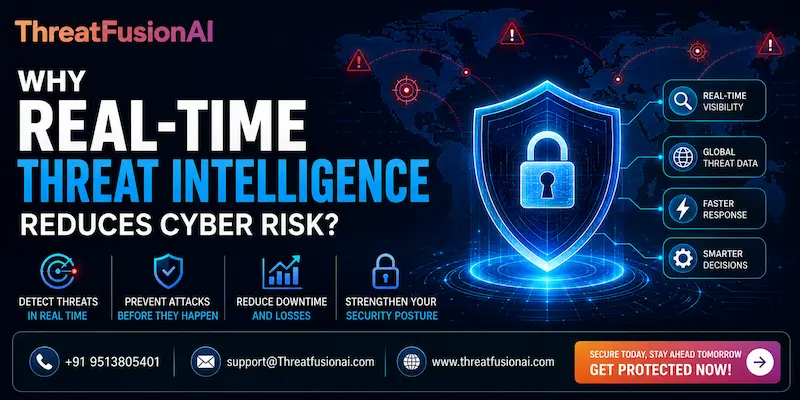
The ongoing gathering, processing, and sharing of real-time data about new cyberthreats and malicious activity as they occur is known as real-time threat intelligence. It enables businesses to automate defenses and stop assaults before they can penetrate the network by giving security professionals quick, useful data into hacker infrastructure, active malware campaigns, and zero-day vulnerabilities.
It significantly reduces an attacker's window of opportunity by moving cybersecurity from a reactive posture to a proactive, instantaneous defense. Let’s take a look at what Real-Time Threat Intelligence is and how it benefits organizations!
Why Traditional Threat Detection Is No Longer Enough?
|
S.No. |
Factors |
Why? |
|
1. |
Relies on Static, Reactive Signatures |
Systems are totally blind to new, zero-day assaults since legacy tools only detect known threats. |
|
2. |
Overwhelmed by Advanced Polymorphic Malware |
Modern dangerous code is able to readily evade conventional, static file scanners because it continuously modifies its structure. |
|
3. |
Fails against Fileless and Identity-Based Attacks |
Instead of dumping unique files that conventional antivirus searches for, attackers utilize stolen credentials and reliable, built-in system utilities. |
|
4. |
Lacks Context and Creates Alert Fatigue |
Outdated technologies bombard security teams with thousands of discrete alerts without revealing the bigger, interconnected assault scenario. |
|
5. |
Incapable of Handling Cloud-Scale Infrastructure |
The enormous volume, speed, and decentralized structure of contemporary cloud networks are too much for legacy perimeter defenses to handle. |
How Real-Time Threat Intelligence Works?
Real-time threat intelligence works in the following ways:
1. Continuous Data Collection: Security tools continuously gather telemetry, dark web activities, and real-time worldwide threat feeds.
2. Automated Processing and Normalization: For machine analysis, raw security data is immediately cleansed and organized in a consistent manner.
3. Contextual Analysis and Enriched Insights: AI models identify real, high-priority threats by comparing incoming data with past attack patterns.
4. Instantaneous Alerting and Integration: Through APIs, verified threat data is immediately and human-free piped into SIEM and SOAR systems.
5. Proactive Defenses and Automated Takedowns: Live updates are used by firewalls and endpoint solutions to automatically stop rogue infrastructure and prevent malicious IPs.
Key Components of an Effective Threat Intelligence Program
The following are the key components of an effective threat intelligence program:
● Comprehensive Data Feeds: Combines a variety of data from multiple sources, including commercial feeds, dark web monitoring, and open-source intelligence.
● Automated Processing and Correlation: Removes noise and false positives by quickly cleaning and cross-referencing enormous amounts of raw data.
● Contextual Human Analysis: Uses knowledgeable security analysts to decipher complicated data, determine the motivations of attackers, and forecast future patterns.
● Seamless Tool Integration: Uses automated APIs to provide actionable threat data straight into current firewalls, EDR, and SIEM systems.
● Actionable Feedback Loops: Improve future detection rules by continuously improving the algorithm by learning from incident response outcomes.
How does Real-Time Threat Intelligence Reduce Cyber Risk?
|
S.No. |
Factors |
How? |
|
1. |
Drastically Minimizes Attacker Dwell Time |
Stops lateral movement before damage spreads by instantly alerting security professionals to active network attacks. |
|
2. |
Enables Proactive Preemptive Blocking |
Automatically updates endpoint security tools and firewalls to stop known harmful infrastructure before an attack occurs. |
|
3. |
Transforms Vulnerability Management |
Helps teams prioritize high-risk updates by identifying software vulnerabilities that are being actively exploited in the field. |
|
4. |
Reduces Costly False Positives |
Filters and contextualizes signals so that analysts only pay attention to real, validated cyberthreats rather than benign network noise. |
|
5. |
Mitigates Supply Chain and Brand Risk |
Keeps an eye on external digital ecosystems and the dark web to quickly identify third-party breaches or compromised company credentials. |
Top Benefits of Real-Time Threat Intelligence for Organizations
The following are the top benefits of real-time threat intelligence for organizations:
a) Accelerated Incident Response: Provides instantaneous, useful information during an active attack, reducing containment time from days to seconds.
b) Proactive Security Posture: Preventively blocking harmful infrastructure before it reaches the network replaces the previous approach of responding to intrusions.
c) Optimized Security Operations (SecOps): Eliminates expensive false positives and significantly lowers analyst burnout by automating regular alert triage.
d) Strategic Vulnerability Prioritization: Identifies the software vulnerabilities that are being actively exploited in the wild and instructs IT on what should be patched first.
e) Informed Executive Decision-Making: Converts unprocessed technical data into understandable, risk-based insights to support leadership in meeting compliance requirements and defending security investments.
Common Challenges in Implementing Real-Time Threat Intelligence
The following are some common challenges in implementing real-time threat intelligence:
1. Overwhelming Volume of Data (Alert Fatigue): Covers important risks in a sea of noise by overwhelming security workers with a regular barrage of alerts.
2. High Cost of Premium Tools and Feeds: Requires large sums of money for infrastructure upgrades, specific software licenses, and subscription feeds.
3. Integration with Legacy Infrastructure: Causes significant friction when attempting to feed high-speed, contemporary API threat data into antiquated security solutions.
4. Lack of Contextual and Actionable Data: Delivers raw indication lists without the important context needed to comprehend how or why a threat matters.
5. Shortage of Skilled Cybersecurity Personnel: Need highly skilled analysts, a labor pool that is currently in short supply, to evaluate complicated threat telemetry.
Best Practices for Maximizing the Value of Threat Intelligence
|
S.No. |
Factors |
What? |
|
1. |
Align Intelligence with Specific Business Risks |
Directly map incoming threat feeds to the industry, location, and vital digital assets of your company. |
|
2. |
Automate Ingestion and Response Pipelines |
When harmful signs are detected, use SOAR platforms to automatically stop them without the need for human interaction. |
|
3. |
Focus on Context Over Raw Volume |
Instead of gathering millions of pointless, raw IP addresses, give priority to enriched threat data that clarifies attacker motivations and tactics. |
|
4. |
Foster Continuous Cross-Department Collaboration |
To create a cohesive defensive plan, executive teams, IT operations, and security should share intelligence insights. |
|
5. |
Regularly Audit and Prune Feed Sources |
Continually assess your threat intelligence providers to eliminate high-noise or redundant data streams that lead to false positives. |
Choosing the Right Real-Time Threat Intelligence Platform
You can choose the right real-time threat intelligence platform:
● Evaluate Integration and Interoperability: Make sure the platform has reliable, fast APIs to integrate natively with your current SIEM, SOAR, and EDR solutions.
● Assess Contextual Enrichment and Accuracy: Select a solution that offers low false-positive rates, behavioral analysis, and deep context in addition to raw data.
● Prioritize Real-Time Automation and Prioritization: Seek out automated scoring tools that can quickly identify and prioritize the most serious risks to your network.
● Verify Data Diversity and Industry Relevance: Verify that the vendor monitors risks unique to your industry sector, operational infrastructure, and unique geographic region.
● Look for Scalability and Strategic Visualizations: Choose a platform that converts technical metrics into understandable executive dashboards and grows with your cloud.
Future Trends in Real-Time Cyber Threat Intelligence
The following are the future trends in real-time cyber threat intelligence:
a) Hyper-Automation via GenAI: AI agents will create containment playbooks and defense rules in real time.
b) Predictive Defense: Before assaults are initiated, machine learning will predict the targets of hackers.
c) Decentralized Sharing: Businesses will be able to rapidly share anonymous danger data thanks to blockchain-style networks.
d) Zero Trust Integration: Live threat feeds will dynamically ban or enable user access on the fly.
e) Edge & Quantum Focus: To combat quantum-era decryption, threat analysis will go to local edge devices.
Conclusion: Why Real-Time Threat Intelligence Is Essential for Modern Cybersecurity?
Now that we have talked about what Real-Time Threat Intelligence is, you might want to get your hands on a dedicated threat intel solution. For that, you can go for Threat Fusion AI, a dedicated threat intelligence platform offered by Craw Security.
Threat Fusion AI can help organizations by giving intel about the latest cyber threats in advance so that they can plan for dealing with future threats. Thus, you will be able to feel at ease while working online or sharing your data online. What are you waiting for? Contact, Now!
Frequently Asked Questions
About Real-Time Threat Intelligence
1. What is real-time threat intelligence in cybersecurity?
The continuous, automatic gathering and analysis of real-time data to detect and stop cyberthreats as they arise is known as real-time threat intelligence.
2. How does real-time threat intelligence reduce cyber risk?
Real-time threat intelligence reduces cyber risk in the following ways:
a) Cuts Attacker Dwell Time,
b) Enables Preemptive Blocking,
c) Prioritizes Vulnerability Patching,
d) Eliminates Alert Fatigue, and
e) Exposes Supply Chain Risks.
3. What is the difference between real-time and traditional threat intelligence?
Real-time threat intelligence continuously analyzes live data to quickly identify and stop active, emergent threats, whereas traditional threat intelligence uses static, historical data to evaluate prior attacks.
4. Which industries benefit the most from real-time threat intelligence?
The following industries benefit the most from real-time threat intelligence:
a) Financial Services & Banking,
b) Healthcare & Life Sciences,
c) Critical Infrastructure & Energy (OT),
d) Government & Defense Sectors, and
e) E-Commerce & Retail.
5. Can small businesses use real-time threat intelligence solutions?
Yes, small firms can employ real-time threat intelligence without hiring a professional security team by implementing inexpensive, automated cloud security products (such as managed EDR or open-source feeds).
6. How does threat intelligence help prevent ransomware attacks?
Threat intelligence helps prevent ransomware attacks in the following ways:
a) Blocks Known Ransomware Domains,
b) Flags Initial Access Vectors,
c) Detects Early Lateral Movement,
d) Prioritizes Urgent Patches, and
e) Provides Actionable Playbooks.
7. What tools are commonly integrated with threat intelligence platforms?
The following tools are commonly integrated with threat intelligence platforms:
a) SIEM (Security Information and Event Management),
b) SOAR (Security Orchestration, Automation, and Response),
c) EDR/XDR (Endpoint Detection and Response),
d) Next-Generation Firewalls (NGFW) & Secure Web Gateways, and
e) Vulnerability Management Tools.
8. How often should threat intelligence feeds be updated?
To successfully stop quickly evolving cyberthreats, threat information streams should be updated continually and in real time, usually every few minutes or seconds.
9. What challenges do organizations face when implementing threat intelligence?
Organizations face the following challenges when implementing threat intelligence:
a) Overwhelming Alert Fatigue,
b) High Operational Costs,
c) Legacy System Integration,
d) Lack of Contextual Relevance, and
e) Severe Cybersecurity Talent Shortage.
10. How can businesses choose the best real-time threat intelligence platform?
Businesses chose the best real-time threat intelligence platform in the following ways:
a) Verify Seamless Integrations,
b) Prioritize Context Over Raw Volume,
c) Insist on Automated Scoring & Triage,
d) Match Data to Your Organization's Footprint, and
e) Demand Actionable Remediation Guidance.