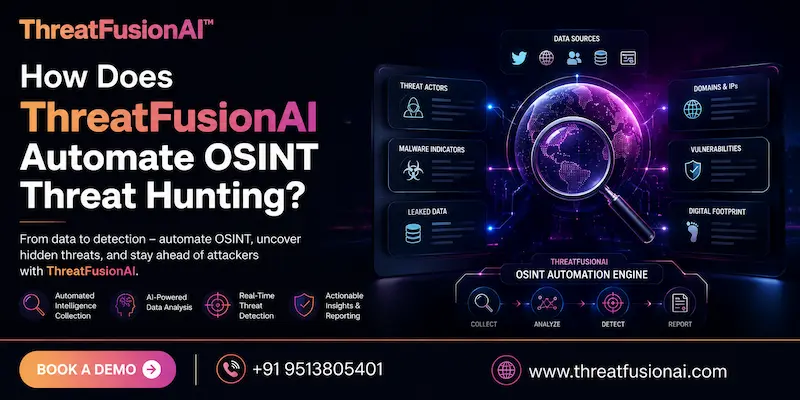
Do you know what ThreatFusionAI is and how it can help organizations to deal with future cybersecurity threats in the IT Industry? If not, then you are at the right place. Here, we will explore how ThreatFusionAI works and related benefits for organizations in detail.
Moreover, we will introduce you to the reliable service provider for this amazing threat intel tool offered to various organizations.
What is Automated OSINT Threat Hunting?
The process of continuously scanning, gathering, and analyzing publicly available intelligence throughout the open, deep, and dark web for possible security threats using artificial intelligence and software scripts is known as automated OSINT threat hunting.
Automated systems gather enormous volumes of data, including compromised credentials, compromised data, and malicious infrastructure, in real time to identify new threats before they happen, replacing the need for analysts to manually search for threat information.
Security teams are able to proactively block threats and fortify their organization's digital footprint as a result of the significant reduction in response times and elimination of manual labor. Let’s take a look at what ThreatFusionAI is and how it helps organizations against online threats!
Why Do Organizations Need Automated OSINT Monitoring?
Organizations need automated OSINT monitoring for the following reasons:
1. Proactive Threat Detection: Finds hostile infrastructure, exposed credentials, and new external threats before an attack takes place.
2. Elimination of Security Blind Spots: Finds latent vulnerabilities beyond typical network perimeters by continuously scanning the open, deep, and black web.
3. Drastic Reduction in Response Time: Converts hours of manual searching into quick action by instantly aggregating and flagging critical intelligence.
4. Alleviation of Analyst Burnout: Enables security teams to concentrate on critical strategic protection by automating time-consuming data collection and triage.
5. Enhanced Incident Response Context: Automatically adds useful background information to unprocessed threat data to speed up well-informed decision-making.
What Is ThreatFusionAI?
ThreatFusionAI is an AI-driven threat intelligence platform that automatically gathers, correlates, and evaluates data from dark web sources, network logs, and international OSINT feeds. In order to assist enterprises in proactively identifying and eliminating cyber threats in real time, it continuously converts raw danger indicators, such as malicious IPs, exposed passwords, and suspicious domains, into actionable intelligence.
How ThreatFusionAI Collects OSINT Data from Multiple Sources?
|
S.No. |
Factors |
How? |
|
1. |
Automated Web Scraping and API Crawling |
Extracts data from code repositories, paste bins, and public websites using intelligent bots and APIs. |
|
2. |
Dark Web and Underground Forum Monitoring |
Finds leaked credentials and specific exploits by scanning encrypted channels and illegal marketplaces. |
|
3. |
Global Feed Aggregation |
Gathers and aggregates raw threat information from hundreds of government, open-source, and commercial intelligence streams. |
|
4. |
Active Surface Scanning & Sensor Networks |
Maps vulnerable assets and monitors questionable infrastructure in real time across international networks. |
|
5. |
AI-Powered Data Parsing & Triangulation |
Highlights important risks by automatically cleaning, classifying, and correlating unstructured data. |
Brand Monitoring and Digital Footprint Protection
Brand Monitoring and Digital Footprint Protection continuously analyzes an organization’s external internet presence to discover unauthorized domain spoofing, social media impersonation, and exposed digital assets.
It protects brand reputation and stops adversaries from taking advantage of exposed perimeter entry points by early detection of corporate vulnerabilities and phishing campaigns throughout the open and deep web.
ThreatFusionAI's IOC Enrichment and Investigation Capabilities
The following are ThreatFusionAI’s IOC enrichment and investigation capabilities:
● Real-Time Context Enrichment: Instantly connects geolocation, domain age, malware affiliation, and threat actor history to raw signs of compromise.
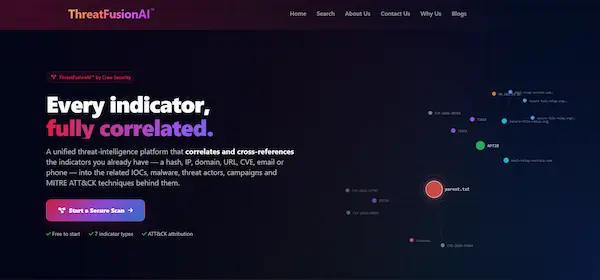
● Interactive Cross-Referencing & Pivoting: Allows security experts to visually map and traverse relationships between connected IPs, hashes, domains, and infrastructure.
● MITRE ATT&CK Mapping: Automatically matches identified IOCs with known adversary tactics, strategies, and procedures to elucidate attack approach.
● Multi-Signal Alert Correlation: Connects isolated indications across several data streams to eliminate false positives and reveal complicated attack strategies.
● Automated Root Cause Analysis: Traces IOCs back to their initial entry point and vector to speed containment and long-term cleanup.
Architectural Workflow of ThreatFusionAI
ThreatFusionAI's architecture operates an end-to-end pipeline that continually ingests raw threat indicators from multi-source OSINT, telemetry, and dark web feeds, then standardizes and enriches them with sandbox judgments and risk scores.
It then indexes these assets using a multi-signal correlation engine to map relationships, match strategies with the MITRE ATT&CK paradigm, and deliver actionable insights directly to SOAR playbooks for automated protection.
Integrating ThreatFusionAI with Existing Security Infrastructure
ThreatFusionAI effortlessly interfaces with existing SIEM, SOAR, EDR, and firewall stacks with native REST APIs and standardized STIX/TAXII feeds. This bi-directional connectivity automatically sends high-fidelity, richer IOCs directly into active security workflows, triggering machine-speed automated containment playbooks and rapid perimeter blocking.
Real-World Use Cases and Defense Scenarios
The following are some real-world use cases and defense scenarios:
a) Early Phishing & Impersonation Takedowns: Identifies faked domains and false brand assets to take down phishing sites before launch.
b) Proactive Credential Exposure Containment: Instantly resets passwords by identifying hacked corporate logins on dark web marketplaces.
c) Automated Incident Response & Threat Hunting: Automatically isolates compromised endpoints and blocks malicious IPs by correlating wild IOCs with internal network data.
Key Benefits of Automating OSINT Threat Hunting with ThreatFusionAI
|
S.No. |
Benefits |
How? |
|
1. |
Real-Time Visibility Beyond the Perimeter |
Keeps an eye on unprotected attack surfaces, dark web leaks, and external digital assets. |
|
2. |
Massive Reduction in Alert Fatigue |
Only high-fidelity threats are revealed by automatically filtering noise and correlating multi-signal data. |
|
3. |
Faster Incident Detection and Containment |
Increases reaction times by initiating automated containment and quickly enhancing raw IOCs. |
|
4. |
Scalable and Cost-Effective Threat Coverage |
Substitutes continuous, machine-speed intelligence collection for labor-intensive human OSINT searches. |
|
5. |
Seamless Automation of Defense Workflows |
Provides rapid protection by directly feeding actionable intelligence into the current SIEM, SOAR, and EDR systems. |
Best Practices for Maximizing ThreatFusionAI's Effectiveness
The following are best practices for maximizing ThreatFusionAI’s effectiveness:
1. Fine-Tune Data Sources & Keyword Watchlists: To reduce noise and concentrate on pertinent threats, personalize brand phrases, asset listings, and OSINT feeds.
2. Integrate Bi-Directionally with SIEM & SOAR: Link APIs to initiate automated SOAR containment playbooks and send high-fidelity IOCs into active SIEM technologies.
3. Calibrate AI Risk-Scoring Thresholds: Reduce false positives by adjusting alert sensitivity settings to match your organization's risk tolerance.
4. Establish Continuous Feedback Loops for Machine Learning: To train algorithms and enhance threat triage in the future, give analysts regular feedback on alert accuracy.
5. Map External Intelligence to MITRE ATT&CK Frameworks: To swiftly comprehend adversary strategies and tactics, match identified external IOCs with internal threat models.
Future of AI-Driven OSINT Threat Hunting
Fully autonomous, predictive intelligence hubs that transition cybersecurity from reactive defense to proactive threat neutralization are the key to the future of AI-driven OSINT threat hunting.
Future systems will predict new adversary campaigns and automatically carry out machine-speed defense playbooks before attacks materialize by fusing generative NLP with multi-modal AI agents.
Conclusion
Now that we have talked about what ThreatFusionAI is, you might want to get your hands on it with reliable support from service providers. For that, you can get in contact with Craw Security, offering this amazing threat intel platform “ThreatFusionAI” to organizations.
ThreatFusionAI can help organizations to learn about the latest cyber threats, and that helps in improving security measures for future threats. What are you waiting for? Contact, Now!
Frequently Asked Questions
About ThreatFusionAI
1. What is OSINT threat hunting, and why is it important?
The proactive technique of examining open-source intelligence to identify new threats and weaknesses before adversaries can take advantage of them is known as OSINT threat hunting.
2. How does ThreatFusionAI automate OSINT threat hunting?
ThreatFusionAI automates OSINT threat hunting in the following ways:
a) Continuous Multi-Source Scraping,
b) Automated Data Enrichment,
c) Graph-Based Multi-Signal Correlation,
d) MITRE ATT&CK Behavioral Attribution, and
e) Instant Defensive Workflow Triggering.
3. Which OSINT sources does ThreatFusionAI monitor?
ThreatFusionAI monitors the following OSINT sources:
a) Global Threat & Commercial Intelligence Feeds,
b) Dark Web & Underground Markets,
c) Domain & DNS Registries,
d) File & Malware Analysis Repositories, and
e) Vulnerability & Exploit Databases.
4. Can ThreatFusionAI detect threats from the dark web?
In order to identify exposed credentials, compromised data, and new threats in real time, ThreatFusionAI does indeed actively scan dark web forums, marketplaces, breach dumps, and encrypted channels.
5. How does AI improve OSINT threat intelligence in ThreatFusionAI?
AI improves OSINT threat intelligence in ThreatFusionAI in the following ways:
a) Intelligent Unstructured Data Parsing,
b) Graph-Based Entity Correlation,
c) Rarity-Weighted ATT&CK Attribution,
d) Contextual Risk Scoring & Noise Reduction, and
e) Predictive Anomaly Detection.
6. Does ThreatFusionAI provide real-time threat alerts?
Yes, ThreatFusionAI continuously monitors global intelligence feeds, dark web signals, and multi-source telemetry to provide real-time threat warnings that rapidly alert security teams to important threats.
7. Can ThreatFusionAI integrate with SIEM and SOAR platforms?
Yes, ThreatFusionAI easily connects with SIEM and SOAR platforms through STIX/TAXII feeds and REST APIs to automate incident response playbooks, threat correlation, and real-time alert enrichment.
8. How does ThreatFusionAI prioritize high-risk cyber threats?
ThreatFusionAI prioritizes high-risk cyber threats in the following ways:
a) Multi-Engine Risk Scoring,
b) Rarity-Weighted ATT&CK Attribution,
c) Multi-Signal Contextual Correlation,
d) Impact & Critical Asset Mapping, and
e) Predictive Anomaly & Behavior Ranking.
9. Which industries can benefit most from ThreatFusionAI's OSINT automation?
The following industries can benefit most from ThreatFusionAI’s OSINT automation:
a) Financial Services & Banking,
b) Healthcare & Life Sciences,
c) Critical Infrastructure & Energy,
d) E-Commerce & Retail, and
e) Government & Defense.
10. What are the key advantages of using ThreatFusionAI over manual OSINT threat hunting?
The following are the key advantages of using ThreatFusionAI over manual OSINT threat hunting:
a) 24/7 Automated Processing Speed,
b) Automated Graph & Network Correlation,
c) Rarity-Weighted ATT&CK Attribution,
d) Drastic Reduction in Alert Fatigue, and
e) Direct Integration with Security Tools.