Do you know what DNS Threat Intelligence is and how it can help businesses to protect their data against online threats? If not, then you are at the right place. Here, we will talk about what DNS threat intelligence is and its related benefits in detail.
Moreover, we will introduce you to a reliable threat intelligence solution offered by a reputable VAPT service provider. What are we waiting for? Let’s get straight to the topic!
What Is DNS Threat Intelligence?
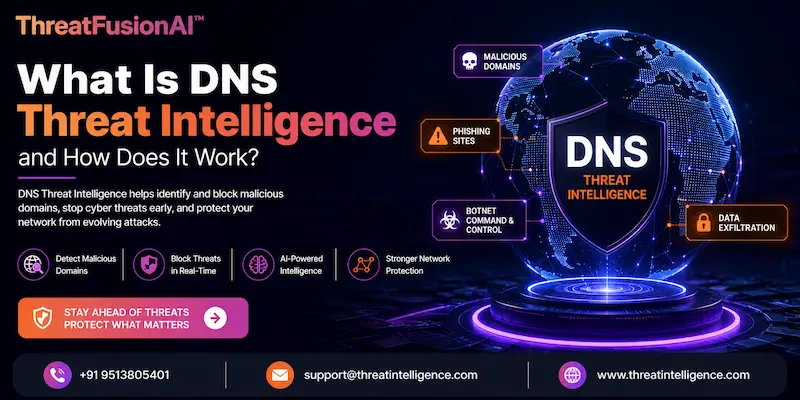
The process of gathering, evaluating, and using Domain Name System (DNS) data to find and stop harmful cyberthreats before they compromise a network is known as DNS Threat Intelligence.
It assists security teams in identifying covert operations such as phishing, malware communication, and ransomware infrastructure by keeping an eye on domain requests, IP addresses, and DNS traffic patterns.
By taking a proactive stance, companies may prevent cyberattacks at the fundamental protocol level before any damage is done. Let’s take a look at the roles of DNS Threat Intelligence, its features, and its benefits for organizations in the IT Industry!
Why Is DNS Threat Intelligence Important for Modern Cybersecurity?
DNS threat intelligence is important for modern cybersecurity for the following reasons:
1. Early-Stage Attack Detection: Prevents harmful payloads from ever reaching your network by blocking threats during domain resolution.
2. Neutralizes Command and Control (C2) Traffic: Cuts off communication between servers under the control of the attacker and compromised endpoints.
3. Visibility Across the Entire Network: Monitors all outgoing DNS traffic to keep track of all connected devices, even unmanaged IoT.
4. Proactive Defense over Reactive Patching: Stops active attacks at the protocol level without waiting for patches to software vulnerabilities.
5. Automated Response & SIEM/SOC Efficiency: Automatically filters out loud noise so security officers can concentrate on important alerts.
DNS Threat Intelligence vs Traditional Threat Intelligence
|
S.No. |
Topics |
Factors |
What? |
|
1. |
DNS Threat Intelligence |
Focuses at the Protocol Level |
Examines IP lookups and domain inquiries to prevent attacks before harmful traffic ever reaches your network. |
|
Covers Every Connected Endpoint |
Without the need for agents, it automatically monitors all outgoing DNS requests throughout the whole infrastructure, including unmanaged or Internet of Things devices. |
||
|
2. |
Traditional Threat Intelligence |
Focuses at the Endpoint & Network Level |
Examines post-connection signs following a threat's interaction with systems, such as file hashes, email headers, or endpoint behavior. |
|
Requires Deep System Access |
Largely relies on firewall logs, host agents, and intricate SIEM connections, which may leave unmonitored devices with blind spots. |
How Does DNS Threat Intelligence Work?
DNS threat intelligence works in the following ways:
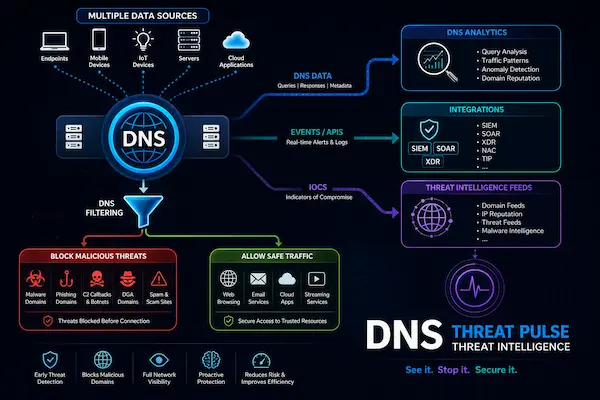
● Continuous DNS Data Collection: Collects real-time logs of IP resolutions, outgoing domain searches, and network traffic metadata.
● Correlation with Threat Feeds: Cross-references current DNS requests with international databases of IP addresses, rogue domains, and subpar infrastructure.
● Pattern & Behavioral Analysis: Uses machine learning to identify anomalies such as DNS tunneling, domain generation algorithms (DGA), and abrupt increases in query volume.
● Risk Scoring & Categorization: Gives detected domains a context term (such as phishing, malware, or ransomware) and a threat severity score.
● Automated Enforcement & Response: Instantly prevents dubious DNS resolutions at the resolver level and provides current security tools with actionable context.
Key Components of DNS Threat Intelligence
The following are some key components of DNS threat intelligence:
a) DNS Data Feeds: Provide real-time worldwide streams of known threat infrastructure, malicious IP addresses, and recently registered domains.
b) DNS Resolvers & Logging Engine: Intercept, process, and record all internal DNS queries and responses throughout the network in real time.
c) Analytics & Machine Learning Engine: Examines query patterns to find automated domain generation algorithms (DGAs), DNS tunneling, and hidden anomalies.
d) Threat Intelligence Platform (TIP) Integration: Automates site-wide incident response by seamlessly integrating DNS analytics with SIEM, SOAR, and firewalls.
e) Reputation & Risk Scoring Matrix: Quickly flags high-risk destinations by dynamically assessing domain intent and assigning severity rankings.
Common Sources of DNS Threat Intelligence Data
|
S.No. |
Sources |
What? |
|
1. |
Domain Registries and WHOIS Databases |
To identify newly minted or suspicious domains, provide important ownership information, registration dates, and infrastructure changes. |
|
2. |
Commercial and Vendor Threat Feeds |
Provide carefully chosen, high-fidelity intelligence on malicious infrastructure that is now active and has been validated by professional cybersecurity research teams. |
|
3. |
Internal Network DNS Logs |
Provide query records from local resolvers, both historical and current, to identify anomalous endpoint behavior and internal compromise. |
|
4. |
Open-Source Intelligence (OSINT) & Community Feeds |
Provide publicly available, crowdsourced domain blocklists and community-reported indicators of compromise (IoCs). |
|
5. |
ISP and Telecommunication Partner Data |
Provide extensive, macroscopic insight into large-scale botnet activities, rogue DNS routing, and global Internet traffic flows. |
Types of DNS Threats It Can Detect
The following are the types of DNS threats it can detect:
1. DNS Tunneling & Data Exfiltration: Detects covert attempts to get around conventional firewalls by encoding sensitive data in DNS queries and answers.
2. Domain Generation Algorithms (DGA): Detects randomly-looking, dynamically produced domains that malware creates to keep secret communication channels open.
3. Command & Control (C2) Callouts: Stops ransomware and malware from calling home to server infrastructure under the control of an attacker.
4. Phishing & Lookalike Domains: Detects fraudulent URLs and recently registered typosquatting domains that are intended to pose as reliable brands and steal login credentials.
5. DNS Spoofing & Cache Poisoning: Detects attempts to tamper with DNS resolver caches to covertly reroute users to malicious, fraudulent IP addresses.
Role of AI and Machine Learning in DNS Threat Intelligence
The following are the roles of AI and ML in DNS threat intelligence:
● Real-Time Anomaly Detection: Detects small changes in baseline DNS traffic as soon as an attack takes place.
● Automated DGA Identification: Highlights realms created by algorithms before their activation by malevolent controllers.
● Proactive Predictive Scoring: Uses infrastructure relationship patterns to determine the danger of newly registered domains.
● Dramatically Lowered False Positives: Reduces security alert fatigue by automatically filtering benign query surges.
● Advanced Encrypted Traffic Analysis: Analyzes DoH/DoT session structure metadata to reveal threats without decrypting payloads.
Benefits of Using DNS Threat Intelligence
|
S.No. |
Benefits |
How? |
|
1. |
Pre-Execution Threat Prevention |
Prevents harmful payloads from executing by stopping assaults at the domain lookup stage. |
|
2. |
Universal Security Blanket |
Protects all devices connected to the network, including agentless IoT, without the need for additional software. |
|
3. |
Accelerated Incident Response |
Gives SOC teams immediate domain information to help them contain threats more quickly. |
|
4. |
Operational Cost & Noise Reduction |
Reduces firewall load and alert fatigue by filtering out high-volume harmful traffic early. |
|
5. |
Protection Against Data Exfiltration |
Prevents efforts at secret DNS tunneling that are intended to disclose private company information. |
DNS Threat Intelligence in SOC and Incident Response
DNS Threat Intelligence functions as an early-warning radar in a SOC and incident response workflow, enhancing alarms with crucial context and assisting analysts in quickly tracing patient zero and locating infected endpoints throughout the network.
It initiates automated blocking rules that instantly isolate threats and significantly shorten the time-to-containment during an active breach by sending real-time domain risk data into SIEM and SOAR platforms.
Real-World Use Cases for DNS Threat Intelligence
The following are some real-world use cases for DNS threat intelligence:
a) Stopping Brand Abuse & Executive Phishing: Prevents counterfeit emails and lookalike websites before consumers are targeted by credential harvesting attacks.
b) Securing Unmanaged & IoT Networks: Just filters outbound domain requests from agentless smart devices to protect them.
c) Preventing Stealthy Data Exfiltration: Prevents corporate data leaks by terminating secret DNS tunneling connections in the middle of transmission.
Compliance and Regulatory Advantages of DNS Threat Intelligence
|
S.No. |
Benefits |
How? |
|
1. |
Meets Framework Control Requirements |
Directly corresponds to the fundamental technical controls required by CMMC, ISO 27001, SOC 2, and NIST. |
|
2. |
Proactively Protects Regulated Data |
Stops sensitive PII, PHI, and payment data protected by GDPR, HIPAA, and PCI-DSS from being exfiltrated using DNS. |
|
3. |
Demonstrates Due Diligence for Audits |
Produces transparent, ongoing DNS inspection logs that demonstrate to compliance auditors that network monitoring is ongoing. |
|
4. |
Ensures Supply Chain Compliance |
By preventing fraudulent communication routes from external vendor connections, it assists in meeting third-party risk management standards. |
|
5. |
Mitigates Cyber Insurance Liability |
Helps lower policy premiums and the likelihood of claims denial by meeting insurers' required requirements for proactive perimeter defense. |
How to Choose the Right DNS Threat Intelligence Solution?
You can choose the right DNS threat intelligence solution in the following ways:
1. Data Fidelity & Update Frequency: Give top priority to low false-positive rates supported by real-time, worldwide threat feed updates.
2. Low Latency & High Performance: To avoid network damage at scale, make sure queries are resolved in less than a millisecond.
3. Seamless Ecosystem Integration: Select systems that make it simple to input clean data into the firewalls, SOAR, and SIEM that are already in place.
4. Behavioral & Machine Learning Detection: Seek out sophisticated analytics that can identify unknown attacks, such as zero-day DGAs.
5. Flexible Deployment & Granular Control: Demand flexible on-premises and cloud solutions with adaptable policy enforcement rules.
How to Integrate DNS Threat Intelligence into Existing Security Architecture?
You can integrate DNS threat intelligence into existing security architecture in the following ways:
● Point DNS Resolvers to Intelligent Forwarders: For quick, policy-driven domain filtering, route internal DNS traffic to recursive resolvers that are aware of threats.
● Stream Logs to SIEM & Data Lakes: For centralized visibility, correlation, and past threat hunting, feed your SIEM with real-time DNS resolution data.
● Automate SOAR Playbooks: When a serious DNS threat is identified, initiate automated containment measures such as quarantining compromised hosts.
● Integrate Feeds into Perimeter Firewalls: For multi-layered perimeter defense, sync harmful domain and IP blocklists straight to edge firewalls.
● Deploy Endpoint Agents for Off-Network Coverage: To implement security rules outside of the company network, install DNS protection clients on roaming devices.
Key Challenges in Implementing DNS Threat Intelligence
|
S.No. |
Challenges |
What? |
|
1. |
Managing High False-Positive Rates |
Requires constant feed adjustment to avoid unintentionally blocking important business domains. |
|
2. |
Overcoming Visibility Gaps from Encrypted DNS |
To examine DoH/DoT sessions, sophisticated decryption or structural metadata analysis is required. |
|
3. |
Handling Massive Log Volumes |
Requires effective data processing and scalable storage to prevent SIEM ingest costs from rising. |
|
4. |
Skill Shortages for Complex Threat Hunting |
Need skilled analysts who are able to differentiate between active breaches and benign DNS anomalies. |
|
5. |
Latency & Performance Impact |
Demands high-performance resolvers to evaluate requests instantly without slowing down user surfing. |
Future Trends in DNS Threat Intelligence
The following are future trends in DNS threat intelligence:
a) AI-Driven Infrastructure Predictive Analytics: Predicts and stops harmful domains before threat actors have a chance to start their campaigns.
b) Native Encrypted DNS Telemetry Inspection: Uses structural metadata to assess DoH and DoT session patterns without requiring payload decryption.
c) Zero-Trust & SASE Core Integration: Integrated as a crucial, non-negotiable identification and verification layer right into access mechanisms.
d) Autonomous Threat Hunting & Auto-Remediation: Uses self-healing AI playbooks to quickly identify, isolate, and eliminate DNS threats without the need for human intervention.
e) Decentralized & Multi-Cloud DNS Defense: Enables seamless enforcement of unified, policy-driven security in edge, multi-cloud, and hybrid settings.
Conclusion
Now that we have talked about what DNS Threat Intelligence is, you might want to get your hands on a dedicated threat intel solution from a reliable source. For that, you can go for ThreatFusionAI, a dedicated threat intelligence platform offered by Craw Security.
ThreatFusionAI can notify organizations about the latest cyberthreats so that they can prepare better security measures to fight against such attacks. Thus, you will feel secure while working online in your working environment. What are you waiting for? Contact, Now!
Frequently Asked Questions
About DNS Threat Intelligence
1. What is DNS Threat Intelligence?
The process of gathering and evaluating DNS data in order to identify and stop online dangers before they can establish a connection to your network is known as DNS threat intelligence.
2. How does DNS Threat Intelligence work?
DNS threat intelligence works in the following ways:
a) Continuous Data Collection,
b) Threat Feed Cross-Referencing,
c) Behavioral & Pattern Analysis,
d) Risk Scoring & Categorization, and
e) Automated Blocking & Enforcement:
3. Why is DNS Threat Intelligence important for cybersecurity?
DNS threat intelligence is important for cybersecurity for the following reasons:
a) Early-Stage Attack Detection,
b) Neutralizes Command & Control (C2) Traffic,
c) Provides Universal Network Visibility,
d) Proactive Defense Over Reactive Patching, and
e) Improves SOC Efficiency & Lowers Noise.
4. What types of cyber threats can DNS Threat Intelligence detect?
DNS threat intelligence can detect the following types of cyber threats:
a) DNS Tunneling & Data Exfiltration,
b) Domain Generation Algorithms (DGA),
c) Command & Control (C2) Callouts,
d) Phishing & Lookalike Domains, and
e) DNS Spoofing & Cache Poisoning.
5. What is the difference between DNS Threat Intelligence and traditional threat intelligence?
While traditional threat intelligence examines a more comprehensive combination of system logs, file signatures, and post-breach signs, DNS Threat Intelligence primarily examines domain-level resolution traffic to prevent attacks before connection.
6. How does DNS Threat Intelligence help prevent phishing attacks?
DNS threat intelligence helps prevent phishing attacks in the following ways:
a) Blocks Lookalike & Typosquatted Domains,
b) Inspects Real-Time Domain Age & Infrastructure,
c) Neutralizes Phishing Links Pre-Execution,
d) Analyzes Email Authentication Metadata,
e) Leverages Machine Learning for Zero-Day Threats.
7. Can DNS Threat Intelligence detect malware and ransomware domains?
Yes, DNS Threat Intelligence uses behavioral analysis to identify freshly created harmful infrastructure and cross-references outbound requests against known blocklists to identify malware and ransomware domains.
8. Which industries benefit the most from DNS Threat Intelligence?
The following industries benefit the most from DNS threat intelligence:
a) Financial Services & Banking,
b) Healthcare & Life Sciences,
c) Government & Defense,
d) Retail & E-Commerce, and
e) Higher Education & Research.
9. What are the best DNS Threat Intelligence tools available?
The following are the best DNS threat intelligence tools available:
a) Cisco Umbrella,
b) Infoblox BloxOne Threat Defense,
c) Palo Alto Networks Advanced DNS Security,
d) Cloudflare Gateway, and
e) HYAS Protect.
10. How can businesses implement DNS Threat Intelligence to improve their security?
Businesses implement DNS threat intelligence to improve their security in the following ways:
a) Transition to Secure Recursive Resolvers,
b) Integrate DNS Telemetry with SIEM/SOAR,
c) Extend Protection to Roaming & Remote Users,
d) Incorporate Behavioral & AI-Based Detection, and
e) Establish Continuous Feed Auditing & Tuning.