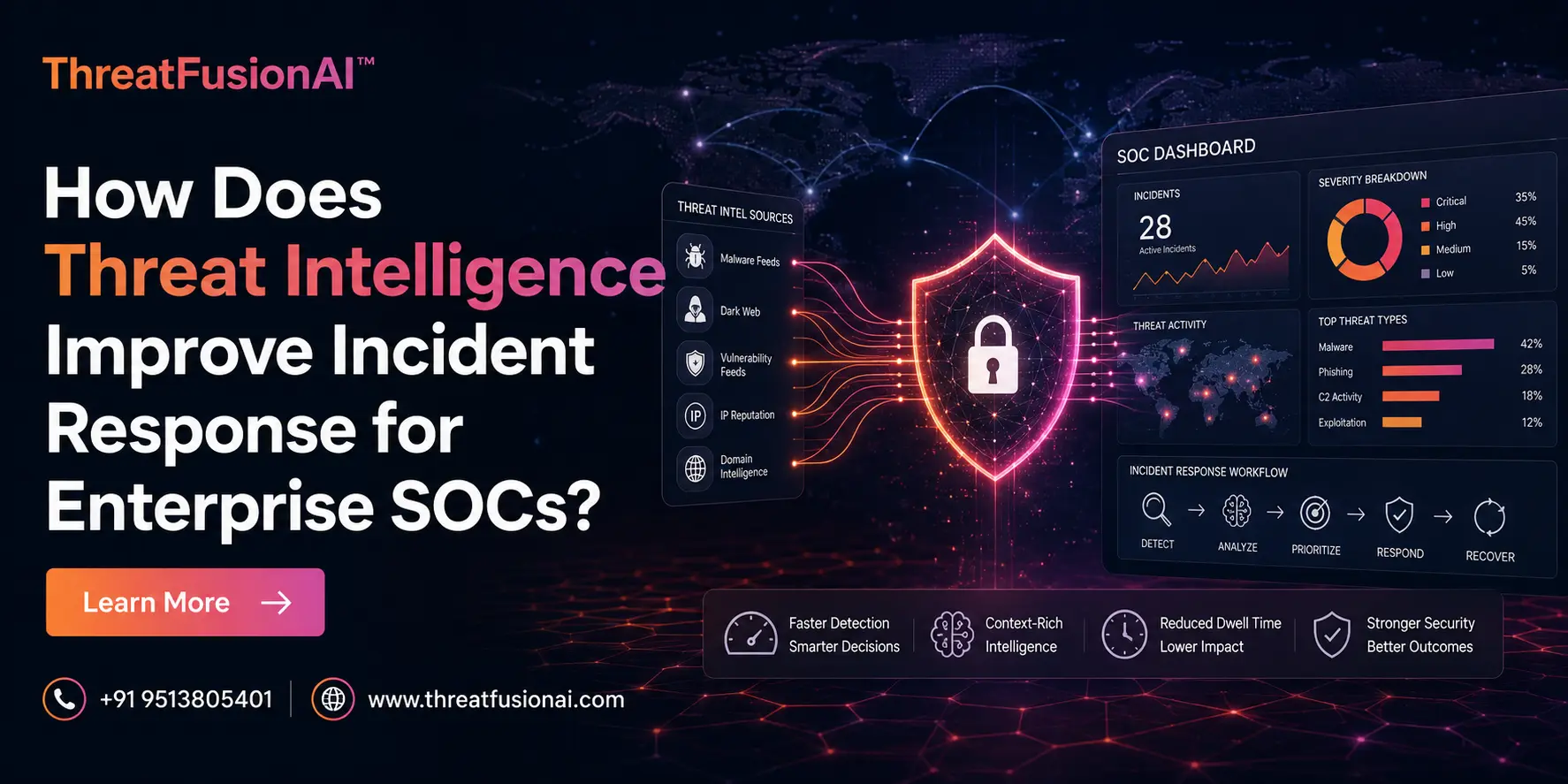
Do you know the role of Threat Intelligence in Incident Response and how it helps businesses working in the IT Industry? If not, then you are in the right place. Here, we will talk about what threat intelligence is and related benefits in detail!
Moreover, we will introduce you to a reliable threat intel solution offered by a reputable VAPT service provider. What are we waiting for? Let’s get started!
What Is Threat Intelligence in Incident Response?
The incorporation of contextual information, including adversary strategies, threat actor profiles, and indicators of compromise, into the active triage and containment lifecycle is known as threat intelligence in incident response.
Security operations teams may quickly ascertain the extent, purpose, and seriousness of an ongoing cyberattack by adding external threat context to raw security notifications. This significantly speeds up the detection and treatment processes by converting simple reactive log analysis into focused decision-making.
Let’s talk about what is the role of Threat Intelligence in Incident Response and how it works for the safety of the users’ data!
Why Threat Intelligence Matters for Enterprise SOCs?
|
S.No. |
Factors |
Why? |
|
1. |
Accelerates Triage and Investigation |
Provides immediate external context for alert validation without the need for laborious analyst research. |
|
2. |
Drives Risk-Based Alert Prioritization |
Ranks security events by comparing the criticality of particular enterprise assets to the severity of the current danger. |
|
3. |
Proactively Anticipates Attack Trajectories |
Enables SOC teams to prevent further kill-chain steps by mapping detected adversary behaviors to common frameworks. |
|
4. |
Powers Automated SOAR Playbooks |
Gives the high-confidence threat information required to safely initiate procedures for blocking and isolation. |
|
5. |
Enhances Threat Hunting Capabilities |
Provides adversary signatures and known indicators to proactively search environment telemetry for persistent, concealed threats. |
How Does Threat Intelligence Strengthen Incident Detection?
Threat intelligence strengthens incident detection in the following ways:
1. Provides High-Confidence Signatures: Compares real-time, verified Indicators of Compromise (IoCs) such as malicious IPs, hashes, and domains with live environment activities.
2. Enables Behavioral Detection via TTPs: Uses adversary tactics, techniques, and procedures mapped to MITER ATT&CK to detect new attacks and living-off-the-land strategies.
3. Supplies Predictive Early-Warning Signals: Detects targeted threat actor campaigns and active reconnaissance before an initial intrusion turns into a breach.
4. Transforms Generic Logs into Contextual Alerts: Transforms low-fidelity telemetry into useful detection signals by adding threat feeds to standard SIEM event rules.
5. Reduces Detection Blind Spots: Uses global threat intelligence to continuously update security controls to identify new vulnerabilities and enemy infrastructure.
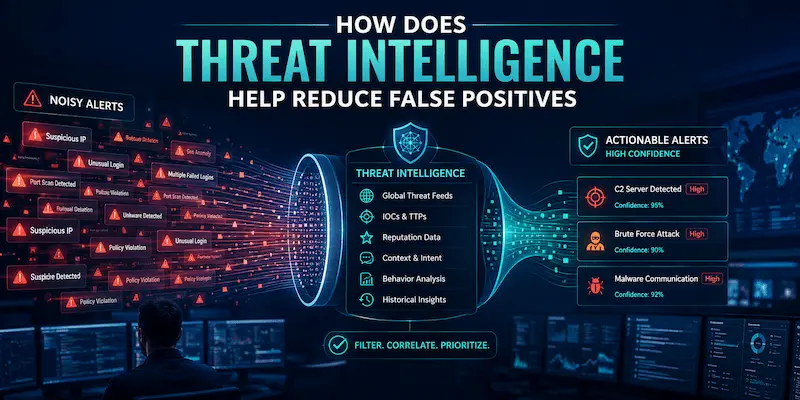
How Does Threat Intelligence Help Reduce False Positives?
Threat intelligence helps reduce false positives in the following ways:
● Validates Alerts with Live Global Data: Before sending out an alert, internal triggers are cross-referenced with verified global threat feeds to verify active malicious intent.
● Correlates Telemetry across Multiple Sources: Filters out benign single-point anomalies by connecting isolated suspicious occurrences to confirmed threat actor profiles.
● Establishes Dynamic Risk and Behavioral Baselines: Ignores regular operating noise and ordinary administrative activity by using contextual threat scores.
● Filters Out Known Good Indicators: Automatically suppresses alarms generated by valid enterprise apps by integrating allowlists and benign software registries.
● Eliminates Stale Indicators: Retires expired infrastructure data and out-of-date threat indicators automatically to avoid setting off alarms on reused or historical assets.
How Does Threat Intelligence Improve Incident Triage?
|
S.No. |
Factors |
How? |
|
1. |
Instantly Delivers Operational Context |
By automatically linking actor profiles, malware families, and threat origins to new tickets, laborious investigation is eliminated. |
|
2. |
Separates Active Attacks from Noise |
Quickly separates dangerous breaches from innocuous background activity by identifying known adversary activities. |
|
3. |
Verifies Campaign Intent and Scope |
Determines if an incident is a targeted campaign or an isolated probe by mapping early indicators to recognized attack patterns. |
|
4. |
Accelerates Severity Scoring |
Automatically determines incident priority by comparing the criticality of internal assets with the capabilities of threat actors. |
|
5. |
Guides Initial Containment Decisions |
Based on the particular behaviors of the identified threat, it suggests precise isolation and repair measures. |
Using Threat Intelligence to Prioritize Security Alerts
By comparing internal event severity to actual adversary capabilities and active exploit activity, threat intelligence may be leveraged to prioritize security warnings, turning overwhelming ticket queues into a targeted, risk-driven process.
SOC teams may quickly concentrate resources on high-impact attacks while reducing low-risk operational noise by dynamically grading alerts based on threat actor intent, exploit availability, and target asset criticality.
How Threat Intelligence Helps SOC Teams Investigate Incidents?
Threat intelligence helps SOC teams investigate incidents in the following ways:
a) Uncovers the Full Attack Timeline: Connects single signs to the entire enemy campaign infrastructure in order to reconstruct the entire sequence of events.
b) Maps Adversary TTPs to Frameworks: Directly links reported attacker actions to well-known frameworks for standardized analysis, such as MITER ATT&CK.
c) Predicts Next Likely Attacker Steps: Uses recorded adversary playbooks to predict future exfiltration or lateral movement tactics.
d) Accelerates Root-Cause Analysis: Traces compromised accounts and endpoints back to the original vector, such as spear-phishing campaigns or vulnerabilities that were exploited.
e) Reveals Hidden Collateral Scope: Cross-referencing global infrastructure data associated with the attacker reveals more affected systems around the company.
Using Threat Intelligence to Identify Attackers and Their Tactics
By comparing observed system actions to known adversary profiles, infrastructure, and MITER ATT&CK methodologies, threat intelligence finds attackers and their strategies. Because of this attribution, SOC teams are able to anticipate lateral movement patterns, comprehend adversary motivation, and implement targeted defenses that are specific to the threat group.
The Role of Threat Intelligence in Threat Hunting
The following are the roles of threat intelligence in threat hunting:
1. Provides Hypothesis-Driven Triggers: Transforms global actor patterns into precise, verifiable hunting hypotheses.
2. Exposes Unseen and Lingering Threats: Finds latent breaches by comparing newly found indications with past telemetry.
3. Directs Focused Investigation Efforts: Directs hunters to susceptible locations and valuable assets that are being targeted by active actors.
4. Reveals Evasive Attacker TTPs: Identifies covert, fileless techniques that get beyond conventional signature-based security measures.
5. Transforms Hunts into Automated Detections: Creates long-term, automatic monitoring rules based on successful manual hunt finds.
Integrating Threat Intelligence With SIEM and SOAR Platforms
At the enterprise level, threat intelligence integration with SIEM and SOAR solutions automates dynamic correlation and ongoing log enrichment. Real-time alert contextualization and automatic SOAR playbooks that isolate risks and instantly carry out containment actions are made possible by this seamless integration.
How Does Threat Intelligence Support Faster Incident Containment?
|
S.No. |
Factors |
How? |
|
1. |
Triggers Automated Playbooks |
Uses SOAR systems to carry out quick, high-confidence isolation processes without requiring human intervention. |
|
2. |
Pinpoints Blast Radius Rapidly |
Identifies each compromised host, account, and infrastructure element connected to the threat actor throughout the network. |
|
3. |
Prevents Lateral Movement |
Stops the attack in its tracks by blocking active enemy communication nodes and command-and-control channels. |
|
4. |
Minimizes Business Disruption |
Instead of shutting down entire production systems, it allows for the targeted, surgeon-like isolation of damaged assets. |
|
5. |
Provides Prescriptive Remediation Steps |
Gives SOC analysts precise, actor-tested containment and eradication procedures based on the current danger. |
Post-Incident Root Cause Analysis and Lessons Learned
Threat intelligence is used in post-incident root cause analysis and lessons learned to track compromised access points, find systemic security flaws, and feed new threat information back into organizational defenses.
This closes the feedback loop, preventing the same adversary from exploiting you again and continuously improving detection engineering in the future.
The Future of Threat Intelligence-Driven Incident Response
AI-powered predictive analytics, autonomous playbooks, and ongoing threat exposure management are key components of threat intelligence-driven incident response in the future. With automated adversary hunting and machine-readable information feeds, SOCs will switch from reactive triage to proactive, real-time defense.
Conlclusion
Now that we have talked about what is the role of Threat Intelligence in Incident Response, you might want to get your hands on a dedicated threat intel solution. For that, you can go for ThreatFusionAI, a dedicated threat intel platform offered by Craw Security.
ThreatFusionAI can help businesses by notifying them about the latest cyber threats and malicious attacks so that they can enhance their security measures in advance. Thus, you will feel secure working online. What are you waiting for? Contact, Now!
Frequently Asked Questions
About Threat Intelligence in Incident Response
1. What is threat intelligence in incident response?
In incident response, threat intelligence refers to the contextual information such as threat actor profiles, activities, and indicators that is utilized to quickly detect, look into, and stop cyberattacks.
2. How does threat intelligence improve incident detection?
Threat intelligence improves incident detection in the following ways:
a) Automates IoC Matching,
b) Enables Behavioral Detection,
c) Provides Early-Warning Signals,
d) Reduces Detection Blind Spots, and
e) Enriches Log Telemetry.
3. Why is threat intelligence important for enterprise SOCs?
Threat intelligence is important for enterprise SOCs for the following reasons:
a) Accelerates Incident Response,
b) Drives Risk-Based Prioritization,
c) Reduces False Positives,
d) Powers Response Automation, and
e) Enables Proactive Threat Hunting.
4. How does threat intelligence help prioritize security alerts?
Threat intelligence helps prioritize security alerts in the following ways:
a) Filters Low-Threat Activity,
b) Correlates Asset Criticality,
c) Weights Exploit Availability,
d) Assigns Dynamic Risk Scores, and
e) Reduces Alert Fatigue.
5. How can SOC teams use threat intelligence for incident investigation?
SOC teams can use threat intelligence for incident investigation in the following ways:
a) Reconstruct the Attack Sequence,
b) Identify Attacker TTPs,
c) Determine Total Blast Radius,
d) Pinpoint Root Cause, and
e) Anticipate Attacker Strategy.
6. What role does threat intelligence play in threat hunting?
Threat intelligence plays the following roles in threat hunting:
a) Drives Hypothesis Creation,
b) Uncovers Unknown Stealth Threats,
c) Directs Search Focus,
d) Provides Context for Behavioral Anomalies, and
e) Converts Insights into Detections.
7. How does threat intelligence reduce false positives in SOC operations?
Threat intelligence reduces false positives in SOC operations in the following ways:
a) Filters Known Good Behavior,
b) Validates with Live Global Data,
c) Correlates Telemetry Across Sources,
d) Establishes Dynamic Risk Baselines, and
e) Deprecates Stale Indicators.
8. How can threat intelligence be integrated with SIEM and SOAR platforms?
Threat intelligence can be integrated with SIEM and SOAR platforms in the following ways:
a) Automates Continuous Log Enrichment,
b) Powers Automated SOAR Containment,
c) Enhances Real-Time Alert Correlation,
d) Streamlines Incident Case Management, and
e) Maintains Dynamic Indicator Life Cycles.
9. What are the challenges of implementing threat intelligence in an enterprise SOC?
The following are the challenges of implementing threat intelligence in an enterprise SOC:
a) Data Overload and Alert Fatigue,
b) Lack of Contextual Relevance,
c) Integration Complexity,
d) High Operational Cost and Skills Gap, and
e) Stale and Ephemeral Indicators.