The Threat Intelligence Tools can help organizations to prepare their teams to fight against unknown future cyber threat events in advance. Don’t know how? You don’t need to worry about that.
Here, we will talk about threat intelligence tools in detail, while exploring their uses, features, and benefits. Moreover, we will introduce you to a reliable threat intel tool offered by a reputable VAPT service provider. What are we waiting for? Let’s get started!
What Are Threat Intelligence Tools?
Threat intelligence tools are specialized software programs made to automatically gather, compile, standardize, and evaluate unprocessed cyber risk data from numerous international sources.
These technologies effortlessly integrate real-time security data into pre-existing defense architectures, such as SIEMs and firewalls, by converting disparate signs into organized, actionable insights.
In the end, they enable security operations teams to quickly identify new threats, expedite incident response, and proactively stop cyberattacks at machine speed. Let’s take a look at what Threat Intelligence Tools are and their benefits!
Why Security Teams Need Threat Intelligence Platforms?
Security teams need threat intelligence platforms for the following reasons:
1. Centralizes and Normalizes Disparate Feeds: They provide a single, uniform dashboard by combining a disorganized collection of commercial, internal, and public danger data.
2. Reduces Alert Fatigue with Automated Triage: By automatically removing duplicates and background noise, they enable analysts to concentrate solely on confirmed high-priority risks.
3. Enriches Incidents with Actionable Context: They immediately add important information to raw security warnings, such as malware activity, industry targets, and attacker intent.
4. Drives Machine-Speed Security Automation: In order to rapidly stop attacks without the need for human intervention, they smoothly transfer real-time threat data to firewalls, EDRs, and SOAR tools.
5. Facilitates Secure Collaboration and Sharing: Using defined standards, they enable security professionals to quickly and safely share threat indications with peers in the industry.
Commercial vs Open-Source Threat Intelligence Tools
|
S.No. |
Topics |
Factors |
What? |
|
1. |
Commercial Threat Intelligence Tools |
Out-of-the-Box Enrichment and High Accuracy |
They minimize false positives by providing carefully selected, low-noise threat data with committed vendor support. |
|
Seamless Ecosystem Integrations |
They include pre-made, vendor-maintained interfaces that rapidly synchronize new threat data with popular SIEM, SOAR, and EDR systems. |
||
|
Predictive, Proprietary Context |
They offer advanced nation-state attribution, zero-day tracking, and unique access to private dark web operations that are not available through open-source channels. |
||
|
2. |
Open-Source Threat Intelligence Tools |
Zero Licensing Fees |
They make threat intelligence available to teams on a tight budget by providing a totally free tier of community-driven threat telemetry (such as MISP or OpenCTI). |
|
Complete Customization and Control |
They give enterprises complete access to the source code, allowing them to create customized analysis procedures and change database structures. |
||
|
Heavy Operational Management Overhead |
To manually remove data noise, create unique APIs, and repair the self-hosted infrastructure on a regular basis, they need a highly qualified engineering team. |
Key Features to Look for in Threat Intelligence Tools
The following are some key features to look for in threat intelligence tools:
● Automated Data Ingestion and Normalization: Creates a single, standardized data format by automatically combining and transforming a disorganized collection of worldwide threat feeds.
● Advanced Alert Enrichment and Contextualization: Instantly adds important danger information to raw indications, such as the identity, motivations, and attack methods of the hacker.
● Bidirectional Integration and Orchestration: Smoothly transfers real-time security data between all of your firewalls, SIEMs, and EDR agents.
● Intelligent False-Positive Filtering: Saves analysts from alert fatigue by regularly removing outdated or innocuous data with sophisticated scoring algorithms.
● Customizable Dashboards and Role-Based Reporting: Customizes security displays to show high-level risk metrics for business leaders or technical data for SOC analysts.
Top Threat Intelligence Tools Used by Security Teams
The following are the top threat intelligence tools used by security teams:
a) Threatfusionai: Employs cutting-edge machine learning to automatically identify data leaks, scrape dark web signals, and determine an organization's particular breach probability.
b) Recorded Future: Uses a large, automated graph analytics engine to continually map open-source intelligence, geopolitical changes, and global digital hazards in real time.
c) Anomali ThreatStream: Removes duplicates to create clear, high-confidence danger feeds by normalizing millions of raw, diverse data indicators into a single workspace.
Integrating Threat Intelligence Tools with SIEM and SOAR Platforms
By automatically adding real-time adversary context to incoming security logs, integrating threat intelligence products with SIEM and SOAR platforms closes the gap between passive detection and active enforcement.
Organizations can quickly identify high-priority threats and initiate automatic, machine-speed playbooks to isolate infected endpoints and block malicious equipment throughout the network thanks to this unified ecosystem.
How Threat Intelligence Tools Improve Cybersecurity Operations?
Threat intelligence tools improve cybersecurity operations in the following ways:
1. Drastically Reduces Mean Time to Detect (MTTD): Detects active attackers instantly by comparing known worldwide hacker infrastructure with real-time network traffic.
2. Eliminates Alert Fatigue via Smart Triaging: Silently eliminates thousands of innocuous background warnings, allowing analysts to concentrate only on actual, verified threats.
3. Empowers Dynamic and Proactive Threat Hunting: Provides defenders with precise attacker behavior patterns to locate covert, silent dangers within the network.
4. Enables Instant, Machine-Speed Threat Mitigation: The instant a threat is identified, automated processes are triggered to isolate compromised devices and block malicious IPs.
5. Transforms Cyber Defense from Reactive to Strategic: Gives business executives industry-specific risk information so they may invest funds more wisely and prevent attacks before they start.
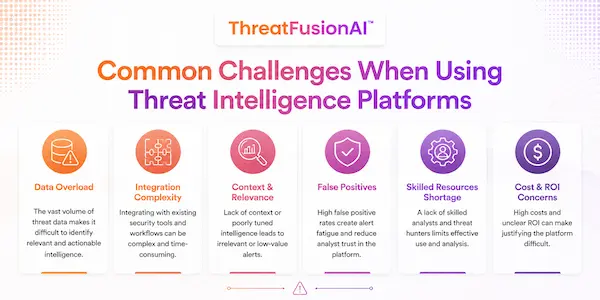
Common Challenges When Using Threat Intelligence Platforms
The following are some common challenges when using threat intelligence platforms:
● Overwhelming Alert Volume and Noise: Analyst fatigue is exacerbated when too many unvetted feeds are ingested, flooding security dashboards with redundant data.
● Severe Shortage of Skilled Analysts: It is still quite challenging to find experts who can correctly evaluate advanced threat data and apply it to protection.
● Lack of Actionable, Contextual Data: In order to prioritize mitigation, raw threat indicators frequently lack crucial information, such as target industries or hacker motivations.
● Integration Hurdles with Legacy Infrastructure: The contemporary APIs needed to consume, parse, and respond to real-time threat inputs are sometimes absent from older security systems.
● High Operational Cost and Stale Data: It is costly to subscribe to premium commercial platforms, yet if threat actors alter infrastructure, the data may soon become outdated.
How to Choose the Right Threat Intelligence Tool for Your Organization?
|
S.No. |
Factors |
How? |
|
1. |
Alignment with Your Organizational Threat Landscape |
Select an adversary tracking tool that focuses on your industry, area, and technological stack. |
|
2. |
Integration with Your Existing Security Stack |
Make sure the platform uses APIs to smoothly feed data into your existing firewall, SIEM, and SOAR technologies. |
|
3. |
Data Quality Over Data Quantity |
Give relevant, accurate, and deduplicated warnings precedence over a large number of noisy, unverified data feeds. |
|
4. |
Direct Support for the "Three Levels" of Intelligence |
Make sure it provides tactical IOCs for systems, operational adversary tactics for defenders, and strategic trends for executives. |
|
5. |
Delivery Methods and Usability |
Choose an easy-to-use dashboard that supports your chosen sharing formats and corresponds with the ability level of your team. |
Future Trends in Threat Intelligence Technology
The following are the future trends in threat intelligence technology:
a) Autonomous & Agentic AI Defenses: Without human assistance, AI bots will independently find threats, create signatures, and carry out real-time containment.
b) Shift to Behavioral Anomaly Detection: In order to assess attacker behavior, TTPs, and purpose across environments, systems will go beyond static IOCs.
c) Continuous Threat Exposure Management (CTEM): Periodic patching will give way to ongoing, automated assessment of an organization's threat surface and exploitability.
d) Post-Quantum Cryptography (PQC) Readiness: Threat intelligence will monitor timeframes for quantum computing and pinpoint high-risk legacy encryption that is susceptible to "harvest now, decrypt later" assaults.
e) Cross-Domain & Identity-Centric Visibility: With a strong emphasis on safeguarding identity infrastructure against credential misuse, intelligence will consolidate data across cloud, IoT, and OT networks.
Conclusion
Now that we have talked about what Threat Intelligence Tools are, you might want to get a dedicated threat intelligence solution for yourself. For that, you can go for Threat Fusion AI, a dedicated threat intel tool offered by Craw Security.
This amazing Threat Fusion AI tool can offer you real-time threat intel so that you can prepare for future cyber threats and cyber attacks in advance. Moreover, if you use this tool with the amazing ShieldXDR of Craw Security, you don’t have to worry about unknown threats. What are you waiting for? Contact, Now!
Frequently Asked Questions
About Threat Intelligence Tools
1. What are threat intelligence tools used for?
Threat intelligence tools are used for the following factors:
a) Proactive Threat Hunting,
b) Automated Incident Response,
c) Vulnerability Management,
d) Strategic Security Planning, and
e) Accelerating Investigations.
2. How do threat intelligence platforms help security teams detect cyber threats?
Threat intelligence platforms help security teams detect cyber threats in the following ways:
a) Aggregating and Centralizing Data,
b) Correlating Indicators of Compromise (IOCs),
c) Mapping Attacker Behaviors (TTPs),
d) Reducing False Positives, and
e) Providing Contextual Enlistment.
3. What is the difference between threat intelligence and threat hunting?
Threat hunting is the proactive search of a network for unsuspected, hidden attackers, whereas threat intelligence gives information and context about known enemies.
4. Which are the most popular threat intelligence tools in 2026?
The following are the most popular threat intelligence tools in 2026:
a) Recorded Future,
b) Google Mandiant Threat Intelligence,
c) CrowdStrike Falcon Intelligence,
d) Anomali ThreatStream, and
e) ThreatConnect.
5. Are open-source threat intelligence tools effective for enterprises?
Though they typically lack the real-time dark web visibility, automated curation, and deep adversary attribution needed to stand alone against sophisticated enterprise threats, open-source threat intelligence tools are useful for foundational data collection and cost-conscious enterprise enrichment.
6. How do threat intelligence tools integrate with SIEM solutions?
By automatically feeding curated Indicators of Compromise (IOCs), such as malicious IPs, domains, and file hashes, into the SIEM via APIs, threat intelligence systems interface with SIEM solutions.
This enables the SIEM to correlate external threat data with internal network logs to provide real-time warnings.
7. What types of threat data do threat intelligence platforms collect?
Threat intelligence platforms can collect the following types of threat data:
a) Indicators of Compromise (IOCs),
b) Tactics, Techniques, and Procedures (TTPs),
c) Strategic Threat Landscape Reports,
d) Dark Web and Underground Forum Telemetry, and
e) Vulnerability Context and Exploit Intelligence.
8. How can organizations choose the right threat intelligence tool?
Organizations can choose the right threat intelligence tool in the following ways:
a) Assess Your Industry Threat Landscape,
b) Verify Integration Compatibility,
c) Prioritize Data Quality Over Quantity,
d) Evaluate Support for All Three Intel Levels, and
e) Match Tool Usability with Team Maturity.
9. What are the key features of a modern threat intelligence platform?
The following are the key features of a modern threat intelligence platform:
a) AI-Powered Automated Curation,
b) Seamless API-Driven Integration,
c) Comprehensive Dark Web Monitoring,
d) Dynamic Behavioral and TTP Mapping, and
e) Advanced Vulnerability and Risk Prioritization.
10. Can threat intelligence tools help prevent phishing, ransomware, and malware attacks?
Yes, by proactively blocking known malicious senders, infrastructure, and payloads before they enter your network and by offering the behavioral context required to identify and neutralize novel, evasion-focused variants, threat intelligence solutions can avoid these assaults.