Do you know what Threat Intelligence Enrichment is and how it offers better security measures for future operations for businesses? If not, then you are at the right place. Here, we will talk about what Threat Intelligence Enrichment is and related benefits in detail.
Moreover, we will introduce you to a reliable threat intelligence solution offered by a reputable VAPT service provider. What are we waiting for? Let’s get straight to the topic!
What Is Threat Intelligence Enrichment?
The automated process of adding external context, such as ownership information, past activity, and threat actor attribution, to raw security indicators, such as IP addresses, hashes, or domain names, is known as threat intelligence enrichment.
Security teams may eliminate false positives, clarify threat severity, and expedite incident response decisions by integrating external intelligence sources with internal data. Let’s talk about what Threat Intelligence Enrichment is, its uses, its features, and benefits for organizations in the IT Industry!
Raw Threat Data vs. Enriched Threat Intelligence
|
S.No. |
Topics |
Factors |
What? |
|
1. |
Raw Threat Data |
Unprocessed & Contextless |
Consists of discrete observations, such as an IP address, file hash, or URL, without a risk or purpose explanation. |
|
High Volume & Noise |
Produces enormous volumes of unconfirmed warnings, which cause significant false-positive rates and analyst fatigue. |
||
|
2. |
Enriched Threat Intelligence |
Contextualized & Actionable |
Integrates threat actor attribution, geolocation, past activity, and MITER ATT&CK mappings with raw indicators. |
|
Prioritized & Decision-Ready |
Assesses the degree of severity and confidence so that SOAR platforms and security teams can take quick containment measures. |
How Does Threat Intelligence Enrichment Work?
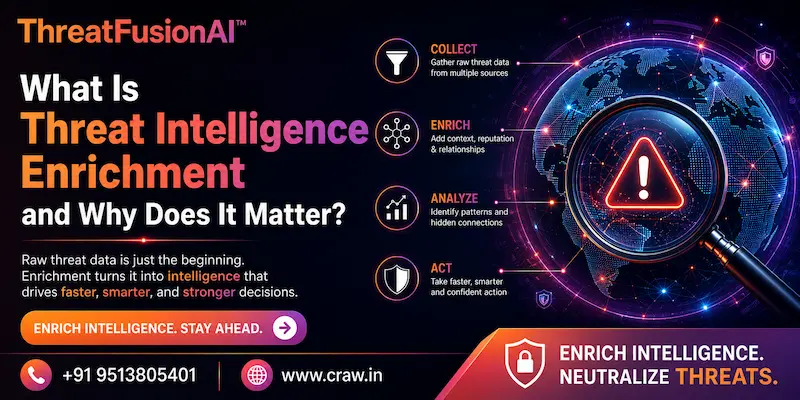
Threat intelligence enrichment works in the following ways:
1. Raw Indicator Ingestion: It gathers raw observable indications (IPs, domains, file hashes, URLs) from endpoint logs, firewalls, and SIEM alerts.
2. Multi-Source Data Aggregation: Collects technical background by querying WHOIS information, passive DNS, sandbox detonation logs, and external threat feeds.
3. Contextual Mapping & Attribution: Connects validated signs to certain MITER ATT&CK methodologies, malware families, and known threat actor campaigns.
4. Scoring & False Positive Filtering: Filters away benign organizational traffic by evaluating indicator risk levels, confidence ratings, and past behavior.
5. Actionable Security Dissemination: Automatically adds improved threat intelligence to SOAR playbooks, firewalls, and EDRs for quick threat containment.
Key Data Sources Used for Threat Intelligence Enrichment
The following key data sources are used for threat intelligence enrichment:
● Infrastructure & Network Registries (WHOIS, Passive DNS, & ASN): Reveals attacker architecture by mapping network routing, IP hosting history, and domain ownership.
● Commercial & Open-Source Threat Feeds (OSINT/ISACs): Provide real-time updates on ongoing campaigns by combining vendor and community IOC sources.
● Malware Sandbox & Dynamic Execution Telemetry: Provides dynamic runtime indicators, such as outgoing C2 beacons, dropped files, and API call sequences.
● Vulnerability & Exploit Intelligence Databases (NVD & CISA KEV): Connects patch severity and real-world exploitation status to software defects.
● Dark Web & Cybercrime Forum Monitoring: Tracks illicit conversations, access sales, and compromised credentials to find specific threats before they are carried out.
Types of Threat Intelligence Enrichment
|
S.No. |
Types |
What? |
|
1. |
Infrastructure & Network Enrichment |
Adds geolocation, WHOIS ownership information, passive DNS history, and ASN hosting details to IP addresses and domains. |
|
2. |
Malware & Behavioral Enrichment |
Adds dynamic C2 indications, dynamic YARA rule matching, sandbox execution telemetry, and static features to file hashes. |
|
3. |
Vulnerability & Exploit Enrichment |
Uses databases such as CISA KEV to contextualize CVEs with CVSS metrics, exploit availability, and active exploitation status. |
|
4. |
Threat Actor & Campaign Attribution |
Connects isolated signs to MITER ATT&CK methods, past campaigns, motivation kinds, and known adversary characteristics. |
|
5. |
Victimology & Identity Enrichment |
Matches exposed IP spaces, compromised passwords, and leaked emails to certain industry sectors or corporate identification assets. |
How Does Threat Intelligence Enrichment Support SOC Teams?
Threat intelligence enrichment supports SOC teams in the following ways:
a) Reduces Alert Fatigue & False Positives: Validates warnings against verified threat reputation databases and filters out innocuous events.
b) Accelerates Incident Triage & Response: Reduces research times from hours to minutes by providing analysts with instant contextual information.
c) Powers Automated Containment Playbooks: Automatically blocks high-confidence indicators across security tools by triggering SOAR procedures.
d) Optimizes Risk-Based Alert Prioritization: Prioritizes genuine threats by ranking warnings according to threat severity, exploit status, and asset criticality.
e) Enhances Proactive Threat Hunting: Gives hunters rich adversary TTPs and associated IOCs so they may look for hidden threats in logs.
How Does Threat Intelligence Enrichment Help Reduce False Positives?
Threat intelligence enrichment helps reduce false positives in the following ways:
1. Whitelisting Known-Good Infrastructure: Suppresses innocuous alarms by cross-referencing indicators with validated lists of trustworthy vendors, CDNs, and cloud services.
2. Reputation & Score Verification: Combines threat rankings from several intelligence sources to guarantee that alarms only sound in response to confirmed, high-confidence threats.
3. Contextual Correlation: Confirms if an indicator shows innocuous administrative activity or real malicious behavior in your network.
4. Age & Stale Indicator Decay: In order to prevent falsealarms from being triggered by reassigned IP addresses and expired domains, older IOCs are automatically downgraded or expired.
5. Active Exploitation Verification: Before marking an indicator as critical, it verifies that it is actively exploited by consulting real-world threat databases (such as CISA KEV).
Integrations with SIEM, SOAR, and XDR Platforms
|
S.No. |
Factors |
How? |
|
1. |
SIEM |
Streams indicator feeds and normalized log data into central correlation engines to compare threat signatures with real-time event telemetry. |
|
2. |
SOAR |
Uses APIs to ingest dynamic intelligence to initiate runbook investigations, automated asset containment, and automated reaction playbooks. |
|
3. |
XDR Platforms |
Integrates multi-layered telemetry (endpoints, network, cloud, identity) with the external threat environment, directly enabling cross-domain correlation and response in real time. |
Common Challenges in Threat Intelligence Enrichment
The following are some common challenges in threat intelligence enrichment:
● Data Overload & Information Noise: Security systems are overloaded, and notification fatigue results from ingesting enormous amounts of uncurated indication feeds.
● API Latency & Processing Delays: Real-time incident triage is delayed, and automated SOAR procedures are stalled by slow third-party enrichment requests.
● Stale Indicators & Lack of Decay: On authentic, reassigned internet infrastructure, out-of-date or recycled IOCs cause false positive warnings.
● Schema Fragmentation & Data Inconsistency: Different vendors' non-standard data formats necessitate extensive specialized parsing and normalization work.
● High Operational Costs & Integration Overhead: Custom API interfaces and commercial threat intelligence feeds require substantial engineering and financial resources.
How Is AI Transforming Threat Intelligence Enrichment?
AI is transforming threat intelligence enrichment in the following ways:
a) Unstructured Data & Dark Web NLP Extraction: Automatically converts multilingual postings, leak sites, and unstructured dark net forum chatter into organized indicators.
b) Real-Time Behavioral Correlation: Detects latent zero-day execution patterns by connecting telemetry from multiple cloud, endpoint, and network logs.
c) Dynamic Confidence Scoring & Risk Prioritization: Adapts indicator risk ratings in real time according to asset criticality, context, and active exploitation tendencies.
d) Predictive Threat & Campaign Attribution: Uses graph machine learning to anticipate the origins of threat actors or future target campaigns by clustering dissimilar information.
e) Automated Alert Contextualization & Summarization: Provides analysts with quick natural language summaries and MITER ATT&CK mappings to speed up triage.
Best Practices for Effective Threat Intelligence Enrichment
|
S.No. |
Factors |
What? |
|
1. |
Automate API Ingestion & Enrichment Pipelines |
In SOAR and SIEM workflows, initiate automatic API lookups to enhance indicators without the need for human intervention. |
|
2. |
Implement Dynamic Indicator Decay & TTL Rules |
To automatically eliminate outdated data and prevent false positives, give IOCs stringent time-to-live expiration limits. |
|
3. |
Curate High-Quality, Relevant Feeds |
Concentrate on validated threat feeds that are industry-specific and closely align with the technology stack and geographic reach of your company. |
|
4. |
Normalize & Standardize Threat Schemas |
To guarantee consistent data parsing and smooth integration among security systems, use standardized formats like STIX/TAXII. |
|
5. |
Validate Alerts Against Internal Context |
Before escalation, verify actual asset exposure and impact by cross-referencing external threat indicators with internal telemetry. |
How to Choose a Threat Intelligence Enrichment Platform?
You can choose a threat intelligence enrichment platform in the following ways:
1. Seamless Integration & API Latency: Make that the SIEM, SOAR, EDR, and XDR platforms are fed by native integrations and quick, low-latency APIs.
2. Data Diversity & Sourcing Quality: Examine coverage from a variety of sources, such as commercial sources, OSINT, WHOIS, passive DNS, and black web monitoring.
3. Automated Scoring & Indicator Decay: To filter false positives, use automated MITER ATT&CK mapping, TTL decay rules, and dynamic confidence rating.
4. Relevance & Contextual Alignment: Select solutions that adapt risk rating to your industry, attack surface, and technology stack.
5. Scalability & Total Cost of Ownership (TCO): To prevent unforeseen expenses at high query volumes, evaluate processing throughput and transparent licensing arrangements.
Conclusion
Now that we have talked about what Threat Intelligence Enrichment is, you might want to get your hands on a dedicated threat intel solution from a reliable source. For that, you can go for ThreatFusionAI, a dedicated threat intelligence platform offered by Craw Security.
Organizations can get notified about the latest malicious threats and cyber threats via ThreatFusionAI and can deal with them in time for future threats. Thus, you will feel safe in your work environment. What are you waiting for? Contact, Now!
Frequently Asked Questions
About Threat Intelligence Enrichment
1. What is threat intelligence enrichment?
The automated process of turning raw, isolated security indicators like IP addresses, hashes, or URLs into actionable security insights by adding contextual metadata like ownership, past activity, and threat actor attribution is known as threat intelligence enrichment.
2. Why is threat intelligence enrichment important for cybersecurity?
Threat intelligence enrichment is important for cybersecurity for the following reasons:
a) Filters Noise & Reduces False Positives,
b) Accelerates Incident Triage & Response,
c) Powers Automated Containment (SOAR),
d) Prioritizes Critical Vulnerabilities & Risks, and
e) Enhances Proactive Threat Hunting.
3. How does threat intelligence enrichment work?
Threat intelligence enrichment works in the following ways:
a) Raw Indicator Ingestion,
b) Multi-Source Data Aggregation,
c) Contextual Mapping & Attribution,
d) Risk Scoring & Confidence Analysis, and
e) Automated Dissemination & Response.
4. What data sources are used for threat intelligence enrichment?
The following data sources are used for threat intelligence enrichment:
a) Infrastructure & Network Registries (WHOIS, Passive DNS, & ASN),
b) Commercial & Open-Source Threat Feeds (OSINT/ISACs),
c) Malware Sandbox & Dynamic Execution Telemetry,
d) Vulnerability & Exploit Intelligence Databases (NVD & CISA KEV), and
e) Dark Web & Cybercrime Forum Intelligence.
5. What types of threat intelligence can be enriched?
The following types of threat intelligence can be enriched:
a) Technical Threat Intelligence (IOCs & Observables),
b) Tactical Threat Intelligence (TTPs & Behaviors),
c) Operational Threat Intelligence (Campaigns & Threat Actors),
d) Vulnerability & Exploit Intelligence (CVEs), and
e) Strategic Threat Intelligence (High-Level Risk & Trends).
6. How does threat intelligence enrichment improve threat detection?
Threat intelligence enrichment improves threat detection in the following ways:
a) Contextualizes Raw Telemetry,
b) Correlates Disparate Security Events,
c) Enables Behavioral & TTP Detection,
d) Accelerates Mean Time to Detect (MTTD), and
e) Enhances Detection Precision & Accuracy.
7. How does automation help with threat intelligence enrichment?
Automation helps with threat intelligence enrichment in the following ways:
a) Real-Time API Querying & Processing,
b) Data Normalization & Schema Standardization,
c) Dynamic Risk Scoring & Indicator Decay,
d) Seamless Orchestration with Security Tools, and
e) High-Volume Scalability & Labor Reduction.
8. How does threat intelligence enrichment reduce false positives?
Threat intelligence enrichment reduces false positives in the following ways:
a) Suppressing Known-Good & Whitelisted Infrastructure,
b) Multi-Source Reputation & Score Verification,
c) Correlating Real-World Behavioral Context,
d) Applying Dynamic Indicator Decay & TTL Expiration, and
e) Validating Active Exploitation Status.
9. What are the challenges of implementing threat intelligence enrichment?
The following are the challenges of implementing threat intelligence enrichment:
a) API Performance & Processing Delays,
b) Information Overload & Alert Fatigue,
c) Schema Inconsistency & Data Silos,
d) Managing Stale Data & False Positives, and
e) High Operational & Licensing Costs.
10. How can organizations choose the right threat intelligence enrichment platform?
Organizations can choose the right threat intelligence enrichment platform in the following ways:
a) Native Integration & Low API Latency,
b) Data Quality & Feed Diversity,
c) Dynamic Scoring & Indicator Decay,
d) Contextual Alignment to Your Tech Stack, and