Do you know what AI is in Cyber Threat Detection and Response, and how it can help many organizations to deal with future cyber threats? If not, then you are at the right place. Here, we will talk about Artificial Intelligence & its uses in Detail.
Moreover, we will introduce you to a reliable threat detection tool with a threat intel tool offered by a reputable VAPT service provider. What are we waiting for? Let’s get straight to the topic!
What is Artificial Intelligence in Cybersecurity?
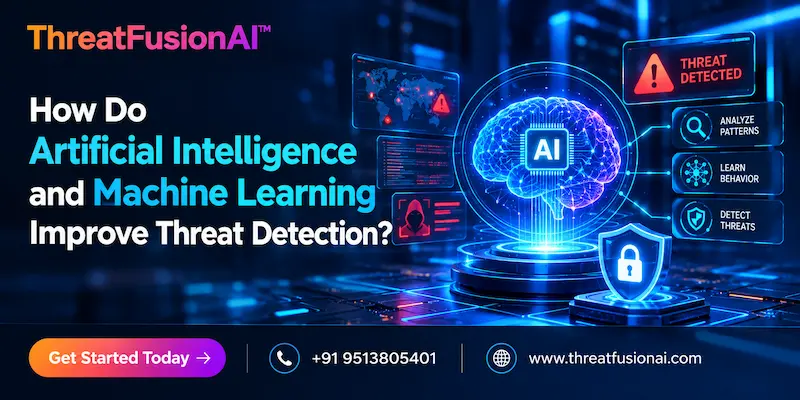
In cybersecurity, artificial intelligence refers to the use of deep learning models and machine learning algorithms to automatically identify, anticipate, and eliminate online threats in real time. AI is significantly faster than human analysts in spotting subtle anomalies that point to a sophisticated phishing effort or a zero-day vulnerability by examining enormous datasets of network traffic and user behavior.
By automating incident response and drastically cutting down on the time it takes to neutralize sophisticated assaults, this proactive method enables organizations to go beyond typical reactive security.
Let’s take a look at what is the role of AI in Cyber Threat Detection and Response and how it works!
How AI is Transforming Modern Cyber Threat Detection?
|
S.No. |
Factors |
How? |
|
1. |
Faster Threat Detection and Incident Response |
By automating the full lifecycle, from detection to remediation, AI cuts the time it takes to identify and contain threats from days to seconds. |
|
2. |
Improved Accuracy and Reduced False Positives |
AI ensures that security professionals only concentrate on real, high-risk abnormalities by filtering out "noise" and alerting to weariness through the learning of behavioral baselines. |
|
3. |
AI-Powered Predictive Threat Intelligence |
In order to anticipate and prevent new threats before they ever get to your internal network, sophisticated models examine worldwide attack trends. |
|
4. |
Automated Malware and Phishing Detection |
Behavioral analysis and natural language processing (NLP) detect deepfake phishing and complex "polymorphic" viruses that evade conventional signature-based filters. |
|
5. |
Enhanced Endpoint and Network Security |
AI rapidly isolates compromised hosts to stop lateral movement inside the infrastructure by continually monitoring every device and data flow. |
AI in Ransomware Prevention and Mitigation
By employing behavioral analytics to identify and stop questionable file-encrypting activity in real-time before data is lost, AI stops ransomware. By automatically isolating compromised systems and locating the most recent clean backups for quick recovery, it speeds up mitigation in the case of a breach.
AI and Machine Learning for Compliance and Data Protection
By continuously scanning enormous datasets to find, categorize, and secure sensitive information like PII or financial records, AI and machine learning automate data protection. These systems monitor data flows and immediately indicate illegal access or policy violations to ensure real-time compliance with international requirements such as the CCPA or GDPR.
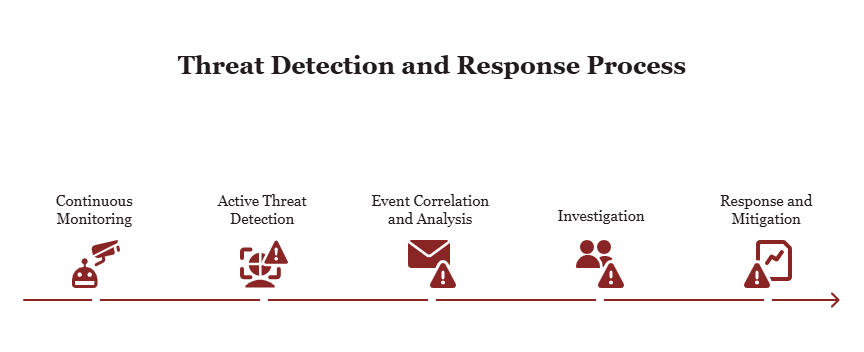
Real-time Behavioral Analysis & Anomaly Detection
By using machine learning to create a "normal" activity baseline for each user and device, real-time behavioral analysis can quickly identify deviations like odd login times or data spikes. Because of this ongoing monitoring, abnormalities both internal and external can be quickly identified, allowing autonomous systems to stop suspicious activity before it becomes a serious breach.
Automated Incident Response Orchestration
Automated Reaction to Incidents AI is used in orchestration to carry out pre-written "playbooks" that automatically isolate compromised systems, deny user access, and patch vulnerabilities without the need for human interaction.
It turns the security operations center (SOC) from a manual, reactive workflow into a proactive, fast defense system by coordinating across multiple security instruments.
Benefits of AI in Security Operations Centers (SOC)
The following are some benefits of AI in Security Operations Centers (SOC):
1. 24/7 Continuous Monitoring: Because AI never sleeps, it can monitor and analyze network data around-the-clock without experiencing the weariness that human analysts do.
2. Rapid Threat Hunting: In just a few seconds, it can sort through petabytes of historical data to identify "low and slow" attacks or hidden patterns that would take weeks for people to discover.
3. Reduced Mean Time to Respond (MTTR): AI reduces the time between a threat's detection and neutralization by automating preliminary investigation and containment procedures.
4. Contextual Alert Enrichment: AI intelligently compiles information from multiple sources (IP reputation, user history, file hashes) to give analysts a comprehensive narrative instead of a confusing, unprocessed alert.
5. Smart Prioritization: In order to ensure that the most serious threats are addressed first, algorithms rank warnings according to their actual danger level and possible impact.
Future of AI in Cyber Threat Detection and Response
By 2026, autonomous agentic systems and predictive analytics that eliminate risks before they arise will be the main focus of AI in cybersecurity. Organizations are moving away from reactive "alert-based" defense and toward self-healing networks that are capable of independently identifying, looking into, and fixing sophisticated AI-orchestrated threats at machine speed.
Why Businesses Should Invest in AI Cybersecurity Solutions?
Businesses should invest in AI Cybersecurity Solutions for the following reasons:
● Countering AI-Powered Attacks: The only security that can match the speed and intricacy of automated, AI-driven malware that can instantly change its signature is artificial intelligence.
● Bridging the Cybersecurity Talent Gap: Smaller security teams can handle enormous workloads and high-level analysis that would otherwise require hundreds of trained human analysts, thanks to AI's force multiplier effect.
● Ensuring Business Continuity: AI guarantees that vital services continue to function and downtime is essentially avoided by anticipating and averting disruptions brought on by cyberattacks.
● Preserving Brand Reputation and Trust: AI-driven data protection keeps the trust that is the cornerstone of your brand's market worth intact by preventing disastrous disclosures of private client information.
● Significant Long-term ROI: The significant decrease in breach cleanup expenses and insurance premiums offers a quantifiable financial return over time, even though initial adoption necessitates expenditure.
Conclusion
Now that we have talked about AI in Cyber Threat Detection and Response, you might want to get your hands on a dedicated threat detection tool. For that, you can go for ShieldXDR, offered by Craw Security, which automatically detects unknown & suspicious activity and deals with them before it causes loss to the victims.
Moreover, if you want to get intel about the latest cyberthreats before you become victims, you can go for Threat Fusion AI, a dedicated threat intelligence tool. What are you waiting for? Contact, Now!
Frequently Asked Questions
About AI in Cyber Threat Detection and Response
1. What is AI in cyber threat detection?
By identifying trends and abnormalities that people might overlook, artificial intelligence (AI) in cyber threat detection uses machine learning to automatically discover, analyze, and neutralize digital threats in real-time.
2. How does AI improve cybersecurity?
In the following ways, AI can improve cybersecurity:
a) Real-Time Threat Detection,
b) Automated Incident Response,
c) Predictive Analytics,
d) Reduction in Alert Fatigue,
e) Enhanced Authentication.
3. How does AI help in cyber threat detection?
In the following ways, AI can help in cyber threat detection:
a) Behavioral Pattern Recognition,
b) Predictive Intelligence,
c) Automated Threat Hunting,
d) Drastic Reduction in False Positives, and
e) Machine-Speed Response.
4. What are the benefits of AI in cybersecurity?
The following are the benefits of AI in cybersecurity:
a) Autonomous Threat Hunting,
b) Zero-Day Exploit Detection,
c) Drastic Reduction in Alert Fatigue,
d) Machine-Speed Incident Response, and
e) Adaptive Identity Management.
5. Can AI prevent ransomware attacks?
Yes, AI stops ransomware by employing behavioral analytics to identify and stop harmful encryption in real-time, frequently eliminating the danger in milliseconds before any data is lost.
6. How is machine learning used in cybersecurity?
Cybersecurity uses machine learning to find patterns in large datasets, enabling systems to automatically recognize and prevent abnormalities that indicate a possible attack without depending on pre-established criteria.
7. What are AI-powered threat detection systems?
AI-powered threat detection systems are security platforms that utilize machine learning to autonomously monitor user behavior and network traffic. By finding anomalies that depart from known "normal" patterns, these systems can identify and neutralize cyber threats in real-time.
8. Is AI replacing cybersecurity professionals?
No, AI is not taking the place of cybersecurity experts; rather, it serves as a "force multiplier" by automating tedious chores so that specialists may concentrate on sophisticated threat hunting and high-level planning.
9. How does AI improve incident response?
In the following ways, AI improves incident response:
a) Automated Containment,
b) Rapid Root Cause Analysis,
c) Intelligent Playbook Execution,
d) Enriched Contextual Evidence, and
e) Dynamic Remediation Suggestions.
10. What industries benefit most from AI cybersecurity solutions?
The following industries benefit most from AI cybersecurity solutions:
a) Banking and Financial Services (BFSI),
b) Healthcare and MedTech,
c) Critical Infrastructure (Energy & Utilities),
d) Manufacturing and Supply Chain, and
e) Government and Public Sector.
Read More :
Top Threat Hunting Techniques Every Security Analyst Should Know