Do you know what Threat Hunting Techniques are and how they can help you in protecting your confidential data against online threats? If not, then you are at the right place. Here, we will talk about Threat Hunting in detail.
Moreover, we will introduce you to a reliable security solution offered by a VAPT service provider. What are we waiting for? Let’s get straight to the topic!
What is Threat Hunting?
Searching networks for hidden, sophisticated dangers that have eluded automated security technologies is known as "threat hunting," a proactive, analyst-led security technique. Hunters utilize a combination of threat intelligence and behavioral analysis to find harmful activity already present in the environment instead of waiting for a system warning to go off.
By discovering tiny patterns, anomalies, and unauthorized lateral movement before they can carry out a full-scale breach, this iterative technique aims to uncover skilled adversaries. Let’s take a look at what Threat Hunting Techniques are and what their best uses are!
Why Threat Hunting Matters in Modern Cybersecurity?
Threat hunting matters in modern cybersecurity for the following reasons:
1. Reduces "Dwell Time": By aggressively locating and removing hackers who have already gained access to the network, it reduces the amount of time they have to steal information.
2. Finds "Living off the Land" Attacks: It finds adversaries that conceal their existence and get beyond conventional signature-based protection by using trustworthy system utilities (like PowerShell).
3. Strengthens Automated Defenses: Over time, automated systems become more resilient as new rules for SIEMs and firewalls are developed using insights from manual hunts.
4. Identifies Hidden Vulnerabilities: The procedure finds insecure gaps and incorrect setups in the infrastructure that automated scanners frequently miss.
5. Counteracts Zero-Day Exploits: Hunters can identify the activities of newly undiscovered malware or exploits by concentrating on questionable behavior rather than known signatures.
Difference Between Threat Hunting and Traditional Detection
|
S.No. |
Topics |
Factors |
What? |
|
1. |
Traditional Detection |
Reactive Nature |
Only occurs when a security tool finds a known danger or a particular signature or rule. |
|
Alert-Driven |
Responding to large numbers of automatic alerts produced by SIEMs, firewalls, and EDRs takes up analysts' time. |
||
|
Focus on Known Threats |
Extremely successful at thwarting "commodity" malware and known attack patterns (IOCs). |
||
|
2. |
Threat Hunting |
Proactive Nature |
Analysts manually look for proof, assuming that the network has already been infiltrated. |
|
Hypothesis-Driven |
Hunters develop a theory about a possible attack and search for small abnormalities to support it rather than waiting for a warning. |
||
|
Focus on Unknown Threats |
Intended to identify smart enemies and covert "Living off the Land" tactics that evade automated filtering. |
The MITRE ATT&CK Framework in Hunting
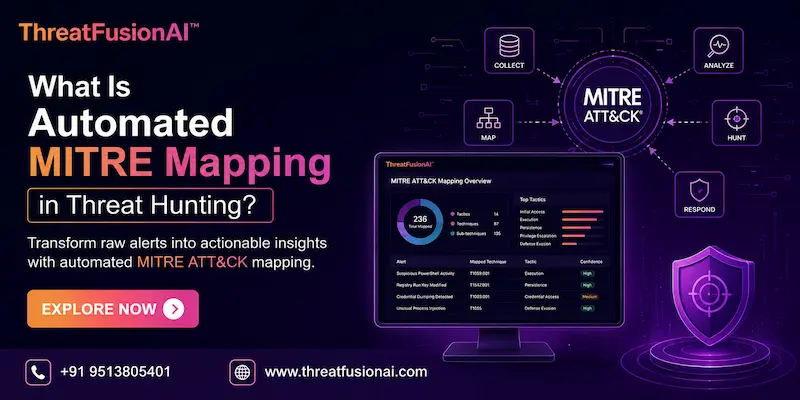
Hunters employ the MITRE ATT&CK Framework as a thorough knowledge base to map particular opponent tactics and behaviors to their own surroundings. It enables analysts to search for the exact strategies used by skilled attackers during the many phases of a breach, such as lateral movement or data exfiltration, rather than just basic indicators like IP addresses.
Key Skills Every Threat Hunter Needs
The following are some key skills every threat hunter needs:
● Deep Operating System Internals: Recognizing unauthorized system modifications requires an understanding of memory management, registry keys, and processes.
● Advanced Networking & Log Analysis: Tracing an attacker's journey requires the capacity to correlate logs from several sources and understand intricate traffic patterns.
● Proficiency in Query Languages: To effectively search through terabytes of data for certain anomalies, proficiency with tools such as KQL (Kusto), SQL, or SPL (Splunk) is required.
● Understanding of Adversary Tactics (TTPs): Hunters can predict and recognize malicious conduct by being aware of the exact tactics, techniques, and procedures employed by threat actors.
● Hypothesis Generation & Critical Thinking: The key to a successful hunt is the ability to formulate reasonable hypotheses based on scant facts and thoroughly test them.
Core Methodologies
|
S.No. |
Methodologies |
What? |
|
1. |
Hypothesis-Based Threat Hunting |
After formulating a hypothesis regarding the actions of a particular threat actor, analysts actively look for proof of that activity in the network. |
|
2. |
Intelligence-Driven Threat Hunting |
Hunters search for certain patterns pertinent to their company using external threat intelligence data, such as malware analysis and APT group profiles. |
|
3. |
Indicators of Compromise (IOC) Hunting |
This entails looking for known harmful artifacts, such as particular file hashes, IP addresses, or domain names, in previous logs and telemetry. |
|
4. |
Indicators of Attack (IOA) Hunting |
By spotting active tactics like code injection or unauthorized privilege escalation as they occur, this focuses on the "intent" of an attacker in real time. |
|
5. |
Behavioral Analytics in Threat Hunting |
To spot abnormalities, such as a user checking in from a different location or an unexpected spike in outgoing data traffic, analysts employ baseline "normal" behavior. |
Threat Hunting with SIEM Tools
Using consolidated log data to correlate events throughout the entire infrastructure and spot intricate patterns that point to a breach is known as threat hunting with SIEM (Security Information and Event Management) solutions.
Analysts can do cross-source analysis utilizing sophisticated query languages and visualization dashboards to find abnormalities that individual security solutions might overlook in isolation, like lateral movement or unexpected data exfiltration.
Threat Hunting Using EDR/ XDR Platforms
Threat hunters may quickly trace execution chains and pinpoint compromised hosts thanks to EDR/ XDR platforms' comprehensive, real-time visibility into endpoint operations and cross-layer telemetry.
By utilizing historical telemetry to precisely reconstruct an adversary's movement across the environment, these technologies allow analysts to advance from a single suspicious event to a comprehensive forensic examination.
Cloud Threat Hunting Best Practices
|
S.No. |
Practices |
What? |
|
1. |
Focus on Identity as the New Perimeter |
Keep an eye out for strange cross-account access patterns, privilege escalations, and abnormal MFA bypass attempts. |
|
2. |
Audit Cloud Control Plane Activity |
Examine management logs (such as Azure Activity Logs or AWS CloudTrail) for unauthorized resource creation or infrastructure modifications. |
|
3. |
Leverage Behavioral Baselining for Serverless & Containers |
To identify malicious code insertion or illegal resource usage in transient situations, establish "normal" execution patterns. |
|
4. |
Monitor API Call Spikes and Anomalies |
Keep an eye out for unexpected spikes or "Access Denied" problems in API calls that can point to credential stuffing or automated reconnaissance. |
|
5. |
Implement "Continuous Posture" Correlation |
To determine when misconfigurations are being actively abused, combine configuration drift data with real-time traffic records. |
Threat Hunting Automation and AI
Threat hunting automation and artificial intelligence employ machine learning to examine large datasets, automatically identifying "low-signal" risks and high-probability abnormalities that human analysts might miss.
These solutions enable hunters to concentrate their skills on probing complex, high-stakes situations instead of manually interpreting logs by automating repetitive data collection and initial triaging.
Building a Threat Hunting Playbook
In the following ways, you can build a threat hunting playbook:
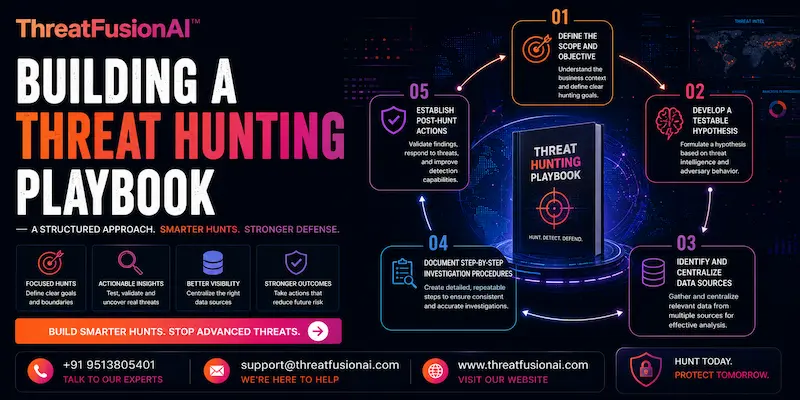
a) Define the Scope and Objective: To concentrate the search on a manageable area, choose a particular threat actor, tactic (from the MITRE ATT&CK matrix), or high-value asset.
b) Develop a Testable Hypothesis: To direct your search, create a "What if?" scenario, such as "What if an attacker is using DLL search order hijacking to gain persistence?"
c) Identify and Centralize Data Sources: Make that your SIEM can search the particular logs that are required, such as Sysmon, EDR telemetry, or firewall logs.
d) Document Step-by-Step Investigation Procedures: Describe the precise questions, instruments, and analysis methods needed to support or refute your theory.
e) Establish Post-Hunt Actions: Establish the process for reporting results, automating new detection rules, and patching vulnerabilities that are found.
Post-Hunt Remediation and Reporting
To stop the same tactic from working in the future, post-hunt remediation includes neutralizing threats that have been found and changing security measures. Technical results are translated into useful business intelligence through reporting, which includes specific suggestions to strengthen the organization's overall security posture as well as information on the attack path and weaknesses found.
Common Threat Hunting Challenges
The following are some common threat hunting challenges:
1. Data Overload and Signal-to-Noise Ratio: Finding "needles in a haystack" is frequently difficult for analysts because of the enormous volume of daily logs and false positives.
2. Lack of Quality Data and Retention: Reconstructing an attacker's past movements may be impossible due to incomplete telemetry or limited log retention periods.
3. Evolution of Adversary Techniques: Hunters must always update their knowledge and theories because sophisticated attackers are always changing their TTPs.
4. Shortage of Specialized Talent: An antagonistic mindset, coding prowess, and in-depth architectural understanding are all necessary for successful hunting.
5. Integration and Tooling Silos: Disconnected security products make it challenging to correlate events across several platforms and hinder a unified view of the environment.
Best Practices for Effective Threat Hunting
The following are the best practices for effective threat hunting:
● Start with a Clear Hypothesis: Instead of randomly looking through logs, base each hunt on a particular, rational idea of attacker behavior.
● Prioritize High-Value Targets: Concentrate your limited attention on safeguarding "crown jewel" assets, like sensitive intellectual property, financial databases, and domain controllers.
● Automate the Mundane: To free up your time for in-depth analysis, use playbooks and scripts to manage data collection and standardization.
● Document and Peer Review Findings: To guarantee consistency and enable others to verify your work, keep thorough records of your search terms and outcomes.
● Close the Feedback Loop: To stop the same threat from going unreported twice, turn each successful hunt into a permanent automatic detection rule.
Future Trends in Threat Hunting
|
S.No. |
Trends |
What? |
|
1. |
Rise of Agentic AI Hunters |
Autonomous AI agents are 30 times faster than human analysts at generating and testing their own theories and conducting parallel investigations. |
|
2. |
Edge Intelligence Systems |
Decentralized AI reduces detection latency and eliminates the need for large-scale cloud data transfers by processing telemetry locally on local devices. |
|
3. |
Combatting AI-Driven Adversaries |
Hunting techniques are changing to combat hyper-realistic deepfake lures produced by adversarial AI and polymorphic malware. |
|
4. |
Shift from Detection to Resilience |
The emphasis is shifting from merely "finding" threats to making sure systems can tolerate active breaches and automatically recover from them. |
|
5. |
Hyper-Contextual Data Lakes |
Security "swimming pools" allow hunters to immediately examine years' worth of historical raw data by combining siloed logs with rich business context. |
Conclusion
Now that we have talked about Threat Hunting Techniques, you might want to get a reliable security solution for yourself as well. For that, you can go for two amazing solutions. One of them is ThreatFusionAI, which collects data online and finds out about the latest cyber threats & intel.
The other one is ShieldXDR, which automatically identifies & eliminates cyber threats in time to reduce unwanted losses. What are you waiting for? Contact, Now!
Frequently Asked Questions
About Threat Hunting Techniques
1. What is threat hunting in cybersecurity?
A proactive, analyst-led network search known as "threat hunting" is used to find and isolate covert threats that have previously gotten past automated security measures.
2. Why is threat hunting important for security analysts?
Threat hunting is important for security analysts for the following reasons:
a) Shifts the Advantage to the Defender,
b) Deepens Environment Knowledge,
c) Reduces Potential Impact,
d) Validates Security Controls, and
e) Develops Advanced Technical Skills.
3. What are the most effective threat hunting techniques?
The following are the most effective threat hunting techniques:
a) Stack Counting (Stacking),
b) Cluster Analysis,
c) Hypothesis-Based Hunting,
d) Living-off-the-Land (LotL) Analysis, and
e) Graph-Based Link Analysis.
4. How does threat hunting differ from incident response?
While incident response is a reactive procedure started by an alert to contain and correct a confirmed breach, threat hunting is a proactive search for undetected dangers before an incident is known.
5. What tools are commonly used for threat hunting?
The following tools are commonly used for threat hunting:
a) SIEM & Data Lakes (e.g., Splunk, Microsoft Sentinel),
b) EDR & XDR Platforms (e.g., CrowdStrike Falcon, SentinelOne, Cortex XDR),
c) Network Detection & Response (NDR) (e.g., Darktrace, Corelight),
d) Threat Intelligence Platforms (TIP) (e.g., Recorded Future, Anomali), and
e) Specialized Forensic & Open-Source Tools.
6. What is the MITRE ATT&CK framework in threat hunting?
Hunters employ the MITRE ATT&CK framework, a globally available knowledge store on adversary tactics and techniques, as a standardized map to classify, monitor, and forecast malicious behavior during the course of an assault.
7. How can analysts detect advanced persistent threats (APTs)?
In the following ways, analysts detect advanced persistent threats (APTs):
a) Long-Term Behavioral Baselining,
b) Monitoring "Living off the Land" (LotL) Techniques,
c) Correlating Low-Signal Alerts,
d) Focusing on Lateral Movement & Staging, and
e) Analyzing Egress and DNS Traffic for Exfiltration.
8. What skills are required to become a threat hunter?
The following skills are required to become a threat hunter:
a) Advanced Data Analysis & Querying,
b) Deep OS & Network Internals,
c) Mastery of Adversary TTPs,
d) Investigative Mindset & Curiosity, and
e) Communication & Reporting.
9. How does AI improve threat hunting capabilities?
In the following ways, AI improves threat hunting capabilities:
a) Automated Hypothesis Generation and Reasoning,
b) Rapid Multi-Source Correlation,
c) Behavioral Anomaly Detection at Scale,
d) Natural Language Querying and Reporting, and
e) Significant Reduction in Triage Time.
10. What are the biggest challenges in threat hunting?
The following are the biggest challenges in threat hunting:
a) Data Saturation and "Signal-to-Noise" Ratio,
b) The Rise of AI-Automated Adversaries,
c) Visibility Gaps in Hybrid/Cloud Environments,
d) Advanced Evasion Techniques, and
e) The Cybersecurity Skills Gap.