Do you know what a Malware Infrastructure is and how threatening it can be for organizations running in the IT Industry? If not, then you are at the right place. Here, we will talk about what it is and how you can protect yourself against it.
Moreover, we will introduce you to a reliable threat detection solution offered by a reputable VAPT service provider. What are we waiting for? Let’s get straight to the topic!
What is Malware Infrastructure?
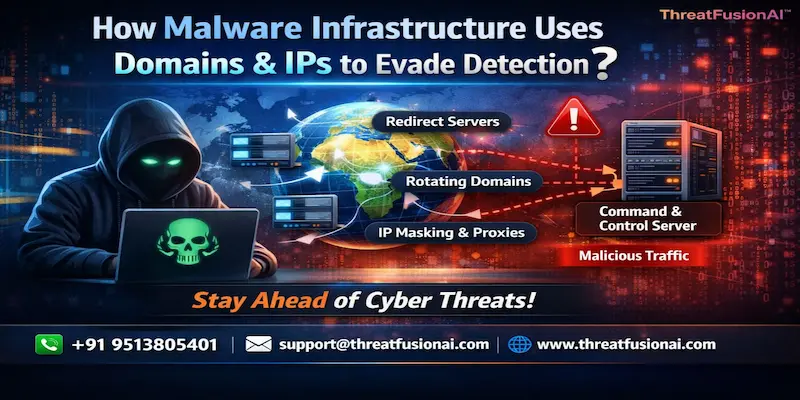
The integrated network of hardware and software resources, such as servers, domains, and compromised devices, that cybercriminals utilize to host, distribute, and manage malicious programs is known as malware infrastructure.
It offers the crucial framework for Command and Control (C2) communication, enabling attackers to exfiltrate private information from victim networks and transmit commands to compromised machines.
This architecture is made to be extremely resilient by using strategies like proxy layers and rotational hosting, which conceal the attacker's actual location to avoid being discovered by security teams. Let’s take a look at what a Malware Infrastructure is and how you can protect your devices from such attacks!
Fundamentals of Malware Infrastructure
|
S.No. |
Factors |
What? |
|
1. |
Command and Control (C2) Servers |
Attackers utilize the operation's central "brain" to deliver commands to compromised systems and obtain stolen data. |
|
2. |
Delivery and Hosting Platforms |
Malicious payloads, exploit kits, and phishing pages for initial infection are stored on the servers of compromised websites. |
|
3. |
Domain Names and DNS |
The naming scheme that enables malware to find its controller; attackers routinely alter addresses using Domain Generation Algorithms (DGAs). |
|
4. |
IP Addresses and Routing |
To stop the trail from tracing back to the attacker, proxy servers, VPNs, and bulletproof hosting are frequently used to conceal the servers' numerical identities. |
|
5. |
Persistence Mechanisms |
Peer-to-peer (P2P) nodes and backup servers are examples of redundant layers that guarantee the infrastructure remains operational even if certain components are taken down by law enforcement. |
|
6. |
Data Exfiltration Points |
Specialized storage facilities are created especially to receive and arrange large amounts of stolen data before it is transported to its intended location. |
Domain-Based Evasion
In the following ways, domain-based evasion takes place:
1. Domain Generation Algorithms (DGAs): Malware's programmatic processes generate hundreds of random domain names every day in order to get around static blacklists and guarantee a connection to the attacker.
2. DNS Abuse and Manipulation: The use of trustworthy DNS protocols, including DNS tunneling or hijacking, to evade firewalls by passing off malicious traffic as legitimate requests.
3. Fast Flux and Double Flux Networks: A method that quickly modifies the IP addresses (and occasionally DNS records) linked to a single domain, making it practically hard to identify and block the infrastructure.
4. Domain-Based Evasion Techniques: The general strategic use of spoofing, rotating, or trustworthy-looking domains to conceal the source of malicious traffic and continue to communicate with compromised hosts.
IP & Hosting Tactics
The following are the IP & Hosting Tactics:
● IP-Based Evasion Techniques: The use of a variety of dynamic IP addresses to get over security filters and conceal the actual location of the attacker's backend servers.
● Bulletproof Hosting Services: Hosting companies who purposefully disregard law enforcement requests and take-down requests, creating a "safe haven" for dangerous content and C2 infrastructure.
● Proxy Servers and Anonymization Techniques: VPNs and Tor are examples of intermediary nodes that relay traffic between the attacker and the victim to conceal the ultimate destination of stolen data.
● IP Shuffling and Rotational Proxies: A way to automatically cycle through a large pool of residential or data center IP addresses to keep security software from flagging or blacklisting any one address.
Challenges in Detecting Malware Infrastructure
|
S.No. |
Challenges |
What? |
|
1. |
Encrypted Traffic Hiding |
Attackers conceal malicious orders and data using SSL/TLS encryption, making it impossible for security tools to examine the traffic's content. |
|
2. |
Blending with Legitimate Services |
To blend in with regular corporate operations, malware hosts C2 traffic on reliable cloud services like Google Drive or GitHub. |
|
3. |
AI-Driven Adaptation |
In order to automatically change its communication patterns and evade behavior-based detection systems, modern malware use machine learning. |
|
4. |
Rapid Infrastructure Volatility |
Static blacklists and conventional blocklists are out of date since infrastructure components are thrown away and rebuilt in a matter of minutes. |
|
5. |
Use of Decentralized Networks |
By using blockchain-based DNS and P2P infrastructures, law enforcement cannot shut down a single central server. |
Indicator of Compromise (IoC) Attribution
The practice of associating particular forensic evidence, like distinct file hashes, dubious IP addresses, or registry keys, with a known threat actor or malware family is known as Indicator of Compromise (IoC) attribution.
Security teams can go beyond basic detection by examining these digital trails to pinpoint the precise adversary's purpose, place of origin, and advanced techniques employed during a breach.
Detection Techniques and Analysis Methods
The following are some detection techniques and analysis methods:
a) Signature-Based Detection: Immediately identifying "wanted" malware versions by comparing file hashes and code snippets against databases of known threats.
b) Behavioral & Dynamic Analysis: Running dubious files in a separate sandbox to keep an eye on things like illicit file encryption and registry modifications in real time.
c) Heuristic and AI-Augmented Scanning: Use machine learning to find anomalies and questionable code patterns that deviate from known baseline system behavior.
d) Memory Forensics: Searching for "fileless" malware that lurks within trustworthy processes and never comes into contact with the hard disk by examining a system's live RAM.
e) Network Traffic & DNS Analysis: Looking for telltale indicators of C2 activity in outgoing communication, such as unusual port utilization or frequent inquiries to DGA-generated domains.
Defensive Strategies and Countermeasures
|
S.No. |
Factors |
What? |
|
1. |
Zero Trust Architecture |
Confirming each user's and device's request, whether they are within or outside the network's perimeter. |
|
2. |
Automated Threat Hunting |
Employing AI to proactively search logs and telemetry for hidden signs of compromise before they set off an alert. |
|
3. |
DNS Filtering and Sinkholing |
Preventing access to known harmful domains and rerouting host traffic to a secure "sinkhole" for examination. |
|
4. |
Multi-Layered Endpoint Protection (EDR/ XDR) |
Implementing technologies that integrate automatic response, detection, and prevention on all devices and cloud settings. |
|
5. |
Segmented Networking |
To stop an attacker from moving laterally if one region is compromised, essential data and systems should be isolated into distinct zones. |
Case Studies and Real-World Examples
The following are some case studies and real-world examples:
1. SolarWinds (SUNBURST): Using a very advanced C2 infrastructure that imitated genuine network protocols and used US-based residential IP addresses to avoid geographic filtering, state-sponsored hackers carried out a historic supply chain attack in which they exploited a software update to spread malware throughout 18,000 businesses.
2. The Emotet Takedown and Resurrection: A multinational law enforcement task force "hijacked" its own C2 servers in 2021 to dismantle the infrastructure of a massive global botnet used for wire fraud. Ten months later, the group showed incredible resilience by rebuilding a new infrastructure using the existing "Trickbot" network.
3. Qakbot (Qbot) Infrastructure: A long-standing modular threat that allowed the main attackers to conceal their backend servers while carrying out extensive credential theft and ransomware distribution throughout the government and banking sectors by using a vast network of compromised "zombie" PCs to serve as proxy layers.
Incident Response and Mitigation
In the following ways, you can do incident response and mitigation:
● Isolate Compromised Systems: To stop the malware from "calling home" to its Command and Control (C2) servers or spreading laterally, immediately disconnect compromised devices from the network.
● Perform Memory and Forensic Analysis: To find the precise Indicators of Compromise (IoCs) and comprehend how the infrastructure established persistence, take pictures of the volatile RAM and disk.
● Update Security Policies and Blocklists: Update firewalls and DNS filters using the collected IoCs (IPs, DGAs, hashes), so as to "blind" the virus by severing its communication channels.
● Remediate and Patch: To stop a reinfection from the same infrastructure, remove the malware components, reset the compromised passwords, and patch the vulnerabilities that allowed the original access.
Future Trends in Malware Evasion
|
S.No. |
Trends |
What? |
|
1. |
AI-Generated Domain Schemes |
Large Language Models (LLMs) will be used by attackers more frequently to create "human-like" domain names that are more difficult for security algorithms to discern from authentic commercial websites. |
|
2. |
Deepfake and Identity Mimicry |
In order to counter biometric and multi-factor authentication, infrastructure will probably incorporate deepfake technologies, enabling attackers to pretend to be authorized administrators during C2 connections. |
|
3. |
Interplanetary File System (IPFS) Hosting |
In order to host harmful payloads in a way that is nearly impossible to remove, decentralized, peer-to-peer storage systems like IPFS are replacing standard web servers. |
|
4. |
Quantum-Resistant Encryption |
Malware creators will use new encryption standards for their communication channels as quantum computing develops in order to prevent future traffic cracking by security agencies. |
Frequently Asked Questions
About Malware Infrastructure
1. What is malware infrastructure?
The network of servers, domains, and compromised devices used by attackers to host, distribute, and manage malicious code while avoiding security detection is known as malware infrastructure.
2. Why do attackers frequently change domains?
For the following reasons, attackers frequently change domains:
a) Evading Static Blacklists,
b) Bypassing Reputation-Based Filters,
c) Neutralizing DNS Take-Downs,
d) Complicating Forensic Attribution, and
e) Circumventing Pattern Recognition.
3. What is a Command-and-Control (C2) server?
Cybercriminals utilize a centralized computer called a Command-and-Control (C2) server to deliver commands to compromised devices and obtain stolen data from a compromised network.
4. What is fast flux in cybersecurity?
By continuously cycling through a high-frequency pool of various IP addresses linked to a single domain name, fast flux is a DNS evasion technique that quickly conceals an attacker's server.
5. What are DGAs, and why are they dangerous?
Programmatic procedures known as Domain Generation Algorithms (DGAs) generate millions of random domain names, making it practically hard for defenders to stop the malware's communication path using conventional blacklists.
6. How does DNS tunneling work?
In the following ways, DNS tunneling works:
a) Infection and Encoding,
b) Formulating the Query,
c) Bypassing Firewalls,
d) Routing to the C2, and
e) Extraction and Response.
7. What is a botnet?
A botnet is a network of compromised computers and devices, sometimes referred to as "zombies," that are remotely managed by a single attacker to carry out coordinated cyberattacks, such as major DDoS attacks or data theft.
8. How do attackers use cloud services maliciously?
In order to get around conventional security filters, attackers use cloud services to host malware, store stolen data, and conceal Command-and-Control (C2) traffic behind the reputable brands of companies like AWS, Google, or Microsoft.
9. What is IP rotation?
In order to conceal its identity, get around rate restrictions, and stop security software from blacklisting a particular source, an attacker or automated system can use IP rotation.
10. What makes malware detection challenging?
The following factors make malware detection challenging:
a) Polymorphic and Metamorphic Code,
b) Living-off-the-Land (LotL) Tactics,
c) Encrypted Communication Channels,
d) Fileless Malware Execution, and
e) Anti-Sandboxing and Evasion.
Conclusion
Now that we have talked about what Malware Infrastructure is, you might want to get a dedicated tool to protect yourself against such infrastructures. For that, you can get in contact with Craw Security, offering a dedicated AI-based threat detection tool, “Threat Fusion AI,” to organizations.
This amazing tool can detect unknown malware infrastructure and help you by offering solutions to enhance the quality of security measures. What are you waiting for? Contact, Now!
Read More: