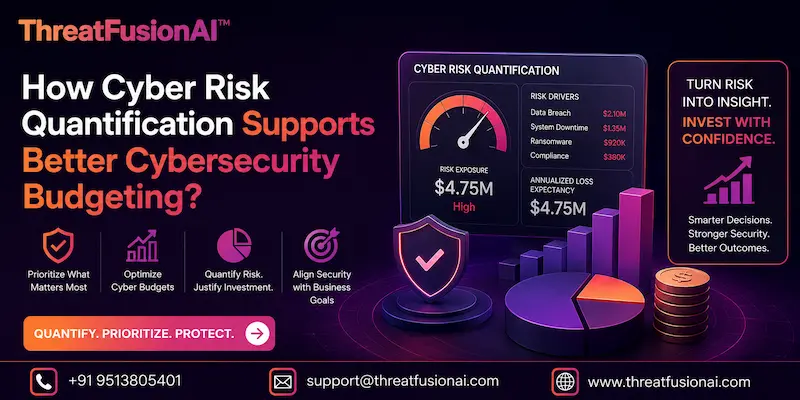
Do you know how Cyber Risk Quantification (CRQ) works and is beneficial for organizations in the IT Industry? If not, then you are at the right place. Here, we will talk about what cyber risk qualification is and the related benefits in detail.
Moreover, we will introduce you to a reliable threat intel platform offered by a reputable VAPT service provider. What are we waiting for? Let’s get straight to the topic!
Why Traditional Cybersecurity Budgeting Often Falls Short?
|
S.No. |
Factors |
Why? |
|
1. |
Treating Security as a Rigid Capital Expense (CapEx) |
Restricts funding to rigid yearly cycles that are unable to adjust to quickly changing, real-time threat environments. |
|
2. |
Relying on Fear, Uncertainty, and Doubt (FUD) |
Destroys long-term credibility and trust with board-level executives by using emotional terror rather than objective data. |
|
3. |
Failing to Quantify Cyber Risk in Financial Terms |
Instead of estimating actual prospective monetary losses for corporate assets, it uses abstract technical vocabulary to express dangers. |
|
4. |
Over-Investing in Tools While Underfunding Human Talent |
Gathers costly software licenses but lacks the qualified staff needed to manage and monitor them. |
|
5. |
Ignoring the Security Costs of Shadow IT and Cloud Migration |
Ignores fast cloud installations and unapproved employee software, resulting in significant concealed shortfalls in the baseline military budget. |
The Limitations of Qualitative Risk Matrices (The "Red-Amber-Green" Problem)
The following are the limitations of qualitative risk matrices:
1. Creates the Illusion of Precision (The "Range Compression" Trap): Flattens important subtleties by forcing wildly disparate financial risks into a single basic color box.
2. Suffers from Severe Subjective Bias: Relies not on hard, verifiable empirical data but only on personal perception and conjecture.
3. Fails to Account for Multiplicative and Compounding Risks: Ignores how little concurrent weaknesses can cause a major systemic breakdown when evaluating threats in isolation.
4. Flawed Mathematical Logic (The Rank-Order Error): Creates statistically flawed and deceptive danger rankings by multiplying arbitrary, non-numerical scale ranks (such as 3 x 4).
5. Paralyzes Actionable Budget Allocation: Executives are unable to determine the true return on investment (ROI) for security spending since specific financial amounts are not provided.
The Connection Between Cyber Risk and Budget Planning
The fundamental data source for budget planning is cyber risk, which converts intangible technical risks into measurable financial obligations that board members can comprehend. Organizations can move from reactive, speculative spending to strategic investments that directly support protection for their most valuable company assets by quantifying threats in monetary terms.
What Is Cyber Risk Quantification (CRQ)?
A data-driven process called Cyber Risk Quantification (CRQ) converts abstract technical vulnerabilities and attack probability into tangible financial terms, including dollar amounts at risk.
CRQ helps leaders make data-driven, business-focused decisions about security investments and insurance coverage by estimating the possible economic impact of a breach.
How does Cyber Risk Quantification Measure Financial Impact?
Cyber risk quantification measures financial impact in the following ways:
● Models Frequency and Severity Separately: Separates the likelihood of an assault from the real financial harm it does each time.
● Calculates Primary (Direct) Losses: Calculates the immediate, out-of-pocket costs associated with a breach, including regulatory fines, forensic response fees, and system restoration costs.
● Projects Secondary (Indirect) Losses: Calculates the long-term, trailing economic damages, such as intellectual property theft, customer attrition, and deterioration of a company's brand.
● Utilizes Monte Carlo Simulations: Creates a probability distribution that displays the whole range of possible financial loss by doing thousands of automated algorithmic trials.
● Maps Financial Risk to Specific Business Assets: Connects abstract cyberthreats to the precise financial worth of sensitive data repositories and key revenue-generating systems.
Communicating Cyber Risk in Financial Terms to the Board and CFO
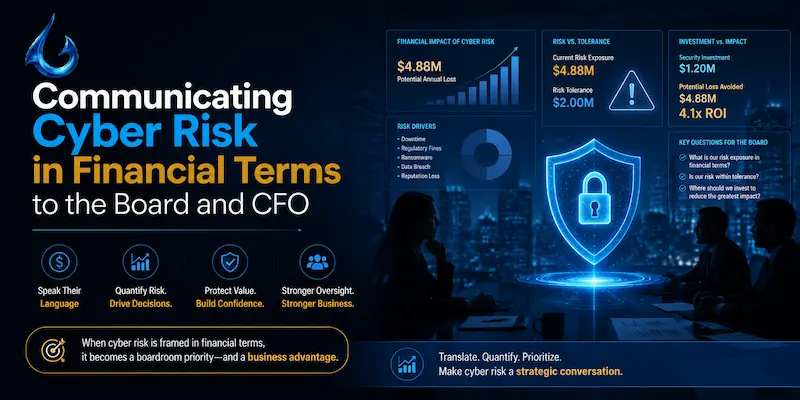
By putting cyber risk into financial terms, the discussion moves from technical language to business metrics and immediately aligns security measures with the board's and CFO's priorities.
Security executives may demonstrate the tangible return on investment (ROI) of defensive spending and gain executive support for strategic budget requests by framing threats as possible financial losses.
How Cyber Risk Quantification Helps Reduce Unnecessary Security Costs?
|
S.No. |
Factors |
How? |
|
1. |
Eliminates Tool Redundancy and Shelfware |
Finds and eliminates multimillion-dollar software licenses that either offer no discernible risk reduction or overlap in coverage. |
|
2. |
Prevents Over-Engineering Low-Risk Systems |
Prevents businesses from investing $5,00,000 to safeguard a non-critical asset with a $50,000 possible breach damage. |
|
3. |
Optimizes Cyber Insurance Premiums |
Avoids purchasing needless, expensive policy limitations by negotiating cheaper coverage premiums using accurate, data-backed risk profiles. |
|
4. |
Validates Cost-Effective Security Alternatives |
Demonstrates that built-in OS controls or straightforward, inexpensive process modifications can lower financial risk just as much as a high-end third-party technology. |
|
5. |
Reduces Costly "Firefighting" Actions |
Spends money on targeted, preemptive defense expenditures instead of costly, panicky emergency cleanup following a disaster. |
Leveraging Cyber Risk Quantification for Regulatory and Compliance Planning
By estimating the monetary fines, compliance expenses, and legal risks related to security non-compliance, cyber risk quantification synchronizes regulatory requirements with financial strategy.
Organizations can see compliance as a strategic investment aimed directly at avoiding the most costly legal and regulatory liabilities rather than as a static, check-the-box exercise, thanks to this data-driven strategy.
Real-World Examples of Cyber Risk Quantification in Budget Allocation
The following are some real-world examples of cyber risk quantification in budget allocation:
a) Justifying a SIEM Upgrade via MTTR Reductions: Demonstrates how a 40% reduction in Mean Time to Resolution (MTTR) can reduce possible data breach costs by millions, making a $5,00,000 tool upgrade extremely profitable.
b) Mitigating Third-Party Vendor Risk: To directly target security budgets at the most risky third-party integrations, rank supply-chain vendors according to their financial exposure.
c) Right-Sizing Ransomware Insurance and Defenses: In order to prevent paying excessive insurance premiums and to finance the precise controls required to halt encryption, it simulates the highest possible ransomware damages.
Best Practices for Integrating CRQ into Budgeting Processes
|
S.No. |
Practices |
What? |
|
1. |
Adopt a Standardized Financial Risk Model (like FAIR) |
To create mathematical credibility and communicate in a shared financial language, use a well-established framework. |
|
2. |
Tie the CRQ directly to the Annual Capital Allocation Cycle |
Incorporate risk assessments into the fiscal calendar to ensure that security proposals align with standard business funding schedules. |
|
3. |
Build Cross-Functional Teams of Security Analysts and Financial Advisors |
To make sure risk probabilities match corporate accounting criteria, tech teams are paired with financial experts. |
|
4. |
Focus First on High-Value Business Assets and Core Revenue Streams |
To create instant financial clarity where a breach is most painful, model the crown jewels first. |
|
5. |
Evolve from Static Annual Risk Reports to Continuous, Automated Modeling |
Replace outdated spreadsheets with real-time data streams that dynamically estimate risk in response to evolving infrastructure and threats. |
The Future of Cybersecurity Budgeting with Cyber Risk Quantification
Cybersecurity budgeting will change in the future from static, yearly guessing games to dynamic, data-driven financial strategies driven by AI predictive analytics and real-time risk simulation.
Organizations may convert security from an abstract corporate cost center into an optimized driver of fiscal resilience by automatically shifting funds to battle emerging liabilities through the seamless integration of real threat intelligence into financial models.
Conclusion: Making Smarter Cybersecurity Investments with CRQ
Now that we have talked about what Cyber Risk Quantification (CRQ) is, you might want to get a dedicated solution to prevent cyber threats before they can harm you. For that, you can go for Threat Fusion AI, a dedicated threat intel platform offered by Craw Security.
The amazing Threat Fusion AI can help you with the latest cyber threat intel, so you can be prepared beforehand for the latest cyber threats and be secure. Thus, you can feel safer against unknown threats. What are you waiting for? Contact, Now!
Frequently Asked Questions
About Cyber Risk Quantification (CRQ)
1. What is Cyber Risk Quantification in cybersecurity?
Cyber Risk Quantification (CRQ) is a data-driven method that converts threat probability and abstract technical cybersecurity vulnerabilities into tangible financial terms, like dollar amounts at risk.
2. How does Cyber Risk Quantification improve budget allocation?
Cyber risk quantification improves budget allocation in the following ways:
a) Replaces Emotional Panic with Hard Financial Data,
b) Maximizes Security Return on Investment (ROI),
c) Prevents the Over-Engineering of Low-Risk Systems,
d) Optimizes Cyber Insurance Spending, and
e) Ranks Supply-Chain and Third-Party Liabilities.
3. Why is CRQ important for business leaders and CFOs?
CRQ is important for business leaders and CFOs for the following reasons:
a) Translates Technical Jargon into Business Metrics,
b) Enables Data-Backed Cost-Benefit Analysis,
c) Aligns Cyber Defense with Corporate Risk Appetite,
d) Justifies and Defends Security Budget Requests, and
e) Improves Corporate Governance and Compliance Transparency.
4. What metrics are commonly used in Cyber Risk Quantification?
The following metrics are commonly used in cyber risk quantification:
a) Annualized Loss Expectancy (ALE),
b) Loss Event Frequency (LEF),
c) Loss Magnitude (Secondary and Primary Loss),
d) Value at Risk (VaR / Cyber VaR), and
e) Return on Security Investment (ROSI).
5. Can small businesses benefit from Cyber Risk Quantification?
Yes, Cyber Risk Quantification helps small organizations by identifying the precise low-cost or free security measures that shield their narrow profit margins from the most damaging financial attacks.
6. How does CRQ help justify cybersecurity investments?
CRQ helps justify cybersecurity investments in the following ways:
a) Proves Concrete Return on Investment (ROI),
b) Replaces Fear-Based Pitching with Financial Facts,
c) Enables Side-by-Side Project Comparison,
d) Defends Budgets Against Sudden Fiscal Cuts, and
e) Optimizes the Security vs. Insurance Trade-off.
7. What tools are used for Cyber Risk Quantification?
The following tools are used for cyber risk quantification:
a) Dedicated CRQ Platforms (e.g., Kovrr, CyberSaint),
b) Enterprise GRC Suites (e.g., MetricStream, Archer, ServiceNow),
c) Security Rating and Surface Mapping Tools (e.g., Bitsight, UpGuard),
d) Open-Source and Commercial FAIR Tools (e.g., OpenFAIR, RiskLens), and
e) Custom Statistical Calculators.
8. What is the difference between risk assessment and risk quantification?
While risk quantification uses mathematical modeling to determine the exact, data-backed economic impact and probability of such dangers, risk assessment detects and qualitatively classifies security concerns using descriptive labels like "high, medium, or low."
9. How often should organizations perform Cyber Risk Quantification?
As threat environments evolve, organizations should perform automatic quantification on a regular basis. This should be complemented by required re-evaluations throughout yearly budgeting cycles, significant infrastructure overhauls, or following a significant security incident.
10. What are the challenges of implementing Cyber Risk Quantification?
The following are the challenges of implementing cyber risk quantification:
a) Data Scarcity and Poor Internal Telemetry,
b) The Complexity of the Mathematical Models,
c) Garbage In, Garbage Out Vulnerability,
d) High Initial Time and Resource Investment, and
e) Resistance to Changing the Corporate Culture.
Read More:How Cyber Threat Intelligence Helps Predict Attacks Before They Happen?