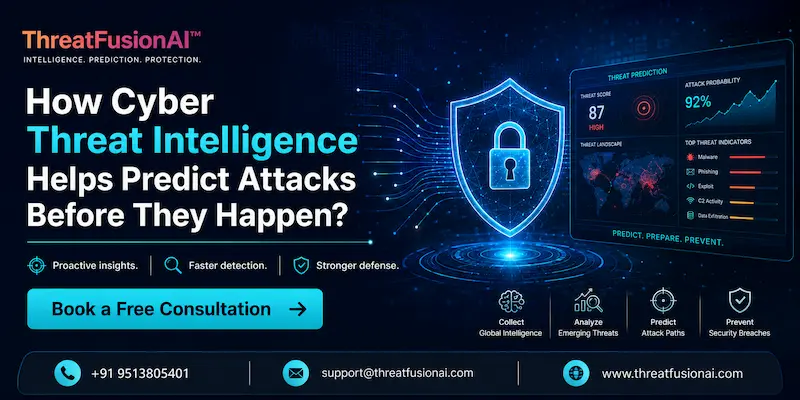
Do you know what Cyber Threat Intelligence is and how you can use such facilities to your benefit? If not, then you are at the right place. Here, we will talk about Cyber Threat Intelligence in detail.
Moreover, we will introduce you to a reliable threat intelligence tool offered by a reputable VAPT service provider. What are we waiting for? Let’s get straight to the topic!
What Is Cyber Threat Intelligence (CTI)?
Evidence-based information regarding current or potential digital threats, such as context, mechanisms, indications, and practical recommendations, is known as cyber threat intelligence (CTI). Security teams employ this gathered and examined data to comprehend the goals, targets, and attack tactics of an opponent.
In the end, CTI converts unprocessed, heterogeneous data into useful insights that enable businesses to proactively protect their networks and thwart cyberattacks before they have a chance to do damage. Let’s talk about what Cyber Threat Intelligence is and how it helps users!
The Shift from Reactive to Proactive Security
The transition from waiting for a breach to happen and repairing the damage to searching for vulnerabilities and foreseeing attacks in advance is known as the shift from reactive to proactive security.
Organizations may actively neutralize possible exploits and isolate attackers before they ever cross the network perimeter by utilizing behavioral analytics and real-time threat intelligence.
The Pillars of CTI : Strategic, Tactical, Operational, and Technical
|
S.No. |
Pillars |
What? |
|
1. |
Strategic |
Gives executive and board-level decision-makers high-level, non-technical insights on long-term commercial risks, geopolitical trends, and adversary motivations. |
|
2. |
Tactical |
Explains the precise Tactics, Techniques, and Procedures (TTPs) that threat actors employ, giving security analysts a better understanding of how an attack would be carried out. |
|
3. |
Operational |
Maps the precise identity, chronology, and operational aim of a threat group's campaign to provide meaningful, real-time context regarding incoming or ongoing threats. |
|
4. |
Technical |
Focuses on specific, transient forensic technical data that is immediately consumed by automated security defense technologies, such as malicious IP addresses, domain names, and file hashes. |
How CTI Sources and Collects Data?
In the following ways, CTI sources and collects data:
1. Internal Network Infrastructure telemetry: Finds active internal irregularities by analyzing network traffic, endpoint data, and local firewall logs.
2. Open-Source Intelligence (OSINT) Feeds: Collects free, publicly accessible information from government alerts, public code repositories, and security blogs.
3. Commercial and Premium Threat Feeds: Uses high-fidelity, validated, and compensated data streams from specialist suppliers to secure data in real time.
4. Dark Web and Underground Forum Monitoring: Searches for compromised credentials and new attacks by searching covert hacker channels and marketplaces.
5. Human-Derived Technical Communities & Partnerships: Shares operational knowledge with specialized research groups and reliable cross-industry security circles.
The Cyber Threat Intelligence Lifecycle
The following is the cyber threat intelligence lifecycle:
● Direction & Planning: Security leaders specify the fundamental goals, pinpointing the precise digital assets that require safeguarding as well as the particular risks that the company must contend with.
● Collection: Firewall logs, OSINT feeds, and dark web surveillance are just a few of the many internal and external sources from which analysts collect raw data.
● Processing: Security systems and human analysts can easily understand unstructured data when it has been cleaned, standardized, and categorized in a structured manner.
● Analysis & Production: In order to explain the "who, why, and how" behind a growing threat, security specialists assess the processed data and offer crucial context.
● Dissemination: The appropriate stakeholders, including executive boardrooms and automated firewall systems, receive the completed, actionable intelligence report.
● Feedback: The intelligence team evaluates the output's efficacy and uses input from stakeholders to improve the subsequent cycle of data collection and analysis.
Threat Intelligence Platforms (TIPs) and Automation
Massive amounts of fragmented threat data from many feeds are combined, normalized, and enhanced by Threat Intelligence Platforms (TIPs) into a single, centralized management hub. TIPs significantly reduce incident response times and do away with the need for analysts to perform manual triage by automating the validation and routing of these high-fidelity warnings straight to security solutions.
Integrating CTI into Security Operations Centers (SOCs)
By adding real-time adversary context, motivations, and behavioral patterns to generic warnings, the integration of Cyber Threat Intelligence (CTI) into Security Operations Centers (SOCs) improves everyday monitoring.
Tier-one analysts can quickly eliminate false positives, rank key incidents, and carry out automated, focused containment playbooks thanks to this structural integration.
Predictive Analytics and Threat Modeling
Threat modeling and predictive analytics sketch out an adversary's expected next moves against an organization's particular architecture by combining behavioral analysis and past attack data.
Security teams can proactively patch important vulnerabilities and implement targeted protections before a hacker ever initiates an exploit by modeling realistic attack vectors using frameworks like MITRE ATT&CK.
Information Sharing: ISACs, ISAOs, and Public-Private Partnerships
|
S.No. |
Pillars |
What? |
|
1. |
Information Sharing and Analysis Centers (ISACs) |
Sector-specific, member-driven hubs that exchange key threat information to safeguard essential infrastructure, such as energy, healthcare, and banking. |
|
2. |
Information Sharing and Analysis Organizations (ISAOs) |
Adaptable security communities that enable businesses, regardless of their particular sector or industry, to cooperate and exchange threat intelligence. |
|
3. |
Public-Private Partnerships |
Cooperative partnerships that, to counter nation-state cyberthreats, connect private companies with government intelligence and law enforcement organizations. |
|
4. |
Collective Cyber Defense |
Organizations automatically pool real-time threat data under a unified defense architecture, ensuring that a defense initiated by one member instantaneously protects everyone else. |
Challenges and Limitations of Threat Intelligence
The following are some challenges and limitations of threat intelligence:
a) High Volume of False Positives: Security systems may be overloaded by massive volumes of unverified data, creating false alarms that divert analysts from actual, serious risks.
b) Rapid Expiration of Indicators: Static threat feeds become outdated almost instantly when technical indications such as IP addresses and malicious websites change in a matter of minutes.
c) Information Overload and Silos: It is quite challenging to combine, standardize, and derive a single, distinct picture of a threat while handling fragmented data from dozens of various vendor feeds.
d) Severe Lack of Context: Security teams are unable to take proactive, strategic defenses when they do not know who transmitted the malware or how it functions.
e) High Implementation Costs: The implementation of sophisticated Threat Intelligence Platforms (TIPs) and the employment of specialized analysts necessitate a substantial financial outlay and highly skilled personnel, both of which are now in limited supply.
Building a Future-Ready CTI Program
In the following ways, you can build a future-ready CTI program:
1. Align with Core Business Risks: To justify security spending, explicitly link your intelligence needs to the company's most valuable digital assets and operational weaknesses.
2. Prioritize Automation and Tool Integration: Instantaneously block incoming attacks without the need for human analyst intervention by feeding threat data straight into current firewalls and detection systems.
3. Focus on Context Over Raw Volume: Give extensive, superior enemy profiles and behavioral analysis precedence over long lists of quickly expiring technical indications.
4. Cultivate Continuous Industry Collaboration: Engage in trusted sharing circles and ISACs to learn about new campaign strategies before they affect your industry.
5. Invest in Analytical Talent: Employ and educate security experts with the critical thinking abilities required to transform unprocessed threat data into strategic operational defense.
Conclusion
Now that we have talked about what Cyber Threat Intelligence is, you might want to get your hands on such a dedicated security solution. For that, you can go for Craw Security offering Threat Fusion AI, a dedicated threat intel solution.
The amazing Threat Fusion AI can help users to find out about the latest & current malicious threats, and they will be able to prepare for better security. Thus, you will be able to protect yourself against cyber threats in the future. What are you waiting for? Contact, Now!
Frequently Asked Questions
About Cyber Threat Intelligence
1. What is Cyber Threat Intelligence, and how does it differ from traditional cybersecurity?
While traditional cybersecurity concentrates on defensively deploying measures to block or respond to active network breaches, cyber threat intelligence is evidence-based information that proactively analyzes enemy intentions and behaviors to predict attacks.
2. How far in advance can CTI actually predict a cyberattack?
Depending on the trigger, CTI can anticipate attacks weeks or months in advance by seeing recently discovered zero-day vulnerabilities and changing geopolitical threat patterns, or days or weeks in advance by monitoring adversary dark web conversations and staging infrastructure.
3. What are the most reliable sources of threat intelligence data?
The following are the most reliable sources of threat intelligence data:
a) Government and Law Enforcement Advisories,
b) Industry-Specific ISACs,
c) Top-Tier Cybersecurity Vendors,
d) The MITRE ATT&CK Framework, and
e) Vetted Open-Source Projects and Repositories.
4. Is Cyber Threat Intelligence only relevant for large enterprises, or can small businesses benefit too?
Small firms greatly benefit from leveraging outsourced threat intelligence integrated directly into managed security services to prevent sophisticated attacks before they affect operations, whereas major enterprises create internal teams.
5. How does dark web monitoring contribute to predicting cyber threats?
Dark web monitoring contributes to predicting cyber threats in the following ways:
a) Early Warning of Credential Stuffing,
b) Tracking Zero-Day and Exploit Sales,
c) Exposing Target Lists and Reconnaissance,
d) Monitoring Access Brokers, and
e) Revealing Shift in Adversary TTPs.
6. What is the difference between Indicators of Compromise (IoCs) and Indicators of Attack (IoAs)?
While Indicators of Attack (IoAs) are proactive, behavioral indicators indicating an attack is now taking place in real time (such as illegal code execution), Indicators of Compromise (IoCs) are reactive, forensic proof that an attack has already occurred (such as a known file hash).
7. How do AI and machine learning improve the accuracy of threat prediction?
AI and ML can improve the accuracy of threat prediction in the following ways:
a) Automating Behavioral Anomaly Detection,
b) Rapid Processing of Threat Big Data,
c) Eliminating False Positives Through Scoring,
d) Predicting Adversary Next Steps, and
e) Continuous Self-Learning and Adaptability.
8. What role do government agencies and information-sharing networks play in CTI?
The following are the roles of government agencies and information-sharing networks in CTI:
a) Declassification of Geopolitical Threat Intelligence,
b) Providing Sector-Specific Contextualized Data,
c) Enabling Automated, Real-Time Indicator Exchange,
d) Coordinating Large-Scale Incident Response, and
e) Establishing Authoritative Baseline Vulnerability Catalogs.
9. How do organizations measure the effectiveness of their threat intelligence program?
Organizations can measure the effectiveness of their threat intelligence program in the following ways:
a) Reduction in Mean Time to Detect and Respond (MTTD/MTTR),
b) Actionable Intelligence Ratio,
c) Feed Efficacy and False Positive Rates,
d) MITRE ATT&CK Matrix Coverage, and
e) FTE Analyst Efficiency and Time Recovered.
10. What are the biggest challenges in acting on threat intelligence before an attack occurs?
The following are the biggest challenges in acting on threat intelligence before an attack occurs:
a) The Challenge of Attributing Intent,
b) Legacy Security Infrastructure Bottlenecks,
c) Internal Friction and "Alert Fatigue",
d) Organizational Change Control and Patching Friction, and
e) Data Disconnect and Siloed Visibility.