Do you know what a Unified Threat Intelligence Platform is and its benefits for users working in the IT Industry? If not, then you are at the right place. Here, we will talk about the UTIP in detail with its benefits.
Moreover, we will introduce you to a reliable threat intelligence tool offered by a reputable VAPT service provider. What are we waiting for? Let’s get straight to the topic!
What Is a Unified Threat Intelligence Platform?
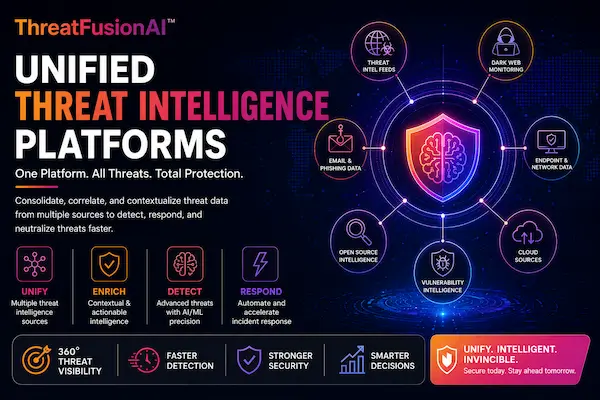
A Unified Threat Intelligence Platform (UTIP) is a centralized security solution that provides a single "source of truth" about cyber threats by combining, correlating, and analyzing raw data from many internal and external sources.
Security teams are better able to prioritize and address significant issues because it removes data silos and employs automation to filter out noise by merging various feeds into a single interface.
By providing actionable insights and promoting smooth coordination across various security technologies and departments, this simplified method improves an organization's proactive defense posture.
Let’s talk about the Unified Threat Intelligence Platform in detail and find out its features for the users!
Why Enterprises Need Unified Threat Intelligence Solutions in 2026?
|
S.No. |
Factors |
Why? |
|
1. |
Combating AI-Driven Adversaries |
"Defensive AI" is used by unified platforms to combat agentic bots that change their strategies in real time and polymorphic malware. |
|
2. |
Mitigating the "Tool Sprawl" Fatigue |
By removing disjointed data silos, security stack consolidation lowers the "index tax" and alert fatigue for overburdened SOC teams. |
|
3. |
Meeting Strict "Proof of Governance" Regulations |
The auditable, "calibrated trust" needed for new regulations that hold executives personally accountable for violations is provided by centralized intelligence. |
|
4. |
Closing the Cybersecurity Skills Gap |
A smaller personnel may concentrate on high-level strategy and threat validation since automation manages high-volume analytical duties. |
|
5. |
Shift from Reactive to Predictive Defense |
By using past patterns to predict an attacker's future TTP, predictive modeling enables preventive patching before an exploit materializes. |
The Evolution from Silos to Unified Intelligence
The transition from fragmented, manual data collecting across disparate platforms to a streamlined, automated ecosystem that correlates global threat telemetry in real-time is symbolized by the move from silos to unified intelligence.
By replacing reactive "whack-a-mole" security with a centralized architecture that offers comprehensive visibility, this shift enables enterprises to outperform sophisticated adversaries with actionable, high-fidelity information.
Core Capabilities & Visibility
The following are some core capabilities & visibility of UTIP:
1. Multisource Data Integration: Creates a single, coherent view by combining and standardizing diverse data from internal telemetry, dark web monitoring, and open-source feeds.
2. AI-Enhanced Correlation: Uses sophisticated machine learning to uncover intricate assault patterns that human analysts might overlook by connecting "weak signals" across various vectors.
3. Real-Time Threat Visualization: Offers dynamic heatmaps and dashboards that link global threats to the unique digital footprint and asset inventory of a company.
4. Automated Contextualization: Automatically adds "who, what, and why" information to raw indicators, rating risks according to their actual significance and possible business impact.
5. Bidirectional Ecosystem Orchestration: Easily synchronizes intelligence with current tools (such as SIEM, SOAR, and EDR) to initiate network-wide automatic defensive measures.
Key Features to Look for in an Enterprise Threat Intelligence Platform
|
S.No. |
Features |
What? |
|
1. |
Agentic AI & Natural Language Reasoning |
Using conversational logic and reasoning, autonomous agents carry out multi-step investigations and comprehend complex requests. |
|
2. |
Broad-Spectrum Ingestion & Normalization |
Absorbs both organized and unstructured data into a single format from internal telemetry, OSINT, and the dark web. |
|
3. |
Contextual Relevance Scoring |
Threats are dynamically prioritized according to your industry, asset value, and amount of current exposure rather than general severity. |
|
4. |
Native MITRE ATT&CK & TTP Mapping |
Displays coverage gaps and defensive preparedness by automatically aligning each indicator with known enemy actions. |
|
5. |
Bidirectional API Orchestration |
In order to automate real-time blocking and confinement, it actively pushes instructions to your security stack in addition to receiving data. |
Top Benefits of Unified Threat Intelligence Platforms for Enterprise Cybersecurity
The following are some of the top benefits of UTIP for enterprise cybersecurity:
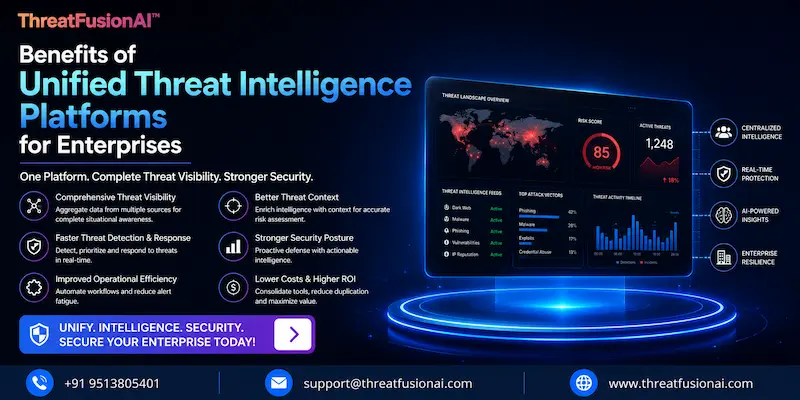
● Operationalized "Context-Aware" Prioritization: Highlights just the particular vulnerabilities that directly endanger your distinct digital footprint by filtering out global noise.
● Drastic Reduction in Mean Time to Respond (MTTR): Enables your SOC to contain threats in minutes as opposed to days by automating the "enrichment-to-action" chain.
● Elimination of the "Index Tax" and Tool Sprawl: Reduces licensing costs and improves data storage efficiency by combining redundant inputs and platforms.
● Enhanced Resilience Against AI-Driven Threats: Uses real-time behavioral analytics to identify and stop self-governing, rapidly changing "agentic" cyberattacks.
● Audit-Ready Governance and Compliance: Enables smooth regulatory reporting by offering a consolidated, unchangeable ledger of threat activity and response actions.
How Unified Threat Intelligence Platforms Improve Threat Detection and Response?
In the following ways, UTIP improves threat detection and response:
a) Precision-Weighted Alerting: Platforms assign risk rankings based on the correlation between global threat feeds and internal telemetry, ensuring that responders prioritize the most deadly threats.
b) Accelerated Triage via Contextualization: Bypassing the manual research stage, analysts receive pre-enriched alerts that include the threat actor's name, motivation, and past TTPs.
c) Dynamic Playbook Activation: When a high-confidence indicator is detected, pre-programmed defensive measures, such as changing firewall rules in a matter of seconds or isolating an infected host, can be promptly triggered.
d) Mapping to MITRE ATT&CK Framework: A clear road map for defensive weaknesses and necessary response actions is provided by automatically mapping each detected event to certain enemy tactics.
e) Reduced "Dwell Time": Subtle lateral motions are detected by AI-driven pattern recognition and continuous surveillance, which stops hackers before they can steal confidential information.
Best Use Cases of Unified Threat Intelligence Platforms Across Industries
|
S.No. |
Factors |
What? |
|
1. |
Financial Services |
In the banking industry, UTIPs use real-time transaction data and dark web chatter to detect account takeover (ATO) patterns before they happen. By 2026, these systems will be specifically geared to identify "AI-synthesized" fraud efforts, connecting suspicious login activity to well-known underground marketplaces that sell deepfake-as-a-service tools and stolen banking credentials. |
|
2. |
Healthcare |
Unified platforms are used by healthcare companies to obtain visibility into susceptible medical devices, such as connected infusion pumps or MRI machines that are unable to run conventional security agents. In order to protect patient care systems from ransomware spreading throughout the corporate network, the platform keeps an eye out for adversary TTPs (Tactics, Techniques, and Procedures) that target certain healthcare protocols. |
|
3. |
Critical Infrastructure & Manufacturing |
UTIPs serve as a link between conventional IT systems and Operational Technology (OT) in the manufacturing and energy sectors. They keep an eye out for specialized malware intended to interfere with industrial control systems, such as variations of Industroyer. When a concerted nation-state effort is discovered, they can isolate power grid segments or initiate "fail-safe" measures by combining local sensor data with global threat intelligence. |
Future Trends in AI-Driven Unified Threat Intelligence for Enterprises
The following are some future trends in AI-Driven UTIP for enterprises:
1. Rise of Agentic AI Swarms: These days, specialized AI bots work together in "swarms" to automatically search for threats, exchange context, and plan multi-vector solutions without human assistance.
2. Hyper-Predictive Attack Forecasting: Weeks before the first packet is delivered, sophisticated models predict particular attack campaigns by analyzing changes in the global enemy infrastructure and economic data.
3. Decentralized Intelligence & "Edge" Reasoning: Security intelligence has shifted to the "Edge," enabling remote sensors and Internet of Things devices to execute local threat containment and reasoning in milliseconds.
Conclusion: How Unified Threat Intelligence Builds a Stronger Cybersecurity Strategy?
Now that we have talked about Unified Threat Intelligence Platform, you might want better threat insight tools to deal with unknown threats faster. For that, you can go for Threat Fusion AI, a dedicated Threat Intel tool offered by Craw Security.
This tool finds out the real-time insights and intel about current threats so that you can easily prepare for them beforehand to deal with threats in time. Moreover, if you want dedicated threat detection and response tools to deal with threats, you can go for ShieldXDR, which is also another tool from Craw Security, specialized in detecting threats in time and eliminating them without human intervention. What are you waiting for? Contact, Now!
Frequently Asked Questions
About Unified Threat Intelligence Platform
1. What is a Unified Threat Intelligence Platform?
In order to give proactive, real-time insights against cyber threats, a unified threat intelligence platform is a centralized security solution that compiles and combines many data sources into a single source of truth.
2. How does a Unified Threat Intelligence Platform work?
In the following ways, a Unified Threat Intelligence Platform works:
a) Data Ingestion & Normalization,
b) AI-Driven Correlation,
c) Contextual Enrichment,
d) Risk-Based Prioritization, and
e) Automated Response Orchestration.
3. Why do enterprises need unified threat intelligence solutions?
Enterprises need unified threat intelligence solutions for the following reasons:
a) Combating AI-Driven Adversaries,
b) Mitigating the "Tool Sprawl" Fatigue,
c) Meeting Strict "Proof of Governance" Regulations,
d) Closing the Cybersecurity Skills Gap, and
e) Shift from Reactive to Predictive Defense.
4. What are the benefits of using a Unified Threat Intelligence Platform?
The following are the benefits of using a Unified Threat Intelligence Platform:
a) Operationalized "Context-Aware" Prioritization,
b) Drastic Reduction in Mean Time to Respond (MTTR),
c) Elimination of the "Index Tax" and Tool Sprawl,
d) Enhanced Resilience Against AI-Driven Threats, and
e) Audit-Ready Governance and Compliance.
5. How does unified threat intelligence improve cybersecurity operations?
In the following ways, unified threat intelligence improves cybersecurity operations:
a) Precision-Weighted Alerting,
b) Accelerated Triage via Contextualization,
c) Dynamic Playbook Activation,
d) Mapping to the MITRE ATT&CK Framework, and
e) Reduced "Dwell Time".
6. Can Unified Threat Intelligence Platforms detect advanced cyber threats?
Yes, AI-driven behavioral analytics and global telemetry correlation are used by Unified Threat Intelligence Platforms to uncover sophisticated patterns that evade conventional signature-based protections, like polymorphic malware and zero-day exploits.
7. How do threat intelligence platforms integrate with SIEM and SOAR tools?
In the following ways, threat intelligence platforms integrate with SIEM and SOAR tools:
a) Real-Time Data Enrichment for SIEM,
b) Automated Contextualization for SOAR,
c) Bi-Directional Feedback Loops,
d) Operationalizing Playbooks with "Threat Actor Profiles", and
e) Reduction of the "Index Tax" and Noise.
8. What features should enterprises look for in a threat intelligence platform?
An enterprise should look for the following features in a threat intelligence platform:
a) Agentic AI & Natural Language Reasoning,
b) Broad-Spectrum Ingestion & Normalization,
c) Contextual Relevance Scoring,
d) Native MITRE ATT&CK & TTP Mapping, and
e) Bidirectional API Orchestration.
9. How does AI enhance unified threat intelligence platforms?
In the following ways, AI enhances unified threat intelligence platforms:
a) Autonomous Correlation at Machine Speed,
b) Predictive Forecasting and Modeling,
c) Natural Language Interaction (GenAI),
d) Adaptive Behavioral Baselining, and
e) Intelligent Noise Reduction.
10. Which industries benefit the most from Unified Threat Intelligence Platforms?
The following industries benefit the most from Unified Threat Intelligence Platforms:
a) Financial Services & Banking,
b) Healthcare & Life Sciences,
c) Critical Infrastructure & Energy,
d) Manufacturing & Industry 4.0, and
e) Government & Public Sector.
Read More:Top Benefits of AI in Cyber Threat Detection and Response