Do you know what URL Threat Intelligence is, and how it can help organizations to secure their working environment against unknown cyber threats? If not, then you are at the right place. Here, we will talk about URL Threat Intelligence in detail.
Moreover, we will introduce you to a reliable threat intel platform offered by a reputable VAPT service provider. What are we waiting for? Let’s get started!
What Is URL Threat Intelligence?
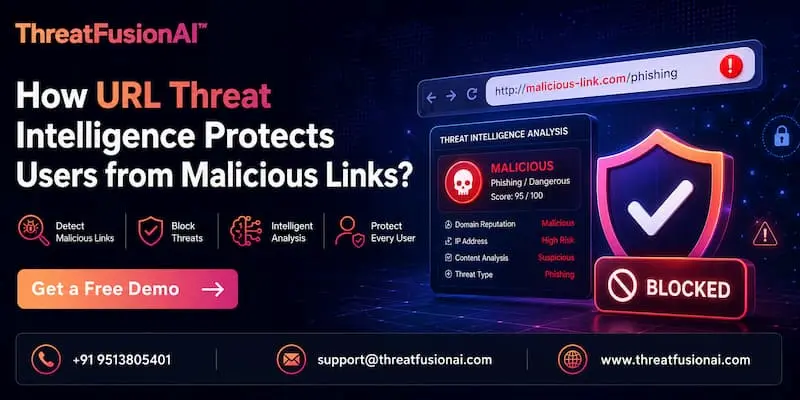
The process of gathering, evaluating, and compiling information on harmful hyperlinks in order to detect online dangers such as phishing, malware distribution, and fraud is known as URL threat intelligence.
It assesses the reputation and risk score of URLs to assist security systems in proactively blocking harmful web traffic by utilizing real-time databases and machine learning. Organizations can protect their networks and users from web-based assaults before a link is ever made, thanks to this practical knowledge. Let’s talk about what URL Threat Intelligence is and how it helps organizations in securing data!
Why Malicious Links Are a Growing Cybersecurity Threat?
|
S.No. |
Factors |
Why? |
|
1. |
Sophisticated Social Engineering |
They utilize deepfakes and artificial intelligence-generated urgency to impersonate reputable brands in order to deceive consumers. |
|
2. |
Evasion of Traditional Security Filters |
To get around static scanners, attackers employ delayed activation and dynamic routing. |
|
3. |
Proliferation of Mobile Attacks (Smishing) |
By focusing on individual mobile devices, text-based links get around company network security measures. |
|
4. |
Exploitation of Zero-Day Vulnerabilities |
Just opening the link can cause unpatched vulnerabilities that infect devices right away. |
|
5. |
Weaponization of Shorteners and QR Codes (Quishing) |
Malicious destinations are hidden from both human sight and email security systems by obscured URLs. |
How URL Threat Intelligence Works?
URL threat intelligence works in the following ways:
1. Data Collection and Crowdsourcing: Security networks use email honeypots, web crawlers, and global user danger reports to collect URL data.
2. Behavioral Analysis and Sandboxing: To check for covert malicious activities, suspicious URLs are opened in segregated virtual environments.
3. Machine Learning and Reputation Scoring: To determine a risk level, AI algorithms consider page structure, hosting history, and domain age.
4. Database Updates and Categorization: Threats that have been verified are categorized by kind and immediately added to global security feeds.
5. Automated Blocking and Prevention: These real-time feeds are used by firewalls and endpoint programs to prevent users from accessing risky URLs.
Heuristic Context Evaluation and Visual Page Cloning Detection
Advanced AI-driven methods, such as Heuristic Context Evaluation and Visual Page Cloning Detection, employ web page properties to detect complex phishing efforts. While the latter uses visual pictures of a page to determine whether it pixel-perfectly matches a reputable brand's login screen, the former looks for contextual irregularities such as domain age, text structures, and mismatched SSL certificates.
When combined, they enable security systems to identify zero-day phishing websites that visually and contextually mimic reputable organizations but lack known signatures.
How URL Reputation Scoring Identifies Dangerous Links?
|
S.No. |
Factors |
How? |
|
1. |
Analyzing Domain Metadata |
To identify recently formed, high-risk websites, it verifies the domain's age, registrar legality, and SSL certificate validity. |
|
2. |
Evaluating Visual and Structural Properties |
It looks for hidden forms, replicated brand logos, and user-tricking layouts on the page. |
|
3. |
Tracking Historical Threat Data |
It compares the autonomous system number (ASN) and hosting IP address to known malicious infrastructure. |
|
4. |
Inspecting Behavioral Anomalies |
It keeps an eye out for any unusual redirects, suspicious background scripts, or triggers for silent file downloads. |
|
5. |
Leveraging Machine Learning Classifiers |
Before a visitor sees the page, it instantaneously calculates a dynamic risk assessment by feeding all of these data points into AI models. |
Key Components of URL Threat Intelligence
The following are some key components of URL threat intelligence:
● Threat Data Feeds: Web crawlers, honeypots, and international security research networks provide constant, real-time streams of known harmful URLs.
● Analysis and Execution Engines: Systems that find hidden threat indications and safely explode links using heuristic evaluation, machine learning, and sandboxing.
● Reputation and Risk Scoring Database: Every web address is given an actionable safety score by a dynamic ledger that keeps track of domain history, metadata, and visual characteristics.
● Integration API Engine: The bridge that smoothly transmits threat intelligence to firewalls, secure web gateways, and endpoint detection software that are already in place.
● Security Response Dashboard: A unified platform that enables security teams to monitor active network blocks, handle warnings, create blocklists, and look into false positives
The Role of Threat Intelligence Feeds in URL Security
The following are some of the roles of threat intelligence feeds in URL security:
a) Proactive Defenses: They change security from reactive cleanup to active prevention by blocking access to harmful websites before they can reach the network.
b) Rapid Incident Response: To speed up the containment and investigation of active online threats, they provide security teams with real-time context and risk data.
c) Elimination of Security Silos: To coordinate a single, network-wide defense, they disperse unified threat data among firewalls, email gateways, and endpoint software.
d) Reduction of False Positives: To guarantee uninterrupted genuine web traffic flows, they employ constant automated cross-referencing against trustworthy domains.
e) Global Crowd-Sourced Protection: By weaponizing telemetry collected from millions of endpoints worldwide, they rapidly protect your company from newly identified assaults.
Automated Sandbox Detonation and Link Rewriting Pipelines
Malicious URLs are intercepted and neutralized by automated sandbox detonation and link rewriting pipelines before they can reach the user. At the precise moment of the click, the pipeline rewrites incoming links to pass them through a secure proxy, which initiates a background sandbox to securely execute and examine the actual destination for hidden risks.
Types of Malicious URLs Detected by Threat Intelligence
The following types of malicious URLs were detected by threat intelligence:
1. Phishing and Spoofing Links: Fake landing pages designed to mimic bank, email, or corporate service login screens to steal login credentials.
2. Malware and Ransomware Distribution Sites: Websites with exploit kits or malicious payloads that, when a person visits the page, cause secret background downloads.
3. Command and Control (C2) Callbacks: Malware contains server links that compromised devices utilize to log in, get instructions, or steal data.
4. Scam and Rogue Advertising Domains: Deceptive websites that use risky drive-by redirection, cryptocurrency giveaway scams, or phony tech help schemes.
5. Typosquatting and Lookalike URLs: Domains that replicate well-known business web addresses with little misspellings (such as g00gle.com) to take advantage of typing errors by users.
Machine Learning and AI in URL Threat Detection
In order to determine whether an unknown URL is harmful before it has a chance to do so, machine learning and artificial intelligence examine intricate patterns such as domain age, structural structure, and semantic behavior.
These algorithms remove the latency associated with static signature lookups and conventional blocklists by identifying subtle obfuscation techniques and zero-day phishing changes in real time.
How Organizations Use URL Threat Intelligence to Prevent Cyberattacks?
|
S.No. |
Factors |
How? |
|
1. |
Secure Email Gateway Filtering |
Stops harmful attachments, phishing, and scams at the email boundary before they reach users' inboxes. |
|
2. |
Next-Gen Firewall and Web Protection |
Limits network perimeter access to malicious, recently registered, or unclassified domains. |
|
3. |
Endpoint Detection and Response Integration |
Prevents harmful link executions off the company network by extending web defense straight to local devices. |
|
4. |
Automated Incident Response Enrichment |
Expedites threat analysis and containment processes by instantly contextualizing alerts with domain risk scores. |
|
5. |
Proactive Security Awareness Training |
Creates realistic, focused phishing simulations that inform susceptible individuals using real-world threat intelligence. |
Common Challenges in URL Threat Detection
The following are some common challenges in URL threat detection:
● Dynamic Routing and Evasion: To evade sandbox scanners, attackers use proxy hops, geographic IP restrictions, and delayed activations.
● The Scale of Zero-Day Phishing: Hours after being created, thousands of lookalike domains disappear, easily surpassing blocklists based on signatures.
● Weaponized Legitimate Infrastructure: The excellent reputation rankings of the supplier are passed down to malicious forms housed on reliable cloud services.
● Obfuscation through QR Codes and Shorteners: By concealing the ultimate harmful location from text scanners, masked URLs evade email gateway scrutiny.
● Alert Fatigue and False Positives: Security personnel are overburdened by misclassified clean links, which can cause disruptions that encourage users to turn off safety features.
Future Trends in URL Threat Intelligence and Cybersecurity
The following are the future trends in URL threat intelligence and cybersecurity:
a) Agentic AI and Autonomous Response: Without waiting for human verification, intelligent security agents independently search for and isolate newly discovered harmful links.
b) Deepfake Visual and Identity Verification: Pixel-perfect replicated web pages are instantly blocked by multi-layered AI models that examine layout physics and rendering faults.
c) Adversary-in-the-Middle (AiTM) Defenses: By gathering session tokens, real-time link scanning intercepts proxy connections that get around conventional multi-factor authentication.
d) Zero Trust Identity Integration: Before permitting an active session to authenticate, conditional access technologies continuously assess dynamic URL safety scores.
e) Decentralized and Web3 Threat Tracking: Collaborative ledger networks outperform distributed hacker infrastructure by instantly disseminating unchangeable threat metrics worldwide.
Conclusion: Strengthening Security with URL Threat Intelligence
Now that we have talked about what URL Threat Intelligence is, you might want to learn where you can get the best threat intelligence services from a reliable source. For that, you can go for Threat Fusion AI, a dedicated threat intel program offered by Craw Security.
Threat Fusion AI can help organizations stay updated with the latest malware attacks so that they can better prepare for future threats. What are you waiting for? Contact, Now!
Frequently Asked Questions
About URL Threat Intelligence
1. What is URL threat intelligence in cybersecurity?
The process of gathering, evaluating, and rating information regarding harmful hyperlinks in order to proactively detect and stop web-based cyberthreats, including malware and phishing, is known as URL threat intelligence.
2. How does URL threat intelligence detect malicious links?
URL threat intelligence detects malicious links in the following ways:
a) Metadata and Domain Age Analysis,
b) Heuristic Context Evaluation,
c) Visual Page Cloning Detection,
d) Automated Sandbox Detonation, and
e) Machine Learning and Reputation Scoring.
3. Why is URL reputation important for online security?
URL reputation is important for online security for the following reasons:
a) Preempts Attacks Before Infiltration,
b) Defends Against Brand Impersonation,
c) Neutralizes Unknown (Zero-Day) Threats,
d) Prevents Malware Command and Control (C2), and
e) Reduces Operational Alert Fatigue.
4. Can URL threat intelligence prevent phishing attacks?
Yes, URL threat intelligence stops phishing assaults by automatically blocking access to credential-harvesting websites before users can open them based on real-time analysis of link behavior, metadata, and visual structures.
5. What types of threats can be identified through URL intelligence?
The following types of threats can be identified through URL intelligence:
a) Credential Harvesting and Phishing,
b) Drive-by Malware Downloads,
c) Command and Control (C2) Infrastructure,
d) Typosquatting and Lookalike Domains, and
e) Rogue Advertisements and Tech Support Scams.
6. How does AI improve URL threat detection?
AI can improve URL threat detection in the following ways:
a) Predictive Zero-Day Detection,
b) Computer Vision for Visual Cloning Detection,
c) Lexical and Contextual Anomaly Tracking,
d) Behavioral Modeling and Adaptive Sandboxing, and
e) Real-Time Dynamic Risk Scoring.
7. What is the difference between URL filtering and URL threat intelligence?
While URL threat intelligence uses dynamic, real-time data and AI analysis to identify and stop active cyber threats like malware and phishing, URL filtering limits web access based on static, pre-defined categories like "Social Media" or "Gambling."
8. Can URL threat intelligence detect zero-day malicious websites?
Yes, instead of depending on past blocklists, URL threat intelligence uses AI, computer vision, and behavioral sandboxing to examine structural anomalies and page layouts in real time to identify zero-day harmful websites.
9. How do businesses benefit from URL threat intelligence solutions?
Businesses benefit from URL threat intelligence solutions in the following ways:
a) Neutralizes Attacks Before the Network Entry,
b) Minimizes Insider and Human Error Risks,
c) Secures Remote and Off-Network Employees,
d) Accelerates Incident Response and Cuts Fatigue, and
e) Protects Brand Reputation and Customer Trust.
10. What are the best practices for using URL threat intelligence effectively?
The following are the best practices for using URL threat intelligence effectively:
a) Implement Multi-Vendor Feed Aggregation,
b) Automate Real-Time API Integrations,
c) Correlate with Internal Telemetry,
d) Enforce Continuous Aging and Expiration, and
e) Deploy Inline Dynamic Rescanning.