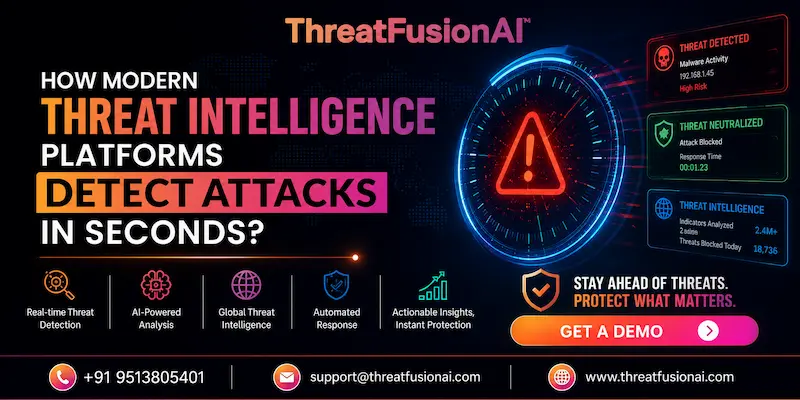
Do you know what Modern Threat Intelligence Platforms are and what the benefits of such platforms are? If not, then you are at the right place. Here, we will talk about what threat intelligence platforms can offer in detail.
Moreover, we will introduce you to a reliable threat intel platform offered by a reputable VAPT service provider. What are we waiting for? Let’s get straight to the topic!
What Are Threat Intelligence Platforms?
Threat Intelligence Platforms (TIPs) are centralized security systems that help enterprises comprehend possible cyber hazards by automatically aggregating, normalizing, and analyzing threat data from many international sources.
These technologies enable security teams to quickly identify, prioritize, and address active vulnerabilities and potential attacks by converting raw indicator data into actionable insights. In the end, TIPs significantly speed up an organization's total defense capabilities by acting as a vital link between threat data collection and automated incident response. Let’s take a look at what Modern Threat Intelligence Platforms are!
Why Speed Matters in Cybersecurity Detection?
|
S.No. |
Factors |
Why? |
|
1. |
Minimizing Threat Dwell Time |
The number of hours or days an attacker can covertly stay inside your network to map vulnerabilities is reduced by quick detection. |
|
2. |
Preventing Data Exfiltration |
Early detection of breaches enables security professionals to cut off unauthorized connections before confidential information is compromised and stolen. |
|
3. |
Limiting Operational Downtime |
By quickly isolating compromised systems, rapid containment stops ransomware from spreading widely or interfering with essential corporate processes. |
|
4. |
Lowering Remediation Costs |
Rebuilding entire networks would require enormous labor and technical costs, which can be avoided by neutralizing a threat at the point of entry. |
|
5. |
Preserving Brand Trust and Compliance |
In addition to preventing expensive regulatory fines and long-term harm to a company's brand, stopping an attack immediately stops public data breaches. |
Core Data Sources Used in Threat Intelligence Platforms
The following are some core data sources used in threat intelligence platforms:
1. Open-Source Intelligence (OSINT): Feeds vulnerability databases, community forums, and public security blogs to monitor worldwide signs of compromise for free.
2. Internal Security Telemetry: Combines endpoint data, network traffic, and logs straight from your firewall, SIEM, and antivirus software.
3. Commercial and Vendor Feeds: Offers top-notch, thoroughly examined threat intelligence and exclusive security information from specialized cybersecurity companies.
4. Dark Web and Underground Forum Monitoring: Finds compromised passwords, planned exploits, and targeted business conversations by scraping underground illicit marketplaces.
5. Human-Generated Analyst Research: Provides manual reverse-engineering of malware developed by skilled threat hunting teams as well as detailed contextual reports.
How Threat Intelligence Platforms Collect and Process Data?
Threat intelligence platforms can collect and process data in the following ways:
● Automated Data Aggregation: Platforms continuously consume structured and unstructured threat feeds from thousands of worldwide sources via connectors and APIs.
● Normalization and Deduplication: To avoid system clutter, redundant or identical signs are combined, and raw data is transformed into standardized forms like STIX/TAXII.
● Enrichment and Contextualization: To give crucial context, raw indicators are automatically mapped to domain registrations, historical data, and profiles of recognized threat actors.
● Scoring and Risk Prioritization: Each danger is given a dynamic confidence and severity score by algorithms according to its age, relevance, and possible organizational impact.
● Actionable Intelligence Dissemination: Security solutions such as firewalls, SIEMs, and SOAR platforms receive processed warnings instantaneously and use them to initiate automatic defensive measures.
Role of AI and Machine Learning in Real-Time Threat Detection
|
S.No. |
Roles |
What? |
|
1. |
Predictive Anomaly Detection |
Machine learning uses a baseline of typical network behavior to quickly identify minute, unheard-of variations that indicate zero-day attacks. |
|
2. |
High-Speed Pattern Recognition |
In milliseconds, AI systems assemble together fragmented, multi-stage attack vectors by scanning millions of concurrent data points. |
|
3. |
Automated False Positive Reduction |
Advanced filters eliminate benign system activity without human intervention by comparing fresh warnings to historical context. |
|
4. |
Adaptive Malware Analysis |
Instead of using static file signatures, models employ heuristic evaluation to detect and neutralize malicious code that is changing or disguised. |
|
5. |
Intelligent Orchestration and Triaging |
Critical threats are ranked by severity by AI, which then automatically directs them to the right security technologies for immediate containment. |
Threat Correlation and Pattern Recognition Techniques
The following are some threat correlation and pattern recognition techniques:
a) Rule-Based (Static) Correlation: Quickly flags known attack signatures and malicious patterns by comparing incoming security events to pre-established "if-then" criteria.
b) Behavioral (Anomaly) Correlation: Compares multi-source activity to a predetermined baseline behavior to identify variations that point to a covert, active compromise.
c) Time-Based and Sequential Tracking: Finds slow-moving, multi-stage attack timelines by analyzing the precise timing and sequence of seemingly unconnected events.
d) Cluster Analysis for Event Grouping: Groups millions of dispersed data points into discrete, manageable clusters based on shared properties using statistical algorithms.
e) Cross-Source Heuristic Mapping: Creates a cohesive, all-encompassing picture of a threat by connecting diverse data from endpoints, networks, and cloud logs.
SIEM and SOAR Integrations
Integrations between SIEM and SOAR combine automatic action with rich insight to unify security operations. Massive data feeds are ingested, correlated, and analyzed by the SIEM to identify risks. This prompts the SOAR platform to immediately execute pre-programmed playbooks for quick incident containment and remediation.
Reducing False Positives with Advanced Filtering Techniques
By continuously comparing security warnings to baseline behavior and historical context, advanced filtering techniques reduce false positives by removing benign system noise. These filters guarantee that security teams only concentrate on real threats while reducing alert fatigue by strategically prioritizing high-confidence signs.
Automated Alerting and Incident Prioritization
By instantaneously rating threats according to their severity, context, and organizational impact, automated alerting and incident prioritization stream security data. This keeps high-risk occurrences from becoming buried under a pile of low-level warnings and guarantees that serious breaches are immediately brought to the forefront for prompt containment.
Cloud-Based Intelligence and Scalability Advantages
The following are the cloud-based intelligence and scalability advantages:
1. Infinite Compute and Storage Capacity: Without the limitations of conventional on-premise hardware, cloud architecture grows on demand to handle petabytes of global threat data.
2. Instant, Real-Time Threat Sharing: When new security threats are found anywhere in the world, they are instantly sent to all renters worldwide at once.
3. Elastic Resource Allocation: In order to guarantee zero detection lag, the platform automatically increases processing power during significant cyber outbreaks or surges in traffic flow.
4. Seamless Multi-Tenant Intelligence Integration: Everyone's security posture is improved without disclosing personal information, thanks to the safe pooling and analysis of threat insights from many businesses.
5. Reduced Maintenance and Infrastructure Overhead: Let's security teams concentrate only on defense by removing the need for manual server provisioning, patching, and data storage upkeep.
Challenges in Achieving Detection in Seconds
|
S.No. |
Challenges |
What? |
|
1. |
Massive Data Ingestion and Noise |
Isolating genuine threat signals from regular network traffic is extremely challenging due to the processing of petabytes of unstructured data each second. |
|
2. |
Complex Evasion and Obfuscation Tactics |
Advanced attackers delay signature-less detection technologies by disguising their activity with encrypted traffic and polymorphic malware. |
|
3. |
Integration and Interoperability Silos |
Real-time data aggregation is slowed down by communication delays caused by disparate data formats among legacy security systems. |
|
4. |
Computing Constraints and Processing Lag |
Complex correlation techniques and heavy cryptographic decryption might put a strain on hardware, adding crucial analytical delay seconds. |
|
5. |
The False Positive Trade-Off |
Security teams run the danger of being overloaded with benign alarms if detection thresholds are set too high for instantaneous alerts. |
Conclusion: The Shift Toward Instant Cyber Defense
Now that we have talked about what Modern Threat Intelligence Platforms are, you might want to get your hands on a reliable threat intel solution. For that, you can go for Threat Fusion AI, a dedicated threat intelligence platform offered by Craw Security.
The amazing Threat Fusion AI platform can help organizations to gather information about the latest cyber attacks and will give them time to prepare for future threats. What are you waiting for? Contact, Now!
Frequently Asked Questions
About Modern Threat Intelligence Platforms
1. What is a Modern Threat Intelligence Platform, and how does it work?
A modern threat intelligence platform is a centralized, cloud-based solution that uses artificial intelligence (AI) and machine learning to automatically aggregate, process, and analyze global threat data to identify and rank cyberattacks in real time.
2. How do threat intelligence platforms detect cyber attacks in real time?
Threat intelligence platforms can detect cyber attacks in real time in the following ways:
a) Automated Real-Time Ingestion,
b) AI and Machine Learning Analysis,
c) High-Speed Pattern Correlation,
d) Dynamic Risk Scoring, and
e) Instant SIEM and SOAR Dissemination.
3. What technologies enable threat detection within seconds?
The following technologies enable threat detection within seconds:
a) AI and Machine Learning Models,
b) Stream Processing and Real-Time Analytics Engines,
c) Cloud-Native XDR and SIEM Architectures,
d) Automated API Integrations and STIX/TAXII Standards, and
e) SOAR Playbooks and Automated Response Actions.
4. How does AI improve the speed of threat identification?
AI can improve the speed of threat identification in the following ways:
a) Instantaneous Anomaly Detection,
b) Automated Data Enrichment,
c) High-Speed Pattern Correlation,
d) Intelligent False Positive Filtering, and
e) Predictive Risk Prioritization.
5. What types of data sources do threat intelligence platforms use?
Threat intelligence platforms use the following types of data sources:
a) Open-Source Intelligence (OSINT),
b) Internal Security Telemetry,
c) Commercial and Vendor Feeds,
d) Dark Web and Underground Forum Monitoring, and
e) Human-Generated Analyst Research.
6. How do threat intelligence platforms reduce false positives?
Threat intelligence platforms can reduce false positives in the following ways:
a) Continuous Behavioral Baselining,
b) Dynamic Threat Risk Scoring,
c) Automated Data Enrichment,
d) Historical Context Evaluation, and
e) Intelligent False Positive Filtering.
7. What is the role of machine learning in attack detection?
The following are the roles of machine learning in attack detection:
a) Predictive Anomaly Detection,
b) High-Speed Pattern Recognition,
c) Automated False Positive Reduction,
d) Adaptive Malware Analysis, and
e) Intelligent Prioritization and Triaging.
8. How do these platforms integrate with SIEM and SOAR systems?
Threat intelligence solutions link through pre-built connectors and APIs, sending raw data to SIEMs for correlation and alert enrichment while also activating SOAR playbooks to automate machine-speed response actions.
9. Can threat intelligence platforms prevent zero-day attacks?
Since there isn't a signature for zero-day attacks, threat intelligence platforms can't stop them directly. However, they can help prevent them by providing real-time behavioral data, infrastructure analysis, and campaign context to security tools like EDR, NGAV, and SOAR so they can intercept the exploit's malicious actions.
10. What are the biggest challenges in achieving instant threat detection?
The following are the biggest challenges in achieving instant threat detection:
a) Massive Data Ingestion and Noise,
b) Complex Evasion and Obfuscation Tactics,
c) Integration and Interoperability Silos,
d) Computing Constraints and Processing Lag, and
e) The False Positive Trade-Off.