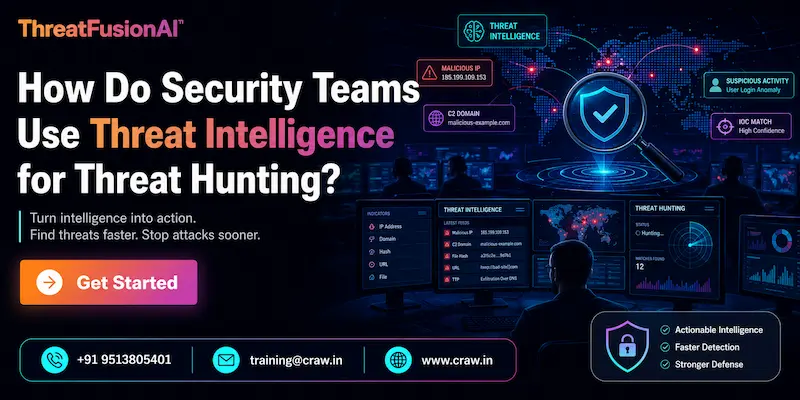
Do you know what Threat Hunting is and how it can help organizations to secure their confidential data against online threats? If not, then you are at the right place. Here, we will talk about threat intelligence help for security teams in detail.
Moreover, we will introduce you to a reliable threat intel platform offered by a reputable VAPT service provider. What are we waiting for? Let’s get straight to the topic!
What Is Threat Hunting?
In order to find hidden, undetected cyberthreats that have gotten past automated security defenses, security analysts actively examine networks, endpoints, and security logs as part of the proactive cybersecurity technique known as "threat hunting."
Threat hunting uses human conjecture, behavior analytics, and threat intelligence to find sophisticated persistent threats before they can inflict harm or steal data, in contrast to passive monitoring systems that wait for an alert.
Let’s talk about what Threat Hunting is and how it can help companies to ensure future safety against online threats!
Why Threat Intelligence Is Essential for Effective Threat Hunting?
|
S.No. |
Factors |
Why? |
|
1. |
Shifts Defense from Reactive to Proactive |
Helps hunters find hidden attackers before automated alerts are set off. |
|
2. |
Provides Context on Adversary Behaviors |
Explains the strategies and tactics of the enemy so that analysts are aware of the precise abnormalities to search for. |
|
3. |
Accelerates Incident Triage and Prioritization |
Expedites investigations by drawing attention to high-risk threats that need to be addressed right away. |
|
4. |
Uncovers Advanced Persistent Threats (APTs) |
Reveals multi-stage, nuanced campaigns that are frequently overlooked by conventional security measures. |
|
5. |
Reduces False Positives and Investigative Fatigue |
Allows security teams to concentrate only on high-fidelity indicators by filtering out typical network noise. |
Types of Threat Intelligence Used in Threat Hunting
The following are some types of threat intelligence used in threat hunting:
1. Tactical Intelligence: Describes the methods, techniques, and technical processes used by immediate attackers to identify ongoing campaigns.
2. Technical Intelligence: Provides particular, transient signs of compromise, such as IP addresses and malicious file hashes.
3. Operational Intelligence: Reveals the identity, timing, and motivations of particular hacker groups or upcoming assaults.
4. Strategic Intelligence: Provides senior decision-makers with high-level summaries of geopolitical threats and global risk patterns.
Identifying Indicators of Compromise (IOCs) with Threat Intelligence
In the following ways, you can identify IOCs with threat intelligence:
● Malicious IP Addresses and Domain Names: Prevents outgoing connections to command servers and recognized rogue hosting networks.
● Known File Hashes (MD5/SHA-256): Detects ransomware, malware variations, and malicious payloads on endpoints instantly.
● Abnormal Network Traffic Patterns: Detects anomalous data spikes or non-standard port communications that point to ongoing data exfiltration.
● Suspicious Registry and System Changes: Identifies unlawful configuration changes that malware makes in order to gain long-term access to the system.
● Unauthorized Account Credential Usage: Detects unusual login locations and timing spikes that indicate compromised user accounts.
Mapping Adversary Behaviors with MITRE ATT&CK Framework
Threat hunters can trace the specific tactics, methods, and procedures (TTPs) employed by attackers across the full intrusion lifecycle by mapping adversary behaviors using the MITRE ATT&CK methodology, which goes beyond simple indications like file hashes.
Security teams can visibly identify defensive blind spots and methodically look for particular, intricate malevolent patterns inside their environment by superimposing real-world threat intelligence onto this extensive knowledge base.
Using Threat Intelligence to Detect Advanced Persistent Threats (APTs)
By tracking the unique behavioral patterns, custom malware, and infrastructure footprint associated with recognized nation-state groups, threat intelligence can be used to identify Advanced Persistent Threats (APTs) and uncover covert, multi-stage campaigns.
Security teams can reveal complex "low-and-slow" lateral movements and covert command-and-control communication before data exfiltration by comparing tiny internal network anomalies with international intelligence databases.
How Security Teams Prioritize Threat Hunting Activities?
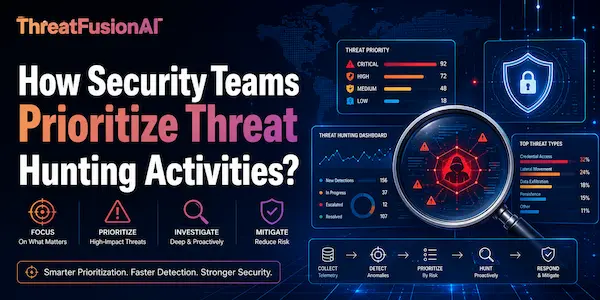
Security teams prioritize threat hunting activities in the following ways:
a) Aligning with Risk and Asset Criticality: Prioritizes safeguarding high-value targets, such as banking systems and critical data servers, when allocating hunting resources.
b) Formulating Priority Intelligence Requirements (PIRs): In order to address senior leadership's top security issues, structures hunt around specific strategic problems.
c) Tracking Threat Likelihood and Actor Prevalence: Focuses on opponents that are aggressively targeting particular industry sectors, geographical areas, or peer organizations.
d) Analyzing Telemetry and Log Completeness: Gives investigations priority in settings with robust, high-visibility logging to guarantee comprehensive analysis is feasible.
e) Evaluating Vulnerability and Patch Exploitation Data: Hunts right into systems that are known to be actively exploited by attackers and are running unpatched software.
Real-World Threat Hunting Workflow Using Intelligence Data
The first step in a real-world threat hunting workflow is to develop a specific hypothesis based on threat intelligence reports, which analysts then test by looking for similar behavioral patterns in network logs and endpoint telemetry.
When an anomaly is found, hunters scope the intrusion's depth, isolate affected hosts to control the threat, and feed their findings back into security systems to automate defenses in the future.
Automating Playbooks and Threat Intelligence Platforms (TIP)
Security teams may collect, deduplicate, and send threat feeds straight into orchestration tools for immediate perimeter defense by integrating threat intelligence platforms (TIPs) with automated playbooks.
Organizations may plan quick reactions like removing API keys, blocking malicious URLs, and isolating compromised endpoints the instant a high-confidence threat indication is detected by substituting these automated procedures for human workflows.
Key Tools and Platforms Used for Threat Intelligence and Hunting
The following are some key tools and platforms used for threat intelligence and hunting:
1. SIEM Platforms: To enable hunters to do intricate cross-platform search queries, aggregate, and index enormous amounts of historical company log data.
2. EDR and XDR Solutions: To identify questionable process executions, offer extensive, ongoing behavioral tracking on cloud workloads and endpoints.
3. Threat Intelligence Platforms: To immediately improve local network telemetry, centralize, normalize, and evaluate global attacker data sources.
4. Network Analysis and Intrusion Tools: To identify illicit data movement or covert lateral traffic, examine raw packet transfers and protocol behaviors.
5. AI-Augmented Hunting Platforms: Automate deep data correlation and reduce incident blast-radius investigations to minutes by utilizing machine-learning models.
Common Challenges in Intelligence-Driven Threat Hunting
|
S.No. |
Challenges |
What? |
|
1. |
Data Sifting and "Noise" Overload |
Hunting teams are rapidly exhausted by massive streams of low-fidelity signals, which also obscure real security risks. |
|
2. |
Perishable and Outdated Intelligence |
IP addresses and other threat indicators expire quickly, rendering outdated intelligence lists useless for ongoing hunts. |
|
3. |
Severe Shortage of Skilled Personnel |
It is still very challenging to find experienced analysts who comprehend both advanced attacker mindsets and technical engineering. |
|
4. |
Telemetry and Visibility Blind Spots |
Adversaries have risky hiding places when logs from unmanaged devices, cloud environments, or older programs are missing. |
|
5. |
Operational Inability to Act at Speed |
Teams are unable to neutralize fast-moving network incursions due to strict approval hierarchies and manual containment procedures. |
Best Practices for Integrating Threat Intelligence into Security Operations
The following are some of the best practices for integrating threat intelligence into security operations:
● Define Explicit Priority Intelligence Requirements (PIRs): Directly coordinate intelligence collection with the organization's most important resources and business threats.
● Normalize and Deduplicate Feeds via a TIP: To get rid of unnecessary notifications, combine many data sources into a single, tidy repository.
● Establish a Closed-Loop Feedback Flow: Make sure local hunts' results are continuously recycled to improve and update threat defense feeds.
● Enrich Local Telemetry with Contextual Mapping: To quickly identify pertinent trends, overlay external threat behaviors onto internal system records.
● Orchestrate Actionable Alert-Level Automation: For immediate network containment, link automated playbooks to verified threat intelligence.
Future Trends in Threat Intelligence and Threat Hunting
The following are some future trends in threat intelligence and threat hunting:
a) Rise of Autonomous Agentic AI: Uses self-directing AI agents to independently research, analyze, and pursue dangers at machine speed.
b) Focus on Continuous Exposure Management (CEM): Focuses on continuous, proactive attack surface reduction rather than reactive patching.
c) Post-Quantum Cryptography Readiness: Searches for early indications of hostile quantum computing attacks that target traditional encrypted data.
d) Identity-First Hunting and Deepfake Defense: Gives priority to identifying compromised user credentials, artificial media manipulation, and biometric bypasses.
e) Supply Chain Telemetry Integration: Monitors extensive third-party vendor data to identify software supply chain breaches before they become widespread.
Conclusion: Building a Proactive Security Strategy with Threat Intelligence
Now that we have talked about what Threat Hunting is, you might want to get your hands on a dedicated tool to get notified about the latest malicious tools in advance to be safe against them. For that, you can go for Threat Fusion AI, a dedicated threat intel platform offered by Craw Security.
Threat Fusion AI can offer you the latest intel about current threats and cyberattacks, so you can be well-prepared for future threats. Thus, you can feel safer in your working environment. What are you waiting for? Contact, Now!
Frequently Asked Questions
About Threat Hunting
1. What is threat intelligence, and why is it important for threat hunting?
Threat hunters can proactively find concealed network incursions before damage happens by using threat intelligence, which is an assessed stream of evidence-based data about the identities, motivations, and technical tactics of cyber attackers.
2. How do security teams use threat intelligence to identify potential threats?
Security teams use threat intelligence to identify potential threats in the following ways:
a) Matching Technical Indicators (IOCs),
b) Tracking Adversary Techniques (TTPs),
c) Profiling Specific Threat Actors,
d) Formulating Hunt Hypotheses, and
e) Enriching Internal Telemetry.
3. What types of threat intelligence are most useful for threat hunting?
The following types of threat intelligence are most useful for threat hunting:
a) Tactical Intelligence,
b) Technical Intelligence,
c) Operational Intelligence, and
d) Strategic Intelligence.
4. How does threat intelligence help detect advanced cyberattacks?
Threat intelligence helps detect advanced cyberattacks in the following ways:
a) Exposes "Low-and-Slow" Behaviors,
b) Tracks Evolving Attacker Tactics,
c) Decodes Custom Attacker Infrastructure,
d) Powers Proactive Hunt Hypotheses, and
e) Provides High-Context Risk Prioritization.
5. What are Indicators of Compromise (IOCs), and how are they used in threat hunting?
Threat hunters employ Indicators of Compromise (IOCs), which are digital pieces of forensic evidence like malicious file hashes, rogue IP addresses, or odd system alterations, as search phrases to go through historical logs and identify current or previous security breaches within a network.
6. How can threat intelligence improve the efficiency of security operations teams?
Threat intelligence improves the efficiency of security operations teams in the following ways:
a) Cuts Down Alert Fatigue,
b) Accelerates Incident Response,
c) Powers Instant Triage,
d) Automates Containment Workflows, and
e) Pinpoints High-Risk Vulnerabilities.
7. What tools do security teams use to integrate threat intelligence into threat hunting?
Security teams use the following tools to integrate threat intelligence into threat hunting:
a) Threat Intelligence Platforms (TIPs, e.g., OpenCTI, MISP),
b) SIEM and Data Lakes (e.g., Splunk ES, Microsoft Sentinel),
c) EDR and XDR Platforms (e.g., CrowdStrike Falcon, SentinelOne),
d) SOAR Engines (e.g., Palo Alto Cortex XSOAR), and
e) AI-Augmented Hunting Platforms (e.g., Dropzone AI).
8. How does threat intelligence support proactive cybersecurity defense strategies?
Threat intelligence supports proactive cybersecurity defense strategies in the following ways:
a) Shifts Defense from Reactive to Proactive,
b) Predicts Industry-Specific Targets,
c) Optimizes Security Controls,
d) Informs Context-Driven Vulnerability Management, and
e) Validates Security Posture via Emulation.
9. What challenges do organizations face when using threat intelligence for threat hunting?
The following are some challenges that organizations face when using threat intelligence for threat hunting:
a) Overwhelming Volume of Low-Fidelity "Noise",
b) Rapid Perishability of Technical Data,
c) Deep Telemetry and Visibility Blind Spots,
d) Severe Scarcity of Skilled Analysts, and
e) Inflexible Architecture and Lack of Automation.
10. How can businesses measure the effectiveness of intelligence-driven threat hunting programs?
Businesses measure the effectiveness of intelligence-driven threat hunting programs in the following ways:
a) Reduction in Attacker Dwell Time,
b) Number of New Detection Rules Engineered,
c) MITRE ATT&CK Technical Coverage Delta,
d) Findings Yield Rate and Quality, and
e) Intelligence Operationalization Speed.