Do you know how Cyber Security Threat Intelligence can help you deal with unknown future cyberattack attempts? If not, then you are at the right place. Here, we will explore how such a tool can help you in preparing for such incidents in advance.
Moreover, we will introduce you to a reliable threat intelligence tool offered by a reputable VAPT service provider. What are we waiting for? Let’s get straight to the topic!
What Is Cyber Security Threat Intelligence?
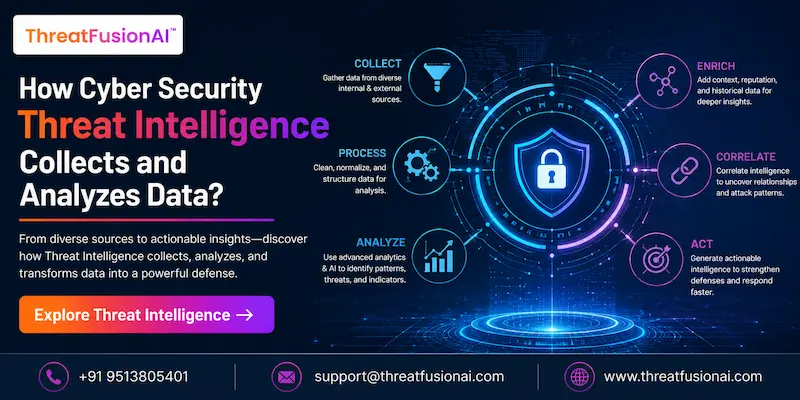
The gathering, processing, and analysis of information about current or potential cyberthreats, threat actors, and their particular attack techniques is known as cyber security threat intelligence. It assists companies in comprehending the intentions, aims, and actions of attackers by converting unprocessed security data into useful insights.
Security teams are better equipped to foresee possible breaches, expedite incident response, and put predictive measures in place before an attack ever happens, thanks to this proactive intelligence. Let’s take a look at what Cyber Security Threat Intelligence is in detail!
Importance of Cyber Security Threat Intelligence in Modern Defense
|
S.No. |
Factors |
How? |
|
1. |
Shifts Defense from Reactive to Proactive |
Exposing attacker techniques early on, it enables organizations to patch vulnerabilities and stop threats before an event starts. |
|
2. |
Accelerates Incident Response Times |
By providing security professionals with instant context about an ongoing assault, it expedites containment by avoiding laborious investigation. |
|
3. |
Reduces Alert Fatigue and False Positives |
In order to emphasize real threats, it automatically correlates warnings against verified worldwide threat feeds, filtering out background noise. |
|
4. |
Powers Strategic, Risk-Based Decision Making |
In order to direct sensible security budget and asset allocations, it gives leadership hard data on industry-specific threat landscapes. |
|
5. |
Enhances Predictability Against Zero-Day Exploits |
In order to assist enterprises in anticipating and eliminating previously unseen malware types, it monitors behavioral patterns and threat actor infrastructure. |
Types of Cyber Security Threat Intelligence
The following are the types of cybersecurity threat intelligence:
1. Strategic Threat Intelligence: High-level study of company risks and broad threat landscapes designed for long-term, executive-level decision-making.
2. Tactical Threat Intelligence: Comprehensive details on the adversary tactics, methods, and procedures (TTPs) that defenders employ to protect current system architectures.
3. Operational Threat Intelligence: Real-time information on ongoing, incoming cyberattacks that provides incident responders with useful context about the "who," "what," and "why."
4. Technical Threat Intelligence: IP addresses, file hashes, and malicious URLs are examples of specific, transient technical indicators of compromise (IoCs) that are given straight into security programs.
Key Sources of Cyber Security Threat Intelligence Data
The following are some key sources of cybersecurity threat intelligence data:
● Internal Security Telemetry: Detects active, localized anomalies by combining real-time data from an organization's own firewalls, endpoints, and SIEM logs.
● Open-Source Intelligence (OSINT): Uses publicly accessible data, such as vulnerability databases, code repositories, and security blogs, to increase threat visibility.
● Commercial Threat Intelligence Feeds: Offers high-fidelity, specialized, and verified data streams that are carefully selected by committed cybersecurity research companies for exact protection.
● The Dark Web and Underground Forums: Plans threat actor campaigns, actively monitors stolen credential dumps, and exploits purchases by breaking into covert illegal markets.
● Industry Information Sharing and Analysis Centers (ISACs): Protect vital infrastructure from industry-wide attacks by facilitating cooperative, sector-specific peer exchange of active threat data.
Role of AI and Machine Learning in Cyber Security Threat Intelligence
|
S.No. |
Roles |
What? |
|
1. |
Automated Data Aggregation and Normalization |
Millions of disorganized, multi-format worldwide logs are quickly ingested by AI and standardized into a single, consistent data stream. |
|
2. |
Predictive Behavioral Pattern Recognition |
By forecasting and identifying new, changing attack strategies through real-time data analysis, machine learning transcends static signatures in security. |
|
3. |
High-Fidelity Indicator Triage |
By automatically scoring and cross-referencing signs of compromise, AI eliminates innocuous false alarms, allowing analysts to concentrate solely on real threats. |
|
4. |
Real-Time Threat Actor Profiling |
In order to precisely assign assaults to particular hacker groups, machine learning instantaneously analyzes active digital footprints against known adversary tendencies. |
|
5. |
Dynamic Intelligence Distribution |
In order to rapidly prevent assaults, AI converts unprocessed threat insights into security policies that can be implemented on firewalls and endpoints. |
Threat Intelligence Frameworks (MITRE ATT&CK, Cyber Kill Chain)
The Cyber Kill Chain and MITRE ATT&CK are two threat intelligence frameworks that offer standardized, structured techniques for tracking and comprehending cyberattacks. The MITRE ATT&CK matrix provides a highly detailed, non-linear repository of particular adversary tactics, techniques, and real-world behaviors observed across various platforms, whereas the Cyber Kill Chain maps the chronological, linear stages of a breach from initial reconnaissance to final data exfiltration.
Tools and Platforms for Cyber Security Threat Intelligence
The following are some tools and platforms for cybersecurity threat intelligence:
a) Commercial Threat Intelligence Platforms (TIPs): High-end, centralized business software that automatically compiles, correlates, and sends carefully selected, high-fidelity threat data straight to your security stack.
b) Open-Source Sharing Platforms: Organizations all over the world can easily share and preserve structured threat indicators thanks to free, cooperative community hubs like MISP.
c) XDR-Native Intelligence Engines: Integrated security intelligence that quickly compares incoming company data with real-time, worldwide telemetry to thwart ongoing threats.
d) Public Enrichment and Research Repositories: Analysts may quickly search for file reputations and analyze exposed global assets using free public databases like VirusTotal and Shodan.
e) Automated Malware Analysis Sandboxes: Isolated online spaces that securely detonate and examine dubious files to record their precise actions, hashes, and network traces.
Challenges in Cyber Security Threat Intelligence
|
S.No. |
Challenges |
What? |
|
1. |
Overwhelming Volume and Alert Fatigue |
Millions of unprioritized daily indicators overwhelm analysts, causing them to become exhausted and fail to notice important security alerts. |
|
2. |
Lack of Context and Actionability |
The crucial operational context needed to comprehend how or why a particular danger is important to the company is frequently absent from raw threat data. |
|
3. |
Rapid Data Obsolescence |
Malicious IP addresses and domains are examples of technical threat indicators that often deteriorate and lose all usefulness within hours of creation. |
|
4. |
Interoperability and Integration Hurdles |
Due to incompatible formats and protocols, modern threat data is difficult for legacy security systems to absorb and use. |
|
5. |
The "Black Box" of Advanced Threat Actors |
Advanced encryption, proprietary malware, and anti-forensics are used by highly skilled state-sponsored organizations to totally conceal their methods. |
Best Practices for Cyber Security Threat Intelligence Programs
The following are the best practices for cybersecurity threat intelligence programs:
1. Align Intelligence Goals with Business Risk: Concentrate only on dangers that are relevant to your industry, region, and technology stack when gathering intelligence.
2. Prioritize Actionable Context Over Volume: Prioritize high-fidelity data over vast amounts of unfiltered, raw indicators that instruct analysts on how to react.
3. Automate Ingestion and Security Stack Integration: To stop known hostile infrastructure without the need for human interaction, feed intelligence straight into firewalls, EDRs, and SIEMs.
4. Foster Collaborative Industry Sharing: Engage in ISACs and sharing communities to receive early alerts about attacks targeting your colleagues in the industry.
5. Continuously Measure and Refine Program Metrics: To demonstrate ROI and continuously improve feed quality, monitor certain KPIs such as mean time to detect (MTTD) and false positive rates.
Future of Cyber Security Threat Intelligence
The hyper-automation of predictive defenses powered by sophisticated generative AI and decentralized, machine-speed data exchange is the key to the future of cybersecurity threat intelligence.
Intelligence platforms will go from evaluating previous compromises to coordinating proactive, context-aware responses across global, linked ecosystems in real time as quantum computing and autonomous malware alter the risk picture.
Conclusion
Now that we have talked about what Cyber Security Threat Intelligence is, you might want to get a dedicated threat intelligence solution in your hands. For that, you can go for Threat Fusion AI, a dedicated threat intel tool created and customized by Craw Security, a reputed VAPT service provider.
This amazing Threat Fusion AI tool can help you gather the latest intel on recent and current cyberattack events and related malicious tools. Thus, you will be able to prepare yourself for fighting against such threats. What are you waiting for? Contact, Now!
Frequently Asked Questions
About Cyber Security Threat Intelligence
1. What is Cyber Security Threat Intelligence?
The gathered, processed, and analyzed information on cyber risks and threat actors that is used to foresee, identify, and thwart possible attacks is known as cyber security threat intelligence.
2. Why is Cyber Security Threat Intelligence important for organizations?
Cybersecurity threat intelligence is important for organizations for the following reasons:
a) Proactive Attack Prevention,
b) Accelerated Incident Response,
c) Mitigation of Alert Fatigue,
d) Informed Strategic Decision-Making, and
e) Defense Against Zero-Day Exploits.
3. What are the main types of Cyber Security Threat Intelligence?
The following are the main types of cybersecurity threat intelligence:
a) Strategic Threat Intelligence,
b) Tactical Threat Intelligence,
c) Operational Threat Intelligence, and
d) Technical Threat Intelligence.
4. How is data collected in Cyber Security Threat Intelligence?
Threat intelligence gathers information via monitoring commercial feeds, gathering technical indications and hacker techniques through dark web forum infiltration, scanning open-source public data (OSINT), and harvesting internal security logs.
5. What is Open Source Intelligence (OSINT) in Cyber Security Threat Intelligence?
The process of lawfully obtaining, evaluating, and utilizing publicly accessible data such as security blogs, code repositories, and vulnerability databases in order to detect and lessen possible cyberthreats is known as open source intelligence, or OSINT.
6. What role does the dark web play in Cyber Security Threat Intelligence?
The following are the roles of the dark web in cybersecurity threat intelligence:
a) Early Warning of Targeted Campaigns,
b) Monitoring Stolen Credentials and Data Leaks,
c) Tracking Exploit Kits and Malware Development,
d) Adversary Profiling and Intelligence Gathering, and
e) Identifying Third-Party and Supply Chain Risks.
7. How do organizations analyze Cyber Security Threat Intelligence data?
Organizations can analyze cybersecurity threat intelligence data in the following ways:
a) Behavioral Pattern and TTP Mapping,
b) Automated Data Correlation and Triage,
c) Adversary Attribution and Profiling,
d) Sandboxing and Reverse Engineering, and
e) Contextual Risk Assessment.
8. What are Indicators of Compromise (IOCs) in Cyber Security Threat Intelligence?
The following are indicators of compromise (IOCs) in cybersecurity threat intelligence:
a) Malicious IP Addresses and Domains,
b) Suspicious File Hashes,
c) Unusual Network Activity and Data Exfiltration,
d) Unauthorized Registry or System Changes, and
e) Spikes in Failed Login Attempts.
9. How is AI used in Cyber Security Threat Intelligence?
Threat intelligence uses AI to automatically compile enormous amounts of global data, identify predictable behavioral patterns to attribute assaults and neutralize zero-day threats in real time, and triage anomalies by removing false positives.
10. What are the biggest challenges in Cyber Security Threat Intelligence?
The following are the biggest challenges in cyber security threat intelligence:
a) Overwhelming Volume and False Positives,
b) Severe Lack of Context,
c) Rapid Data Obsolescence,
d) Interoperability and Integration Silos, and
e) Advanced Adversary Evasion Tactics.
Read More: